
Why the 2026 European Stock Rally May Be Reaching a Tipping Point
The European stock market's 2026 rally appears to be teetering on the edge of a tipping point, caught between a fragile economic foundation and a surge of optimism driven by artificial intelligence (AI) investment, corporate earnings resilience, and expectations of accommodative monetary policy. While the Eurozone's composite PMI hit 52.3 in Q4 2025-the highest since 2023-suggesting robust growth, underlying divergences, cooling manufacturing activity, and geopolitical risks are creating a volatile backdrop. This analysis examines the interplay between these forces and evaluates whether the current momentum is sustainable or if cracks are beginning to show.
Cooling Manufacturing and Regional Divergences
The Eurozone's manufacturing sector has become a red flag. The HCOB Eurozone Manufacturing PMI plummeted to 48.8 in December 2025, marking the fastest contraction since March 2025. Germany, the bloc's industrial engine, saw its worst deterioration since February 2025, driven by declining output and new orders. Italy and Spain remained in contraction, while France showed tentative recovery. This divergence is stark: Spain's GDP grew by 2.9% in 2025, fueled by domestic demand, while Germany's economy stagnated in Q3 2025. Such imbalances risk fragmenting the bloc's economic cohesion, with weaker economies like Italy and Germany struggling to keep pace.
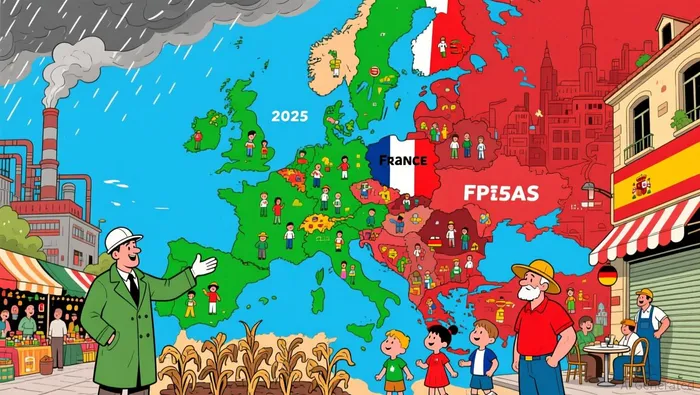
The services sector, however, remains a bright spot. A PMI of 52.4 in Q4 2025 indicates continued expansion, supported by resilient consumer spending and business activity. Yet, this masks structural vulnerabilities. For instance, Spain's growth is increasingly reliant on domestic demand, while its export sector faces headwinds from U.S. tariff policies. Meanwhile, Germany's export-dependent industries are grappling with high energy costs and global trade barriers. These regional disparities suggest that the Eurozone's growth is uneven, with weaker economies potentially dragging on the bloc's overall performance in 2026.
AI Optimism vs. Earnings Realities
The AI sector has emerged as a key driver of the 2026 stock rally, with European firms benefiting from global infrastructure spending and strategic investments in defense and energy. Projections indicate a 25% rise in AI-related capital expenditures by 2026, led by hyperscalers like Amazon and Microsoft. However, this optimism is not without caveats. While AI adoption is boosting short-term earnings, concerns about return on investment and inflationary pressures are emerging. A Reuters report highlights that AI-driven inflation is one of 2026's most overlooked risks, as increased demand for data centers and rare earth metals strains supply chains.
Corporate earnings in Q4 2025 also tell a mixed story. While the ECB's growth projections of 1.2% for 2026 suggest a stable environment, KPMG's outlook warns of a slowdown to 1.1% in 2026 due to subdued consumer confidence and energy costs. The technology sector, in particular, is experiencing a fragile recovery, with aggregate turnover expected to grow by just 0.9% after a 7.8% decline over three years. This fragility raises questions about the sustainability of the AI-driven stock rally, especially if earnings fail to meet lofty expectations.
Monetary Policy and Geopolitical Uncertainty
The ECB's stance further complicates the outlook. Despite inflation trending toward its 2% target, the central bank has ruled out rate cuts through 2026, emphasizing a "meeting-by-meeting" approach. This cautious stance reflects the ECB's desire to avoid premature easing amid persistent inflationary risks and geopolitical volatility. Christine Lagarde's assertion that monetary policy is in a "good place" has provided some stability, but it also means that markets cannot rely on rate cuts to cushion potential downturns.
Geopolitical risks remain a wildcard. Elevated trade policy uncertainty, driven by U.S. tariff announcements and global tensions, is weighing on investment and exports. The Eurozone's open economy and reliance on imported rare earth metals leave it particularly vulnerable to supply chain disruptions. A macro-financial disconnect is also emerging: equity prices remain buoyant despite weak earnings expectations and high tail risks, with one-year-ahead GDP growth projections ranging from -1.7% to -2.6% in the 10th percentile. This disconnect suggests that markets may be underpricing the risks of a contraction, creating a fragile foundation for the current rally.
Conclusion: A Tipping Point Looms
The 2026 European stock rally is built on a precarious balance. On one side, AI-driven earnings growth, resilient services activity, and a cautious ECB have fueled optimism. On the other, cooling manufacturing data, regional divergences, and geopolitical risks are creating a fragile undercurrent. While the Eurozone's composite PMI and GDP forecasts point to growth, the divergence between strong services and weak manufacturing, coupled with structural vulnerabilities in key economies like Germany and Italy, suggests that the rally may be nearing a tipping point.
Investors must remain vigilant. The AI sector's long-term potential is undeniable, but short-term volatility and inflationary pressures could test market resilience. Similarly, the ECB's reluctance to cut rates means that fiscal stimulus and structural reforms-particularly in energy and supply chain resilience-will be critical to sustaining growth. As the Eurozone navigates these challenges, the coming months will reveal whether the current momentum is a durable recovery or a prelude to a correction.







Comentarios
Aún no hay comentarios