
Is the 2026 Crypto Super Cycle a Legitimate Investment Opportunity or a Hyped Mirage?
The debate over whether 2026 will usher in a "crypto superSUPER-- cycle" hinges on three pillars: regulatory shifts, institutional adoption, and long-term price catalysts. Skeptics dismiss the narrative as speculative hype, while optimists point to structural changes in global finance and technology. To evaluate this, we must dissect the interplay of these forces and their potential to catalyze a paradigm shift in digital assets.
Regulatory Shifts: From Uncertainty to Clarity
The 2025 regulatory landscape laid the groundwork for a more institutional-friendly environment in 2026. In the U.S., the Trump administration's pro-crypto stance dismantled barriers for traditional banks to engage with digital assets, shifting policy from risk-aversion to competitiveness according to Fireblocks analysis. This trend accelerated with the delayed but critical passage of the Market Structure Bill, which addressed spot and derivatives trading, custody, and broker-dealer functions-a long-overdue framework for market legitimacy as reported by Fireblocks.
Globally, stablecoin regulation emerged as a focal point. The U.S. GENIUS Act, alongside frameworks in Hong Kong, Canada, and the U.K., provided clear licensing and risk management protocols for stablecoin issuers according to Fireblocks. These measures reduce systemic risks while enabling stablecoins to become standard tools for cross-border payments, displacing traditional wires as Chainup predicts. Meanwhile, the SEC's proposed "innovation exemption" could finally resolve DeFi's regulatory limbo, allowing U.S. institutions to engage with decentralized protocols without enforcement threats according to Fireblocks analysis.
Critically, 2026 will test whether these frameworks foster innovation or stifle it. For now, the trend leans toward clarity, with regulatory sandboxes and cross-jurisdictional partnerships accelerating digital asset adoption as Elliptic reports.
Institutional Adoption: From Niche to Mainstream
Institutional capital's entry into crypto markets is no longer speculative-it's operational. By late 2025, spot and EthereumETH-- ETPs had attracted over $115 billion in institutional capital, signaling a shift from retail-driven volatility to capital-efficient, institutional-grade infrastructure according to B2Broker. Major banks now offer custody, lending, and settlement services for digital assets, with tokenization of real-world assets (RWAs) enabling 24/7 trading of tokenized U.S. Treasuries and commercial real estate as Chainup forecasts.
This institutionalization is not just about capital-it's about infrastructure. As stated by a report from Fireblocks, the Market Structure Bill's implementation in 2026 will further streamline broker-dealer functions, reducing friction for institutional players according to Fireblocks analysis. Meanwhile, DeFi's evolution into "On-Chain Finance" is enabling institutional-grade services like lending and derivatives trading, integrated with compliance tools as Chainup predicts.
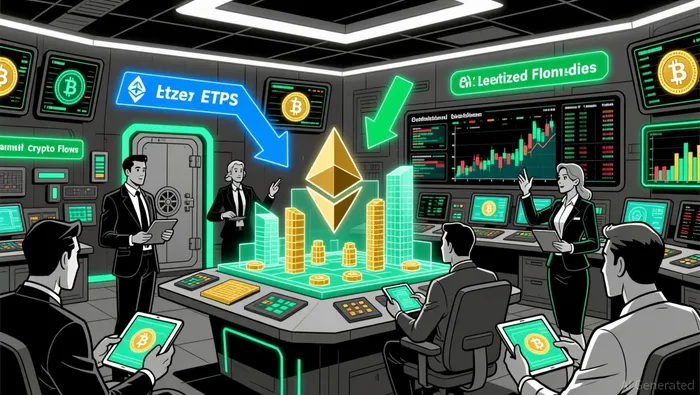
The result? A self-reinforcing cycle: regulatory clarity attracts institutions, which in turn build infrastructure that lowers barriers for broader adoption.
Long-Term Price Catalysts: Macro, Tech, and Scarcity
The 2026 crypto super cycle's legitimacy depends on whether macroeconomic and technological trends align to drive sustained demand.
Macroeconomic Tailwinds: As global fiscal uncertainty and rising sovereign debt intensify, BitcoinBTC-- and Ethereum's programmatic scarcity position them as hedges against fiat devaluation according to Grayscale research. Institutional demand for alternative stores of value is rising, with digital assets increasingly viewed as a counterbalance to traditional portfolios as Grayscale reports.
Technological Advancements: Stablecoins are already reshaping global commerce, while tokenized RWAs unlock liquidity in illiquid markets. According to Chainup, the tokenization of commercial real estate and Treasuries could unlock trillions in new capital flows as Chainup forecasts. Meanwhile, DeFi's maturation into institutional-grade finance-complete with compliance tools-expands its utility beyond speculation as Chainup predicts.
Regulatory Catalysts: The expected passage of bipartisan U.S. crypto legislation in 2026 will further integrate public blockchains with traditional finance, enabling digital asset securities and exchange-traded products according to Grayscale research. This could trigger a surge in demand from pension funds, endowments, and sovereign wealth funds.
The Verdict: Super Cycle or Mirage?
The 2026 crypto super cycle is not a mirage-it is a structural inevitability driven by regulatory alignment, institutional infrastructure, and macroeconomic demand. While risks remain (e.g., geopolitical shifts, technical failures), the confluence of these forces creates a self-reinforcing flywheel:
- Regulatory clarity reduces uncertainty, attracting institutions.
- Institutional capital builds infrastructure, lowering barriers for retail and corporate adoption.
- Macro and tech trends drive demand for digital assets as stores of value and utility.
Skeptics may argue that volatility and regulatory reversals could derail this trajectory. However, the depth of institutional integration and the irreversible innovation in DeFi and tokenization suggest that 2026 will mark not just a cycle, but a permanent shift in global finance.
For investors, the question is no longer if the super cycle will arrive-but how to position for it.






Comentarios
Aún no hay comentarios