
2025's Top 10 Cryptocurrencies: Bitcoin's Dominance and the Rise of High-Potential Alternatives
The cryptocurrency market in 2025 has entered a transformative phase, marked by Bitcoin's enduring dominance and the emergence of asymmetric risk/reward opportunities in altcoins. As institutional adoption accelerates and regulatory frameworks solidify, the market structure is evolving toward a more diversified ecosystem. This analysis explores the top 10 cryptocurrencies by market capitalization, Bitcoin's role as a macro asset, and the potential for high-potential alternatives to outperform in the coming months.
Bitcoin's Dominance: A Macro Asset in a Volatile World
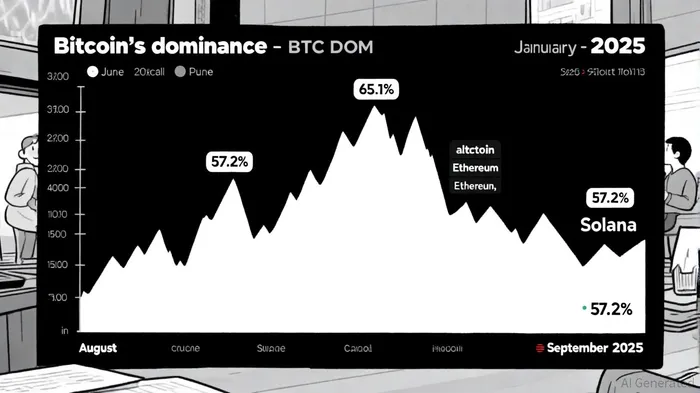
Bitcoin (BTC) remains the cornerstone of the crypto market, commanding a staggering $2.1 trillion market cap as of September 2025 Analytics Insight ranking. Its dominance has fluctuated significantly, peaking at 65.1% in June 2025 amid global macroeconomic uncertainty and ETF-driven inflows, as noted in the Coinpaper mid‑year report on market trends and regulatory milestones Coinpaper mid‑year report. This surge reflects Bitcoin's role as a safe-haven asset, akin to gold, during periods of risk-off sentiment. However, by late August, dominance had eased to 57.2%, signaling a potential rotation of capital toward altcoins, according to Grayscale Research Insights. Historically, such retracements have preceded altcoin seasons, where smaller-cap assets outperform BitcoinBTC--, per the same Grayscale research.
The approval of spot Bitcoin and EthereumETH-- ETFs in the U.S. has further entrenched Bitcoin's dominance. BlackRockBLK-- and Grayscale's ETFs have driven institutional inflows, with corporate treasuries and sovereign reserves increasingly allocating to BTCBTC--, as detailed in the Coinpaper mid‑year report. This structural demand underscores Bitcoin's maturation as a financial asset, though it also raises questions about its ability to sustain growth amid regulatory scrutiny and macroeconomic headwinds.
The Rise of High-Potential Alternatives
While Bitcoin anchors the market, altcoins are gaining traction as specialized utilities and innovation drivers. Ethereum (ETH), the second-largest cryptocurrency with a $289.95 billion market cap, has seen a 36% year-to-date gain, fueled by ETF inflows and institutional adoption, according to Grayscale Research Insights. Ethereum 2.0 upgrades and the passage of the U.S. GENIUS Act-regulating stablecoins-have bolstered its role in decentralized finance (DeFi) and cross-border payments, as discussed in a LinkedIn analysis of 2025 market capitalization trends LinkedIn analysis.
Solana (SOL), with a $75.98 billion market cap, has emerged as a scalability leader, supporting DeFi growth through high-speed transactions and low fees, as shown in Analytics Insight's rankings. CardanoADA-- (ADA) and XRPXRP-- (XRP), at $24.51 billion and $127.47 billion respectively, are also gaining ground, with ADA's smart contract upgrades and XRP's cross-border payment solutions addressing niche market demands, per the same Analytics Insight data. Meanwhile, memeMEME-- coins like DogecoinDOGE-- (DOGE) have retained a $25.69 billion market cap, driven by retail speculation and social media momentum, again reflected in Analytics Insight's figures.
The market structure is increasingly characterized by asymmetric risk/reward profiles. For instance, the ETH/BTC ratio has begun to recover from a 2.5-year downtrend, approaching key resistance levels that could trigger a broader altcoin rally, according to the CoinbaseCOIN-- market outlook Coinbase market outlook. Similarly, the altcoin open interest dominance ratio remains above 1.4, a threshold historically linked to major liquidations and volatility spikes noted in the Coinpaper mid‑year report. These metrics highlight the potential for outsized returns in altcoins but also underscore the risks of overleveraged positions and regulatory shifts.
Historical backtesting of Ethereum's price behavior after breaking key resistance levels (R1) since 2022 reveals nuanced insights. When ETH breaches its first pivot-point resistance, it generates a 50–56% win rate over the subsequent 30 trading days, with cumulative excess returns averaging ~4.6% according to an internal backtest internal backtest. While the signal is not statistically robust, it suggests that resistance-break events can occasionally catalyze short-term momentum, particularly in a bullish market environment. This aligns with the current ETH/BTC ratio's proximity to critical resistance levels, which could amplify altcoin rotation if confirmed by follow-through volume.
Regulatory Clarity and Institutional Adoption: Catalysts for Growth
Regulatory developments in 2025 have been pivotal. The EU's MiCA framework and the U.S. GENIUS Act have provided clarity for stablecoins and DeFi platforms, expanding their utility beyond trading to payments and settlements, as highlighted in the Coinbase market outlook. Stablecoins like TetherUSDT-- (USDT) and USD Coin (USDC) now hold a combined $290 billion in supply, acting as bridges between fiat and digital assets, per the LinkedIn analysis cited above.
Institutional adoption has also accelerated. Major banks like Citigroup are exploring stablecoin custody, while corporate treasuries increasingly allocate to cryptocurrencies, as detailed in the Coinpaper mid‑year report. The CFTC's Crypto Sprint and the SEC's Project Crypto have further normalized institutional engagement, reducing barriers to entry for traditional investors, according to the same Coinpaper analysis.
Strategic Implications for Investors
For investors, the 2025 market presents a dual opportunity:
1. Bitcoin as a Macro Hedge: Given its dominance and ETF-driven inflows, Bitcoin remains a core holding for portfolio diversification.
2. Altcoin Rotation: As dominance retraces, high-potential altcoins like Ethereum, SolanaSOL--, and Cardano offer asymmetric upside, particularly in sectors like DeFi and cross-border payments.
However, caution is warranted. The altcoin open interest dominance ratio and ETH/BTC technical indicators suggest heightened volatility. Investors should prioritize projects with clear use cases (e.g., Ethereum's smart contracts, Solana's scalability) over speculative assets.
Conclusion
The 2025 crypto market is at an inflection point. Bitcoin's dominance reflects its role as a macro asset, while altcoins are carving out niches in innovation and utility. As regulatory clarity and institutional adoption converge, investors must balance Bitcoin's stability with the asymmetric potential of altcoins. The coming months will test whether this maturing ecosystem can sustain growth-or if volatility will once again dominate the narrative.





Comentarios
Aún no hay comentarios