
The 2025 Tariff Tsunami: Sector Vulnerabilities and Hedging Strategies for Investors
The U.S. tariff regime of 2025 has unleashed a seismic shift in global trade dynamics, with ripple effects across manufacturing, agriculture, and technology sectors. These tariffs-described as the most consequential since the Great Depression-have forced firms and investors to grapple with unprecedented uncertainty. According to a Michigan State University study, the policy has triggered a surge in adjustment, transaction, and opportunity costs, compelling companies to rethink sourcing, logistics, and production strategies. For investors, the challenge lies in identifying sector-specific vulnerabilities while deploying hedging strategies to mitigate exposure.
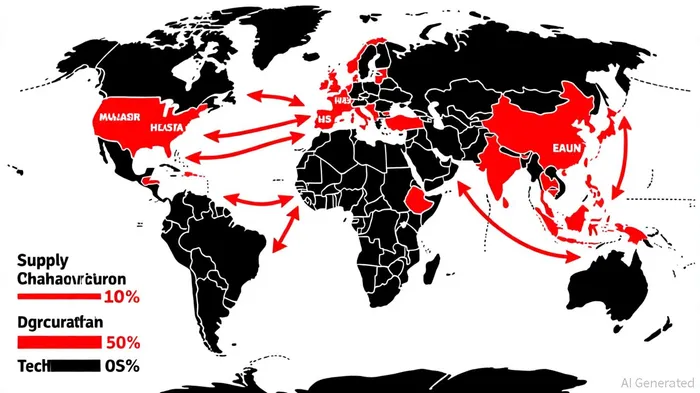
Sector-Specific Vulnerabilities
1. Manufacturing: The Cost of Compliance
The manufacturing sector, particularly electronics, automotive, and medical devices, faces acute disruptions. Stricter customs inspections and revised tariff schedules have delayed shipments and inflated compliance costs. A OneUnion Solutions analysis shows that the U.S. effective tariff rate on imports has spiked to nearly 30% under the "status quo" scenario, with retaliatory measures exacerbating tensions. For example, automotive firms reliant on Chinese components now face a 25% tariff, forcing many to nearshore production to Mexico or Vietnam. However, this shift is costly: a 10% increase in production costs for automotive firms in Southeast Asia could reduce profit margins by 3–5%, according to a CEPR analysis.
2. Agriculture: A Double-Edged Sword
Agriculture has borne the brunt of retaliatory tariffs. U.S. soybean and corn exports to China-a critical market-have plummeted by 50% week-over-week due to Chinese countermeasures, as documented in the MSU study. The agricultural trade deficit is projected to widen to $49 billion in 2025, driven by stagnant exports and rising imports. Low-income households are particularly vulnerable: a 10% tariff on non-compliant Canadian potash has raised corn and soybean production costs by $12–$30 per acre, directly impacting food affordability, as the MSU study also highlights.
3. Technology: The Race for Resilience
The technology sector is recalibrating its global footprint. Semiconductor firms are adopting "regionalization" strategies, shifting production closer to end markets to avoid tariffs. For instance, a KPMG report finds that 57% of tech companies now pass 50% of tariff costs to customers, while others leverage the first-sale-for-export principle to reduce dutiable values. However, this shift is not without trade-offs: precision machinery tariffs have slowed the adoption of AI-driven tools, stifling innovation in automation and IoT, a trend analyzed by Bain & Company in its recent work.
Hedging Strategies for Investors
1. Sector Rotation and Defensive ETFs
Investors are pivoting to defensive sectors less exposed to tariffs. Healthcare and utilities, with minimal foreign revenue exposure, have outperformed technology and materials sectors, which face 57% foreign revenue exposure, as noted in the KPMG report. Sector-specific ETFs, such as the XLV (Health Care Select Sector) and XLU (Utilities Select Sector), offer a shield against trade volatility. Conversely, investors are divesting from goods producers in favor of services-oriented industries like cybersecurity, which benefit from AI-driven demand (per the KPMG findings).
2. Volatility Products and Safe Havens
Volatility products like VIX futures and options are gaining traction as tail-risk hedges. During the 2018–2019 U.S.-China trade war, gold prices surged 18%, underscoring its role as a geopolitical hedge, a point highlighted in the CEPR analysis. Similarly, gold ETFs (e.g., GLD) and volatility-linked instruments (e.g., VXX) are being deployed to buffer against market dislocations.
3. Commodity and Currency Hedging
For sectors like agriculture, futures and options on commodities (e.g., soybean contracts) are critical for price risk management. FX forwards and swaps also help lock in exchange rates, mitigating currency volatility from trade imbalances. For example, U.S. agribusinesses are using FX swaps to hedge against the peso's depreciation in Mexico, a key export market noted in the CEPR work.
4. Corporate-Level Tactics
Companies are adopting tariff engineering and customs programs to reduce exposure. Duty drawback programs, which allow firms to reclaim up to 99% of duties on exported goods, are being leveraged by tech firms, as described in the MSU study. Meanwhile, AI-driven supply chain analytics enable real-time adjustments to procurement and inventory strategies, a capability Bain & Company has explored.
Conclusion
The 2025 tariff landscape demands a dual approach: sector-specific risk mitigation and diversified portfolio strategies. While manufacturing and agriculture face acute headwinds, technology's shift toward regionalization offers long-term resilience. Investors must balance defensive positioning with tactical exposure to innovation-driven sectors. As trade tensions persist, agility-both in corporate strategy and portfolio construction-will define success in this new era of deglobalization.







Comentarios
Aún no hay comentarios