
The 2025 Santa Claus Rally: Thin Trading, High Hopes, and the Road to 7,000 on the S&P 500
The Santa Claus Rally, a seasonal phenomenon that has historically buoyed markets during the year-end holiday period, faces a precarious test in 2025. For decades, investors have relied on the pattern of gains during the final five trading days of December and the first two of January, a tradition first documented by Yale Hirsch in 1972. From 1950 to 2024, the S&P 500 has risen in 79% of these seven-day windows, averaging a 1.3% return. Yet, the 2024 rally collapsed, with the index falling by 3.26% during the traditional window, raising questions about the durability of this pattern in an era of macroeconomic divergence and thin liquidity. As 2025 draws to a close, the market's ability to reclaim its seasonal magic-and push the S&P 500 toward 7,000-hinges on a delicate balance of policy, sentiment, and structural forces.
A Broken Pattern in 2024
The failure of the 2024 Santa Rally was not an anomaly but a symptom of broader market tensions. Rising bond yields, driven by the Federal Reserve's tightening cycle and persistent inflation concerns, siphoned capital away from equities. The 10-year Treasury yield surged 71 basis points from 3.87% to 4.58% during the fourth quarter, making fixed-income assets more attractive than stocks. Simultaneously, thin liquidity-exacerbated by holiday-related trading pauses and reduced institutional activity-amplified volatility. As one analyst noted, "When liquidity dries up, even small trades can move the needle, creating a self-fulfilling prophecy of decline." The 2024 miss, while disheartening, did not presage a poor 2025, as the S&P 500 still gained 23.3% for the year. But it underscored the fragility of seasonal patterns in the face of macroeconomic headwinds.
2025: A Rally Built on a $1 Trillion Foundation
This year's Santa Rally has a different backdrop. A $1 trillion liquidity injection into financial markets-spurred by the resolution of a 43-day government shutdown and the drawdown of the Treasury General Account (TGA)-has provided a critical tailwind. Coupled with the Fed's "hawkish cut" in December 2025, which reduced rates to 3.50-3.75% without clear guidance on future moves, the stage appears set for a rebound. Yet, the Fed's ambiguity has tempered optimism. "Investors are trying to parse whether this rate cut signals the end of tightening or the beginning of easing," said a strategist at a major bank. The S&P 500 closed near 6,834 on 24 December 2025, with analysts debating whether the index would test 7,000 or falter under the weight of thin liquidity.
Thin Liquidity and Macroeconomic Divergence
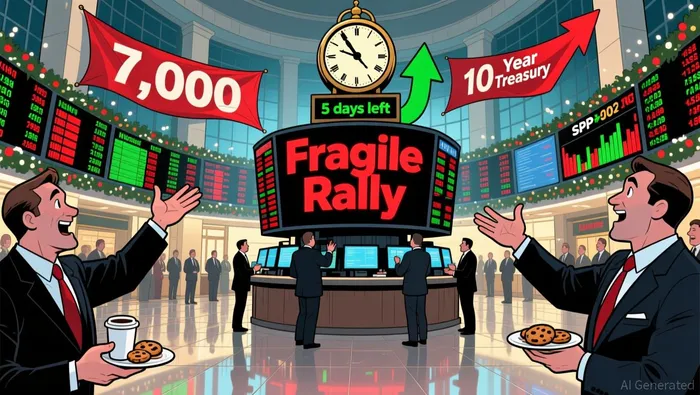 The interplay between thin liquidity and macroeconomic divergence remains a key wildcard. Reduced trading volumes during the holidays mean that even modest shifts in supply and demand can drive sharp price swings. For instance, global liquidity asymmetries-where Asian markets remain active while Western markets close for Christmas-could create unpredictable flows. Meanwhile, macroeconomic signals are mixed: inflation has cooled, but corporate earnings growth remains uneven, and bond yields, though stabilized, still compete with equities for capital. This divergence complicates the rally's sustainability. "The market is pricing in a soft landing," warned a portfolio manager in a recent report.
Gold and the Defense Play
Amid this uncertainty, gold has emerged as a potential beneficiary. Easing monetary policy and soft real yields-rates adjusted for inflation-historically support the metal, and 2025's environment is no exception. Gold has traded near its upper Bollinger Band, signaling sustained upside momentum. If the Santa Rally falters and equities retreat, defensive flows into gold could accelerate. This dynamic highlights a broader theme: investors are hedging against volatility rather than chasing growth.
The Road to 7,000
Projections for the S&P 500's trajectory in 2026 are cautiously optimistic. Analysts at a leading asset manager anticipate a 12% rise in the index, driven by improving corporate earnings and continued Fed easing. However, this forecast hinges on the Fed's ability to navigate thin liquidity without triggering a new round of volatility. The labor market's resilience and fiscal policy's impact on inflation will also play critical roles.
Conclusion: Credibility and Caution
The 2025 Santa Claus Rally, while historically credible, exists in a fragile ecosystem. The $1 trillion liquidity wave and Fed easing provide a foundation for gains, but thin liquidity and macroeconomic divergence threaten to undermine the pattern. For investors, the path to 7,000 on the S&P 500 requires balancing optimism with caution. As the market enters its final stretch of the year, the question is not just whether the rally will materialize-but whether it can endure.







Comentarios
Aún no hay comentarios