
The 2025 Santa Claus Rally: A Realistic Outlook Amid Macro Uncertainty
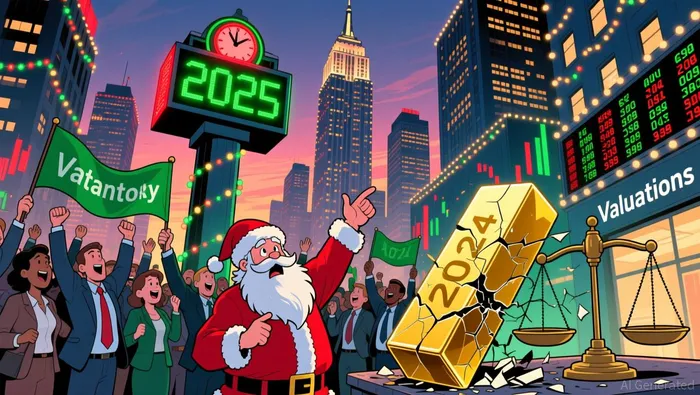
The Santa Claus Rally, a seasonal phenomenon historically observed in the final days of December and the first weeks of January, has long captivated investors. Since 1950, the S&P 500 has delivered an average return of +1.3% during this period, with positive outcomes occurring 79% of the time according to historical data. However, the 2024 rally collapsed, with the index falling -2.4% in December-the first such failure since 2015 as reported in December 2024. As 2025 approaches, the interplay between historical patterns and evolving macroeconomic risks creates a complex landscape for investors. This analysis explores whether the 2025 Santa Claus Rally is plausible, balancing seasonal tendencies with current uncertainties.
Historical Context and Seasonal Patterns
The Santa Claus Rally is rooted in behavioral and structural factors, including year-end portfolio rebalancing, reduced trading activity during holidays, and optimism about the new year as financial analysts note. From 1950 to 2024, this pattern has proven remarkably consistent, offering a statistical edge for those who align their strategies with its rhythm. Yet, 2024's breakdown underscores that no pattern is immune to macroeconomic headwinds. Inflationary pressures, Federal Reserve policy shifts, and sector-specific volatility (notably in AI) disrupted the rally's traditional mechanics.
2025: A Year of Contradictions
The 2025 market environment is defined by a tug-of-war between easing monetary policy and lingering economic fragility. Inflation has shown signs of cooling, with producer prices at 2.6% YoY, and the Federal Reserve is now priced to deliver a 25-basis-point rate cut in December with over 80% probability according to market analysis. Such dovish action could theoretically support risk assets, creating favorable conditions for a rally. However, the S&P 500 has already surged 17% in 2025, leaving investors wary of overextended valuations and potential profit-taking as forecasted by analysts.
Technical indicators further complicate the outlook. The S&P 500 currently hovers near a critical resistance level of 6,850, with support at 6,720–6,760 according to technical analysis. A clean break above resistance could signal renewed bullish momentum, while a pullback might reinforce bearish sentiment. Similarly, the Nasdaq 100, though in a fragile uptrend, faces key levels at 25,500–25,800-a test of its resilience amid AI sector volatility as market data shows.
Macroeconomic and Sector-Specific Risks
The AI sector, a 2025 market darling, remains a double-edged sword. While companies like Nvidia and Microsoft have driven gains, their rapid growth has also introduced volatility, with investors oscillating between euphoria and caution as observed in market data. Meanwhile, the broader economy's reliance on consumer spending-particularly in retail and consumer discretionary sectors-adds another layer of uncertainty. Amazon and Walmart, for instance, could benefit from holiday shopping surges, but any slowdown in consumer demand could dampen the rally's potential according to retail analysts.
Financials and mid/small-cap stocks are also in play, as year-end portfolio rebalancing often favors these sectors. Yet, the Fed's December decision remains a wildcard. Despite high probability of a rate cut, unexpected data (e.g., a rebound in inflation) could trigger a reversal, destabilizing market sentiment as market forecasts suggest.
Balancing the Scales: A Cautious Optimism
While historical patterns suggest a rally is plausible, current conditions demand caution. The S&P 500's proximity to key technical levels and the Fed's dovish stance provide a tailwind. However, the market's already strong performance in 2025, coupled with AI-driven volatility and elevated bearish sentiment as evidenced by increased options hedging, creates a fragile equilibrium.
Investors should consider a hedged approach: positioning for a potential rally while protecting against downside risks. Sectors like retail and financials offer defensive appeal, while AI-related names could deliver outsized returns if the rally materializes. Conversely, those with a pessimistic bias might prioritize cash or defensive assets, given the Fed's uncertain timeline and the potential for sector-specific shocks.
Conclusion
The 2025 Santa Claus Rally is neither a certainty nor a fantasy. Historical data tilts the odds in favor of a positive outcome, but macroeconomic and technical risks have introduced unprecedented complexity. As the December window approaches, investors must remain agile, balancing seasonal tendencies with real-time developments. In a market where sentiment can shift overnight, preparation-and a healthy dose of skepticism-is key.







Comentarios
Aún no hay comentarios