
2025 Fed Rate Cut Implications: Repositioning Portfolios for Equity and Fixed-Income Opportunities in a Lower-Rate Environment
The Federal Reserve's 2025 rate-cutting cycle has ignited a strategic shift in global investment portfolios, as investors recalibrate for a lower-rate environment. With the central bank signaling three quarter-point cuts by year-end-bringing the federal funds rate to 3.50%-3.75%-the implications for equities and fixed-income markets are profound. This analysis unpacks the key drivers of portfolio repositioning, drawing on the Fed's latest projections and actionable strategies from institutional-grade research.
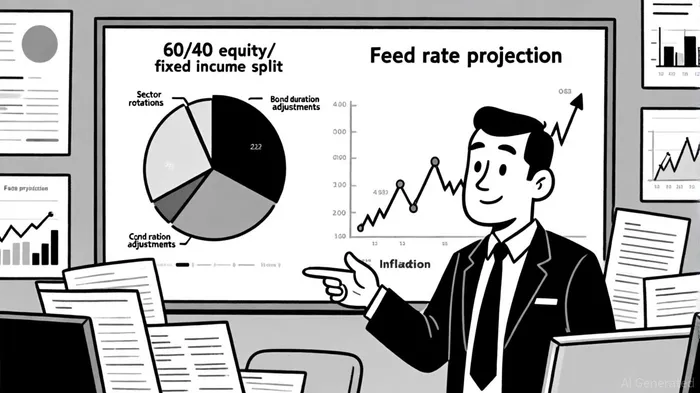
Fed's 2025 Rate Path: A New Monetary Regime
The Fed's September 2025 decision to cut rates by 25 basis points, followed by two more cuts projected for 2025, reflects a recalibration to a "data-dependent" approach amid a slowing labor market and persistent inflation. According to a Federal Reserve report, job gains have decelerated, and unemployment has edged upward, prompting policymakers to acknowledge "downside risks to employment" and an "uncertain economic outlook." While the central bank raised its 2025 GDP growth forecast to 1.6%, core inflation remains stubbornly above 2%, projected to decline only gradually through 2027. This asymmetric policy stance-prioritizing employment over inflation-has created a fertile ground for equity and fixed-income reallocation.
Equity Repositioning: Sector Rotations and Geopolitical Shifts
The initial rate cuts have already triggered a rotation toward defensive sectors and international equities. Historical data from LPL Financial shows that healthcare, utilities, and consumer staples outperformed in the six months following the first 2025 rate cuts, offering stability amid economic uncertainty. Meanwhile, U.S. large-cap growth stocks-particularly in technology-have underperformed as investors pivot to value equities and international markets.
This shift is compounded by U.S. tariff policies and ECB rate cuts. Data compiled in Investology's Q3 ETF portfolio show European and Chinese technology firms have gained traction, with the Eurostoxx 600 Index rising 8% year-to-date compared to the S&P 500's 3%. The divergence underscores the importance of geographic diversification. Additionally, 2025 tax reforms, including expanded SALT deductions, have incentivized capital flows into luxury goods and finance sectors, further skewing sector dynamics, according to Omnicon analysis.
Investors are advised to adopt a dual strategy:
1. Defensive Overweights: Increase allocations to healthcare, utilities, and consumer staples, which historically benefit from rate cuts.
2. Value and International Exposure: Reduce overweights in U.S. growth stocks and rebalance toward value equities and emerging markets, where earnings growth appears more resilient.
Fixed-Income Adjustments: Duration, Yield, and Credit Quality
In fixed-income, the focus has shifted to managing duration risk and capturing yield in a lower-rate environment. BlackRock's analysis highlights a preference for intermediate-term bonds over long-dated bonds, as shallow rate-cut cycles often see long bonds underperform. A strategic ETF portfolio constructed in Q3 2025 targets a 4.9% SEC yield with an effective duration of 4.1 years, emphasizing investment-grade credit to mitigate default risks.
Ultra-short duration strategies have also gained traction, particularly for preserving capital amid volatile short-term rates. The Financeresolver notes that these strategies aim to balance yield preservation with liquidity, a critical consideration as the Fed's policy path remains uncertain.
Dynamic Asset Allocation: Balancing Growth and Stability
The optimal equity/fixed-income split is evolving in response to macroeconomic signals. Vicap Partners' research suggests allocations fluctuating between 50/50 and 70/30, depending on labor market data and inflation trends. For instance, a 70/30 tilt toward equities may be justified in a low-inflation, low-rate environment, while a 50/50 split offers downside protection during periods of policy uncertainty.
Conclusion: Navigating the New Normal
The 2025 Fed rate cuts mark a pivotal shift in monetary policy, demanding proactive portfolio adjustments. Equity investors must embrace sector rotations and geographic diversification, while fixed-income strategies should prioritize intermediate-term duration and credit quality. As the Fed's "dot plot" and economic data evolve, dynamic rebalancing will remain critical to capturing opportunities in a lower-rate world.







Comentarios
Aún no hay comentarios