
2025 Equity Market Melt-Up: Navigating Dislocations and Strategic Positioning
2025 Equity Market Melt-Up: Navigating Dislocations and Strategic Positioning
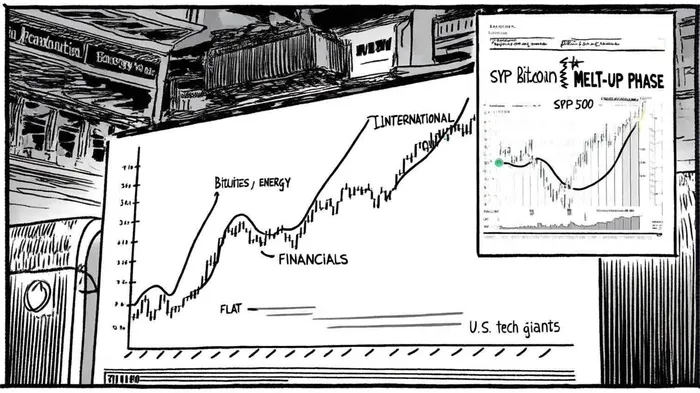
The 2025 equity market is experiencing a historic "melt-up" phase, marked by a broadening of market leadership beyond the long-dominant "Magnificent 7" tech stocks. This surge, driven by reshoring of manufacturing, AI-driven productivity gains, and a shift in macroeconomic policy, has pushed the S&P 500 to record highs and created both opportunities and risks for investors. However, beneath the surface of this rally lie short-term dislocations and structural shifts that demand a nuanced approach to long-term strategic positioning.
Short-Term Dislocations: Sector Rotations and Valuation Extremes
The 2025 melt-up has triggered a dramatic reallocation of capital. According to a Finsyn analysis, the Russell 1000 Value index and the MSCIMSCI-- EAFE (international equities) have surged 1.9% and 11.21% year-to-date, respectively, outpacing the S&P 500's 3% growth. This shift reflects a rotation toward value stocks and cyclical sectors like financials, energy, and industrials, which have benefited from rising interest rates and inflationary pressures, as noted in Charles Schwab's outlook. Meanwhile, defensive sectors such as utilities and healthcare have acted as safe havens amid macroeconomic uncertainty, according to Lombard Odier.
Non-U.S. equities, particularly in Europe and China, have also outperformed. The Eurostoxx 600 Index rose 8% year-to-date, driven by a weaker U.S. dollar and regional tailwinds, as shown in a Twelve Points review. This trend underscores a broader reassessment of valuations, especially in the technology sector, where breakthroughs in generative AI have prompted investors to rebalance portfolios, a dynamic highlighted by Lombard Odier.
However, the melt-up is not without risks. The CAPE ratio has surpassed 40, a level last seen during the 2000 tech bubble, signaling extreme valuations, according to a Cornell Capital memo. Earnings yields of just 2.5% suggest modest long-term returns, while competition in AI-driven sectors threatens to erode profitability - a concern raised in that same Cornell Capital analysis.
Long-Term Strategic Positioning: Diversification and Adaptability
To navigate this environment, investors must prioritize diversification and flexibility. As highlighted by Lombard Odier Asset Management, a balanced approach combining growth and value, alongside tactical exposure to cyclical and defensive sectors, is critical. For instance, low-volatility strategies-focusing on resilient stocks like Berkshire Hathaway and Coca-Cola-have proven effective in preserving capital during market downturns, according to Morningstar's analysis.
Global diversification is another key theme. The Charles SchwabSCHW-- Center for Financial Research notes that international equities are increasingly attractive as U.S. markets face valuation challenges and economic slowdowns. Fixed income, particularly in the 3- to 7-year segment of the yield curve, is also gaining traction as bond yields normalize and term premiums rise, per iShares Investment Directions.
Tactical tools like sector ETFs and AI-driven analytics are enabling real-time portfolio adjustments. For example, energy and financials have shown strength amid inflationary pressures, while healthcare and utilities offer downside protection, as discussed in an AI Signals guide.
Risks and the Road Ahead
Despite the optimism, investors must remain cautious. The Federal Reserve's rate cuts and shifting trade policies, including delayed tariffs, have introduced volatility, as covered in Morningstar's Q3 review. Additionally, the maturation of BitcoinBTC-- as a correlated asset-trading above its June 2025 monthly open of $107,164-reflects broader risk-on sentiment but also highlights the market's susceptibility to macroeconomic shifts, according to a SpeculatorsEdge piece.
In conclusion, the 2025 melt-up presents a unique confluence of opportunities and challenges. By embracing diversification, sector rotation, and global exposure, investors can position themselves to capitalize on the rally while mitigating risks. As the market evolves, adaptability will remain the cornerstone of long-term success.





Comentarios
Aún no hay comentarios