
Will 2025 Deliver a Santa Claus Rally Amid AI Volatility and Fed Uncertainty?
The Santa Claus Rally, a seasonal phenomenon where stock markets often surge in late December and early January, has long captivated investors. Historically, the S&P 500 has gained an average of 1.3% during this seven-day window, with positive returns occurring in 79% of years since 1950 according to historical data. This pattern, first identified by Yale Hirsch in 1972, is driven by factors such as holiday optimism, tax-loss harvesting, and reduced institutional trading activity. However, 2025 presents a unique confluence of forces: a maturing AI sector, persistent Fed policy uncertainty, and shifting investor sentiment. These dynamics threaten to disrupt-or amplify-traditional seasonal trends.
The 2025 Context: AI Volatility and Fed Easing
The AI sector, now accounting for nearly 30% of the S&P 500 according to market analysis, has become a double-edged sword. While it has fueled a 35.1% rally in the S&P 500 since April 2025, concerns over speculative valuations and circular financing are growing. Investors are increasingly demanding tangible earnings impacts from AI investments, shifting from broad enthusiasm to selective scrutiny. This transition introduces volatility, particularly as firms face pressure to demonstrate productivity gains rather than rely on speculative hype.
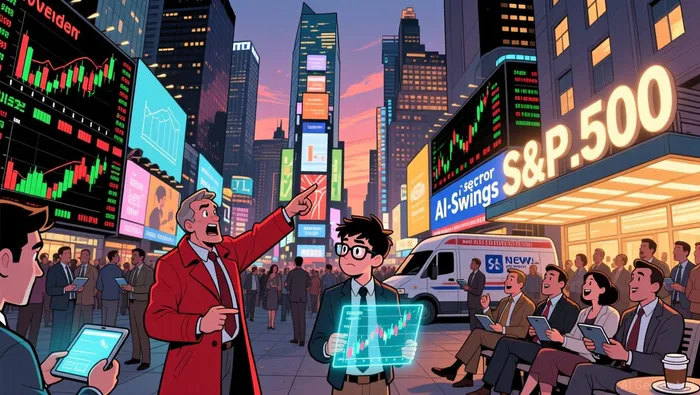
Meanwhile, the Federal Reserve's easing cycle, which resumed in September 2025 with a 25-basis-point rate cut, has created a mixed backdrop. Markets now price in an 83% chance of a 25-basis-point cut by year-end, with further easing expected into 2026. Yet the Fed faces a delicate balancing act: cutting rates to support a cooling labor market risks reigniting inflation, which remains stubbornly above the 2% target. This policy uncertainty is reflected in the elevated Fed policy uncertainty index, which, despite a slight decline from its Q2 2025 peak, remains a drag on clarity.
Seasonal Patterns and Risk-On Sentiment
Historically, December has been the S&P 500's best-performing month, with an average gain of 1.4% and 73% of years ending in positive territory. In 2025, however, the interplay between AI-driven optimism and Fed policy has altered the intensity of these patterns. For instance, August 2025 saw a -0.6% average return-a historical norm-while September, traditionally the worst-performing month, continued its underperformance according to analysis. This suggests that while AI booms and Fed actions have not erased seasonal trends, they have amplified volatility.
Investor positioning reflects a cautious yet optimistic stance. Diversification into non-U.S. assets has gained traction, supported by a moderating U.S. dollar and attractive valuations in international equities. Fixed-income markets have also seen modest gains, with lower yields bolstering bond returns. However, risk-on sentiment remains fragile. The AI sector's circular financing and rising borrowing among AI-focused firms pose correction risks, even as the Fed's accommodative stance supports risk assets according to market analysis.
The Outlook: A Modest Rally Amid Uncertainty
The 2025 Santa Claus Rally is unlikely to mirror its historical vigor but could still materialize in a muted form. A key driver will be the Fed's ability to balance rate cuts with inflation control. If inflation eases further and the December rate cut is delivered without market jitters, a 1–1.5% gain in the S&P 500 during the rally window is plausible. However, AI sector volatility could introduce sharp corrections, particularly if earnings fail to meet expectations.
Investors should also consider the January Barometer's relevance. A strong start to 2026, historically correlated with a positive year, may hinge on whether the AI sector transitions from speculative bets to sustainable growth. For now, a diversified approach-layering in alternative assets, inflation-linked bonds, and high-conviction AI stocks-offers a hedge against both seasonal and structural uncertainties according to investment guidance.
In conclusion, 2025's Santa Claus Rally will likely be shaped by the Fed's precision in navigating inflation and the AI sector's ability to deliver on its promises. While the rally's magnitude may be constrained, the combination of easing policy and seasonal optimism suggests a modest upward bias. Investors, however, must remain vigilant against the fragility of current market sentiment.







Comentarios
Aún no hay comentarios