
2025's Crypto Winners: A Catalyst-Driven Analysis of the Year's Top Performers
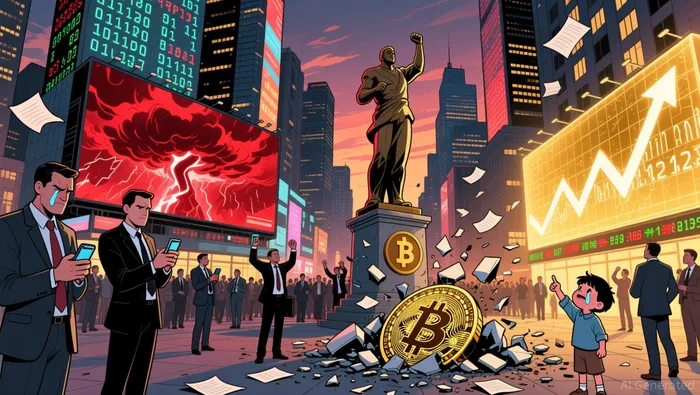
The 2025 crypto market was a story of two starkly different regimes. It began with a powerful, politically-driven euphoria that lifted BitcoinBTC-- to a breathtaking all-time high near $126,000 during the third quarter. This surge was fueled by a perceived crypto-friendly administration, creating a broad wave of optimism that swept through the market. Yet that peak proved fleeting. The euphoria collapsed in October, triggering a severe risk-off pivot that created the mispricing environment where niche assets could outperform.
The catalyst for the collapse was a sudden macroeconomic shock. On October 10, the market experienced what is now known as 'The Great Shake-Out', the largest liquidation event in history. A proposed U.S. tariff sent cascaded liquidations through overleveraged positions, wiping out over $19 billion in hours. This wasn't just a correction; it was a violent purge of speculative excess, marking a sharp and decisive pivot away from risk.
The aftermath of that shake-out defined the final quarter. Instead of the usual year-end rally, Bitcoin and EthereumETH-- posted some of their worst quarterly returns on record. Data shows Bitcoin posted a return of -23.07% in Q4 2025, ranking as the second-worst quarter in its history. Ethereum fell -28.28%, its fourth-worst Q4 ever. This break from the seasonal script shocked investors and cemented a period of deep selling pressure.
The thesis here is that the market's year was defined by this short-lived euphoria followed by a severe liquidation event. The resulting mispricing-where major assets were punished for no fundamental change in their long-term prospects-created an opening. While Bitcoin and Ethereum corrected sharply, assets like BNBBNB--, with its focus on scalability and low costs, were able to outperform by offering tangible utility that stood apart from the broader market's volatility. The catalysts of political optimism and then macroeconomic shock set the stage for a year where niche wins were possible only because the majors were caught in a violent risk-off cycle.
Dissecting the Winners: The Mechanics of Their Outperformance
The top performers of 2025 didn't just ride a broad market wave; they were propelled by specific, often niche, catalysts that diverged sharply from the majors. Their outperformance reveals the mechanics of a market in turmoil, where utility, safe-haven demand, and regulatory arbitrage created temporary mispricings.
Bitcoin Cash presents the most puzzling divergence. While Bitcoin fell by 5% last year, Bitcoin CashBCH-- soared in value by more than 30%. The standard explanation is a search for a "better long-term store of value" alternative. Yet this is a statistical outlier, as the article notes, because Bitcoin Cash almost never outperforms Bitcoin over the long haul. The catalyst here appears to be a technical or narrative shift within the Bitcoin ecosystem, where proponents of a "digital cash" utility model found a receptive audience during the year's volatility. This is a one-time event, not a sustainable re-rating.
The most straightforward catalyst was the flight to store-of-value assets. Gold-backed stablecoins like Pax GoldPAXG-- soared in value by nearly 70%, a direct translation of the underlying asset's performance. This wasn't a bet on the token's utility, but a pure play on gold's rally. The mechanics are simple: as macroeconomic and geopolitical uncertainty mounted, capital flowed into gold, and the 1:1 pegged stablecoins captured that move. This driver is the most repeatable, as the article suggests, because the price of gold shows no signs of cooling off anytime soon.
Privacy coins like ZcashZEC-- and MoneroXMR-- posted triple-digit returns, with Zcash up 782% and Monero 122%. Their performance was a classic momentum play, but one with a critical caveat. These coins offer advanced cryptography for transaction anonymity, a feature that attracts a specific user base. However, their explosive gains are likely to be difficult to repeat. As the article warns, I fully expect the shine to wear off privacy coins by mid-2026. This is due to heightened regulatory scrutiny, which creates a fundamental vulnerability that a utility-driven asset like Bitcoin Cash does not face.
The bottom line is that the 2025 winners were driven by catalysts that were either temporary (Bitcoin Cash's narrative shift) or dependent on external macro trends (gold's rally). The privacy coin surge, while massive, carries the highest risk of reversal due to regulatory headwinds. For an event-driven strategist, these are the mispricings created by the broader market's collapse-a chance to capitalize on a specific, fleeting catalyst before the next regime shift.
Valuation and Risk: Assessing the 2026 Setup
The 2025 gains for the top performers were a classic event-driven mispricing. They represent a temporary rotation into niche narratives during a period of extreme macro stress, not a fundamental re-rating of these assets' intrinsic value. The immediate risk/reward for 2026 hinges on a single question: will the market's focus return to established utility and broader stability?
The most extreme case is MYX Finance. Its 3,700% surge in 2025 was a pure momentum event, capped by a 70% drop from its September high. This volatility is a red flag. The setup now is one of a broken trend; the asset is down sharply from its peak, indicating that the speculative fervor has burned out. For an event-driven strategist, this is a high-risk, low-reward proposition. The catalyst that drove the rally is gone, and there's no evidence of a new one emerging.
The outperformance of niche assets like Bitcoin Cash and privacy coins highlights a market where narrative-driven, low-cap plays can outperform majors during periods of macro stress. Bitcoin Cash's 30% gain while Bitcoin fell is a statistical outlier, driven by a temporary narrative shift. Privacy coins like Zcash and Monero posted triple-digit returns, but their explosive gains are likely to be difficult to repeat. As the article notes, I fully expect the shine to wear off privacy coins by mid-2026. Their primary vulnerability is heightened regulatory scrutiny, which creates a fundamental headwind that a utility-driven asset does not face.
The primary risk for 2026 is a return to broader market stability. When the macroeconomic and geopolitical uncertainty that fueled the 2025 rally subsides, capital is likely to rotate back to established assets. This would pressure the 2025 winners, which were built on temporary catalysts. The only exception noted is gold-backed stablecoins, which should be able to carry its momentum into 2026 if gold remains a safe-haven haven. For all other winners, the event-driven mispricing has likely been arbitraged away. The market's violent shake-out in October created the opening, but the setup now is for a return to the long-term trajectory, where these niche assets are unlikely to sustain their outperformance.
Catalysts and What to Watch in 2026
The 2025 winner list was a product of a specific, volatile regime. For 2026, the tactical watchlist centers on three near-term events that will determine if those niche gains hold or reset.
First, monitor Q1 2026 ETF flows and stablecoin supply for signs of continued institutional adoption or a shift in capital allocation. The structural shift toward institutional balance sheets is clear; in 2025, spot Bitcoin ETFs generated around $21.8 billion worth of net inflows. This trend is the new market baseline. A sustained slowdown in these flows, or a divergence where capital rotates into new ETFs for SolanaSOL-- or XRPXRP--, would signal a broader market re-rating that could pressure the 2025 winners. Similarly, stablecoin supply hitting nearly $300 billion shows deepening institutional integration. Any deceleration here would be a red flag for the utility-driven narratives that powered some of the year's best performers.
Second, watch for regulatory developments, particularly around privacy coins and new stablecoin frameworks, as a potential catalyst for re-rating. The article notes that I fully expect the shine to wear off privacy coins by mid-2026 due to heightened scrutiny. Any concrete regulatory action or framework announcement in 2026 will be a direct catalyst for these assets. Conversely, the approval of new ETFs for assets like Solana and XRP, which followed accelerated SEC listing standards, creates a parallel path for re-rating. The market will be watching for clarity that could either validate or invalidate the niche narratives of 2025.
The key watchpoint is whether the market's focus remains on niche narratives or reverts to the application layer and infrastructure, which captured most network revenue in 2025. The data shows a decisive shift: nearly 90% of all crypto fees generated at the app layer. Platforms like Hyperliquid and Pump pulled in substantial revenue, demonstrating real business traction. If 2026 sees capital rotate back to these high-fee applications and infrastructure projects, it would validate the structural handover from hype to utility. This would likely pressure the 2025 winners, which were built on temporary catalysts. The setup is for a return to fundamentals, where the winners of 2026 will be determined by who captures the next wave of institutional adoption and app-layer revenue, not by a fleeting narrative shift.






Comentarios
Aún no hay comentarios