
The 2025 Crypto Resurgence: Macroeconomic and Institutional Catalysts Driving Institutional Demand
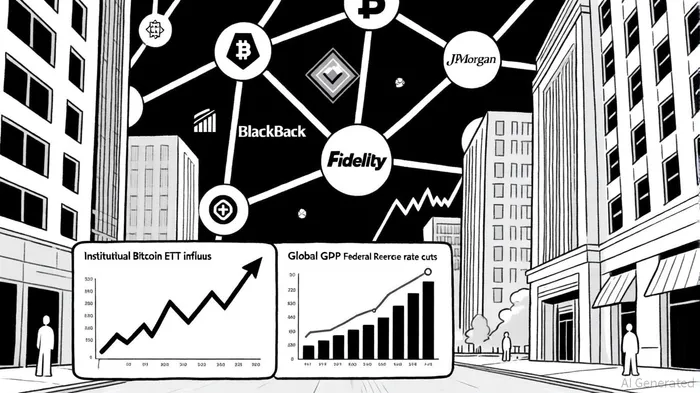
The cryptocurrency market in 2025 is undergoing a profound transformation, driven by a confluence of macroeconomic tailwinds and institutional-grade infrastructure. What was once dismissed as speculative noise is now being reclassified as a strategic asset class, with major financial institutions embedding digital assets into their portfolios. This shift is not merely speculative-it is the result of deliberate regulatory, technological, and economic catalysts that have normalized crypto as a legitimate investment vehicle.
Macroeconomic Tailwinds: Regulatory Clarity and Liquidity Expansion
The U.S. GENIUS Act, enacted in July 2025, marked a watershed moment for institutional adoption. By mandating full cash or T-bill backing for stablecoins and enforcing AML compliance, the law reduced counterparty risks and created a framework for trust, according to a Forbes analysis. Similarly, the EU's MiCA regulation, fully implemented by late 2024, provided a structured legal environment for crypto operations, further legitimizing the sector, as the Forbes analysis notes. These regulatory milestones addressed long-standing concerns about volatility and fraud, enabling institutions to allocate capital with greater confidence.
Monetary policy has also played a pivotal role. The U.S. Federal Reserve's rate-cutting cycle, initiated in mid-2024, has spurred a risk-on environment. With interest rates declining from 5.25% to 3.75% by Q2 2025, investors are reallocating capital from low-yield bonds to higher-risk assets like crypto, as outlined in a CryptoNewer outlook. This liquidity expansion is evident in global M2 money supply, which surged $5.6 trillion in six months, creating fertile ground for digital assets, the Forbes analysis adds. Meanwhile, the OECD projects global GDP growth at 3.2% in 2025, a modest but stable backdrop that supports long-term portfolio diversification, according to the OECD report.
Institutional Adoption: From Niche to Mainstream
Institutional demand has surged, with 83% of surveyed investors planning to increase crypto allocations in 2025, according to Coinbase research. The most striking development is the adoption of spot BitcoinBTC-- ETFs. BlackRock's iShares Bitcoin Trust (IBIT) alone attracted over $80 billion in assets under management by September 2025, mirroring the growth trajectory of gold ETFs. These products have normalized crypto exposure for pension funds, endowments, and family offices, which now view Bitcoin as a hedge against inflation and a complement to traditional equities.
Ethereum, too, has seen robust institutional interest. The Pectra and Dencun upgrades reduced Layer-2 transaction costs by 40%, driving on-chain activity and smart contract adoption, as the Forbes analysis explains. Nearly half of institutional asset managers are now exploring EthereumETH-- allocations, attracted by its role in decentralized finance (DeFi) and tokenized real-world assets, per the CryptoNewer outlook. Stablecoins, meanwhile, have become a cornerstone of institutional cash management, with 84% of surveyed institutions using them for yield generation and cross-border transactions, according to the same CoinbaseCOIN-- research.
Tokenization is another frontier. BlackRock and U.S. Bank have launched tokenized Treasury bonds on Ethereum, offering instant settlement and fractional ownership, a development highlighted in the CryptoNewer outlook. This innovation has expanded institutional access to crypto collateral solutions, with tokenized assets projected to manage $1.2 trillion by 2026, according to a Pinnacle Digest analysis.
Market Maturation: Risk Management and Diversification
The maturation of the crypto market is evident in its infrastructure. Cold storage, multi-signature wallets, and insurance solutions now meet institutional-grade security standards, reducing operational risks, as the CryptoNewer outlook notes. Advanced risk management tools, such as volatility hedging via options and staking derivatives, have also emerged, enabling institutions to navigate crypto's inherent price swings, the Forbes analysis observes.
Diversification is key. While Bitcoin and Ethereum remain dominant, altcoins like SolanaSOL-- (SOL) and Ripple (XRP) are gaining traction. JPMorgan highlighted Solana's 30% price surge in Q2 2025, driven by its high-throughput blockchain and institutional staking demand, according to industry reporting. Meanwhile, 73% of institutions now hold assets beyond the top two cryptocurrencies, reflecting a broader appetite for blockchain innovation, the Coinbase research found.
The Road Ahead: Challenges and Opportunities
Despite the momentum, challenges persist. Regulatory uncertainty lingers in jurisdictions outside the U.S. and EU, with 52% of institutions citing this as a barrier to full adoption, the Coinbase research reports. Additionally, macroeconomic headwinds-such as the CBO's projection of a 0.5 percentage point drag on 2025 GDP growth due to tariffs and immigration constraints-could temper risk appetite, as noted in the OECD report.
However, the trajectory is clear. As of Q3 2025, institutional crypto allocations have doubled to 5% of AUM, with further growth anticipated as tokenization and DeFi mature, according to the Pinnacle Digest analysis. The convergence of traditional finance and crypto is accelerating, with M&A activity surging as banks acquire crypto-native firms to access blockchain expertise, the CryptoNewer outlook adds.
Conclusion
The 2025 crypto resurgence is not a speculative bubble but a structural shift. Regulatory clarity, monetary policy, and institutional infrastructure have created a self-reinforcing cycle of demand. For investors, this means a market that is more liquid, diversified, and integrated with global capital systems. As the OECD warns of crypto's financial stability risks, it also acknowledges the asset class's growing role in modern portfolios, per the OECD report. The question is no longer if institutions will adopt crypto-but how fast.







Comentarios
Aún no hay comentarios