
2025 Crypto Investment Opportunities: BullZilla Presale, Chainlink's ETF Hype, and Hyperliquid's Rising Influence
The 2025 cryptocurrency market is a battleground between speculative frenzy and institutional-grade innovation. As investors navigate this landscape, two distinct archetypes emerge: high-risk, high-reward meme coin presales like BullZilla ($BZIL) and more established, institutional-backed projects such as Chainlink (LINK) and Hyperliquid. This analysis dissects these opportunities, weighing their potential against the backdrop of evolving market dynamics and regulatory scrutiny.
BullZilla: The Meme Coin with a 100x Playbook
BullZilla's presale has become a lightning rod for retail investors chasing exponential returns. Currently in Stage 2B at $0.00003908, the project employs a Mutation Mechanism that increases the token price every 48 hours or upon raising $100,000, whichever occurs first [1]. This creates a sense of urgency, as early buyers secure tokens at exponentially lower prices. For instance, a $1,000 investment at the current stage could yield a projected 13,388.76% ROI if the token reaches its listing price of $0.00527 [2].
The tokenomics are engineered for scarcity and staking incentives. The HODL Furnace offers a 70% APY, locking in long-term holders, while the Roar Burn mechanism permanently removes tokens from circulation, reducing supply and theoretically increasing demand [3]. Additionally, a referral system rewards both parties with 10% bonuses, further fueling community growth [4].
However, these mechanics come with caveats. BullZilla's success hinges on continued hype and execution of its 24-chapter roadmap. Unlike traditional infrastructure projects, its value proposition is largely narrative-driven, making it susceptible to market sentiment shifts. As one analyst notes, “BullZilla is a textbook meme coin—its ROI is speculative, and its risks are commensurate with its rewards” [5].
Chainlink: The Institutional-Grade Infrastructure Play
While BullZilla thrives on volatility, Chainlink is positioning itself as a cornerstone of the institutional crypto ecosystem. Grayscale's recent filing for a Chainlink ETF (GLNK) has injected new momentum into the project, with the fund aiming to provide regulated access to LINK's price performance [6]. This move aligns with broader trends of institutional adoption, as Chainlink's role in connecting blockchain applications to real-world data (via its oracleORCL-- network) solidifies its utility as a “core infrastructure token” [7].
Price projections for LINK are bullish but measured. Analysts at TokenMetrics predict a range of $30.69–$38.26 by 2025 and $196.53–$244.09 by 2030, driven by factors like regulatory clarity and increased enterprise adoption [8]. The project's strategic reserve, funded by both on-chain and off-chain income, further underpins its long-term stability [9].
Unlike BullZilla, Chainlink's value is rooted in tangible use cases. Its partnerships with real estate platforms and DeFi protocols highlight its role as a bridge between traditional finance and blockchain ecosystems. For investors seeking less volatility, ChainlinkLINK-- offers a more predictable, albeit slower, growth trajectory.
Hyperliquid: The Institutional-Driven Derivatives Exchange
Hyperliquid, a derivatives exchange with a TVL of $5 billion as of mid-2025, is another institutional-grade opportunity. The platform's planned USDH stablecoin has attracted major players like Sky (formerly MakerDAO), Paxos, and Native Markets, each vying to manage the token with tailored incentives [10]. For example, Sky's proposal includes a 4.85% yield on USDH holdings and a $25 million investment in Hyperliquid's ecosystem [11].
The USDH auction has also drawn institutional backing. Paxos recently partnered with PayPal, enabling USDH and HYPE token access on Venmo and PayPalPYPL-- with $20 million in incentives [12]. These developments underscore Hyperliquid's potential to disrupt the stablecoin market, particularly as it competes with Circle's USDCUSDC--.
Hyperliquid's TVL and trading volume—$400 billion in August 2025 alone—highlight its growing influence. While the USDH issuer will be determined by community validators, the platform's institutional partnerships and liquidity depth make it a compelling bet for investors prioritizing scalability and real-world adoption.
High-Risk vs. Institutional-Grade: A Strategic Dilemma
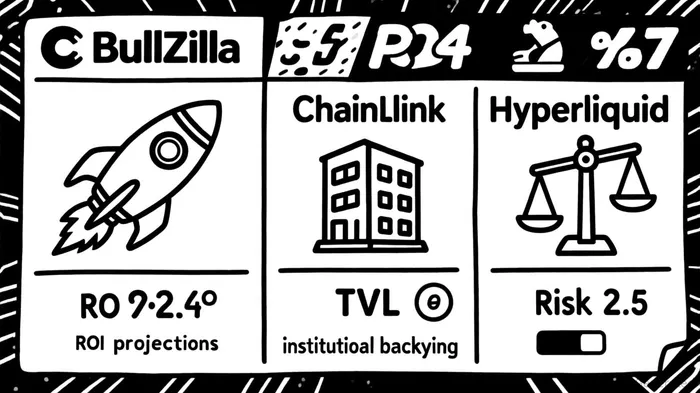
The contrast between BullZilla and projects like Chainlink and Hyperliquid is stark. BullZilla's presale is a high-risk, high-reward play, relying on viral momentum and engineered scarcity. Its ROI projections are staggering, but so are its risks—market sentiment, regulatory shifts, or a failed roadmap could render it a speculative dud.
In contrast, Chainlink and Hyperliquid represent institutional-grade opportunities with more predictable, albeit slower, growth. Chainlink's ETF filing and Hyperliquid's USDH competition reflect the maturation of the crypto market, where utility and infrastructure trump virality. These projects cater to investors seeking exposure to blockchain's foundational layers, rather than the whims of meme culture.
Conclusion
The 2025 crypto market offers divergent paths for investors. BullZilla's presale is a gamble for the bold, with ROI potential that could redefine meme coins as a class. Meanwhile, Chainlink and Hyperliquid represent the future of institutional crypto, where infrastructure and utility drive value. For a balanced portfolio, diversification across both archetypes may be prudent—but investors must weigh their risk tolerance against the allure of exponential gains.






Comentarios
Aún no hay comentarios