
2025 Crypto Investment Opportunities: BullZilla, Hedera, and BNB in a Shifting Market Landscape
The 2025 cryptocurrency market is a tapestry of volatility and innovation, shaped by macroeconomic headwinds, regulatory shifts, and the relentless pursuit of scalable solutions. As institutional interest converges with grassroots adoption, three projects—BullZilla, HederaHBAR--, and BNBBNB-- Chain—stand out for their distinct approaches to navigating this evolving landscape. This analysis examines their viability through the lens of emerging project mechanics, technological advancements, and market catalysts, offering a roadmap for investors seeking high-conviction opportunities.
BullZilla: Meme-Driven Mechanics with Structured Scarcity
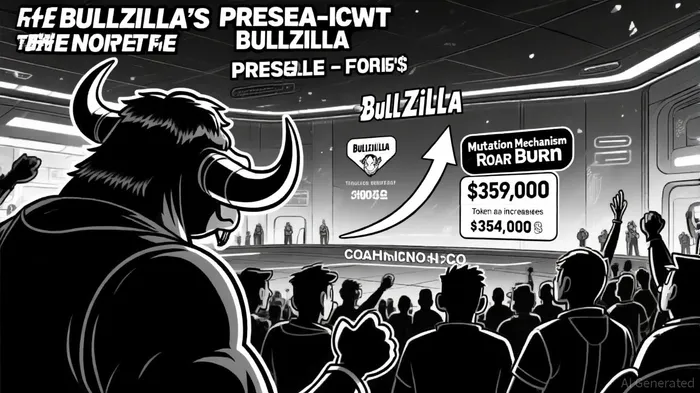
BullZilla ($BZIL) has redefined the meme coin paradigm with its "Mutation Mechanism," a presale model designed to create artificial scarcity and incentivize early participation. As of September 2025, the project is in its second stage, having raised over $359,000 with 1,236 holders, while its token price increases every 48 hours or upon reaching $100,000 in funding [3]. This dynamic pricing engine, combined with a "Roar Burn" mechanism that permanently reduces supply at key milestones, creates a compounding effect on token value [5].
The project's tokenomics further reinforce its speculative appeal: 50% of tokens are allocated to the presale, 20% to staking (offering up to 70% APY), and 5% to the Roar Burn pool [5]. Analysts project a 6,566% ROI if the token lists at $0.00527, a target driven by aggressive whale accumulation and narrative-driven scarcity [1]. Unlike traditional meme coins, BullZilla's 24-chapter roadmap blends community engagement with financial mechanics, positioning it as a hybrid of speculative and utility-driven innovation [4].
Hedera: Enterprise-Grade Infrastructure for Tokenization and AI
Hedera Hashgraph (HBAR) has carved a niche in 2025 by targeting enterprise use cases with its high-performance consensus model. The network recently demonstrated 10,000 transactions per second (TPS) in a public beta, a critical benchmark for institutions seeking scalable solutions [3]. Strategic partnerships with NVIDIA, Intel, and EQTYLab have expanded its footprint into AI-driven "Verifiable Compute" systems, where computations are recorded on the Hedera ledger for transparency [3].
A key catalyst for HBAR's adoption is abrdn's use of Hedera to tokenize real-world assets, democratizing access to investment opportunities [6]. This aligns with the platform's broader vision of an "internet of value," bolstered by the appointment of Shyam Nagarajan as COO to oversee AI and tokenization initiatives [6]. Additionally, Hedera's integration of Chainlink's Data Feeds and quantum-resistant semiconductors from SEALSQ underscores its commitment to security and innovation [3]. The launch of an HBARHBAR-- ETP on Euronext Amsterdam has further broadened institutional access, making it a compelling play for investors targeting enterprise blockchain adoption [3].
BNB Chain: Scaling for Web3's Next Frontier
Binance Smart Chain (BNB) continues to evolve beyond its exchange-centric roots, with 2025 marking a pivotal year for infrastructure upgrades. The chain plans to scale to 5,000 DEX swaps per second by increasing the block gas limit to 1 billion and introducing a Rust-based client optimized for high-throughput performance [3]. Innovations like "Super Instructions" and StateDB optimizations aim to streamline smart contract execution, reducing redundant data access and enabling faster transactions [3].
Looking ahead, BNB Chain's 2026 roadmap targets 20,000 TPS with sub-150ms confirmation times, alongside native privacy features and user-friendly tools to bridge Web2 and Web3 [3]. BNB's expanding utility as a settlement and governance asset in DeFi, NFTs, and multi-chain bridges positions it as a foundational layer for decentralized ecosystems [2]. While its growth is more incremental than BullZilla's speculative surge, BNB's developer support and Binance's ecosystem dominance make it a safer bet for long-term investors [2].
Market Catalysts: Regulatory Clarity and Macro Shifts
The 2025 market is being reshaped by regulatory clarity in the U.S., including the GENIUS Act and the Working Group on Digital Asset Markets, which have spurred Ethereum's DeFi and stablecoin adoption [3]. Conversely, macroeconomic headwinds—such as U.S. tariffs and geopolitical tensions—have contributed to a bearish sentiment, with BitcoinBTC-- and Ether experiencing declines [1]. India's regulatory uncertainty further amplifies volatility, but projects like BullZilla, Hedera, and BNB are leveraging their unique value propositions to weather the storm.
BullZilla's presale mechanics and narrative-driven scarcity appeal to retail investors seeking high-risk, high-reward opportunities. Hedera's enterprise partnerships and tokenization initiatives cater to institutional demand for scalable infrastructure. BNB's infrastructure upgrades and expanding utility position it as a bridge between Web2 and Web3, attracting both developers and traditional investors.
Conclusion: Balancing Risk and Reward in a Shifting Landscape
In 2025, the crypto market demands a nuanced approach to investment. BullZilla's speculative model, while volatile, offers exponential upside for early adopters. Hedera's enterprise-grade solutions and BNB's infrastructure upgrades provide more stable, long-term value. Investors must weigh these options against macroeconomic risks and regulatory developments, but the projects' distinct strengths—whether in scarcity mechanics, enterprise adoption, or scalability—make them compelling candidates for a diversified portfolio.
As the market continues to consolidate, the winners will be those who align with projects that notNOT-- only adapt to current trends but redefine the boundaries of blockchain innovation.






Comentarios
Aún no hay comentarios