
2025 Crypto Institutionalization: From Hype to High-Conviction Allocations
The year 2025 marks a seismic shift in the institutionalization of digital assets. What was once dismissed as speculative hype has evolved into a high-conviction allocation for global financial institutions. The convergence of compliance-ready infrastructure, regulatory clarity, and AI-driven tokenized ecosystems has created a fertile ground for capital reallocation, reshaping traditional finance and unlocking new paradigms of value creation.
Regulatory Frameworks: The Bedrock of Institutional Confidence
Institutional adoption in 2025 is no longer hindered by regulatory ambiguity. Landmark frameworks like the EU's Markets in Crypto-Assets (MiCAR) regulation and the U.S. Global Economic and Financial Innovation and Stability (GENIUS) Act have provided a harmonized legal structure, distinguishing sustainable blockchain-based models from speculative noise. These frameworks have transformed legal uncertainty into a competitive advantage, enabling institutions to deploy capital with confidence. For instance, the GENIUS Act's focus on "filtration mechanisms" ensures that only projects with robust governance and compliance protocols gain traction, fostering a stable environment for long-term investment.
Compliance-Ready Infrastructure: The New Financial Backbone
The rise of institutional-grade infrastructure has been pivotal. Custody solutions, compliance platforms, and exchange services tailored for institutional clients have matured into standardized offerings. Standard Chartered's partnership with FalconX and Citigroup's integration of fiat-stablecoin operations exemplify how traditional banks are embedding digital assets into their core services. Meanwhile, Deutsche Börse Group's incorporation of stablecoins into trading infrastructure highlights the sector's shift from experimentation to operationalization.
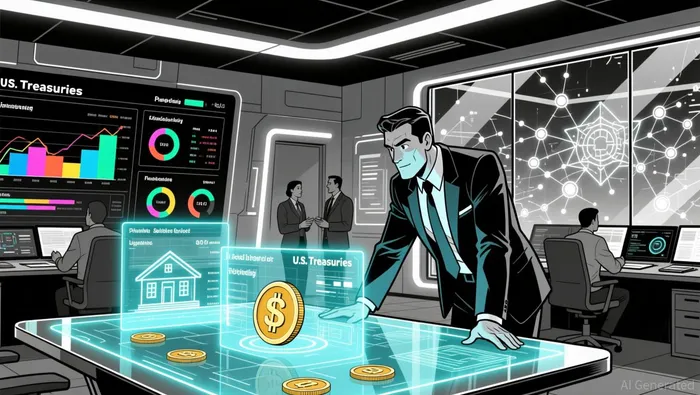
Real-world asset (RWA) tokenization has further accelerated this transition. Tokenized U.S. Treasuries, real estate, and private credit now offer unprecedented liquidity and transparency. BlackRock's USD Institutional Digital Liquidity Fund (BUIDL), which tokenizes Treasuries, has attracted over $500 million in assets, proving that institutional-grade RWA products can coexist with traditional markets. Similarly, Hamilton Lane's tokenization of middle-market corporate loans has democratized access to private credit, enabling fractional ownership and real-time settlement.
AI-Driven Tokenized Ecosystems: Efficiency and Democratization
Artificial intelligence (AI) has become the linchpin of tokenized ecosystems. Advanced models like OpenAI's GPT-5 and Google's Gemini 3 Flash are automating valuation, compliance, and market analysis, reducing operational friction and democratizing access to high-value assets. For example, tokenized real estate now allows investors to purchase fractional ownership in luxury properties for as little as $1,000, a stark contrast to the $10 million minimums of traditional real estate funds.
AI tokens have also surged in value, with projects like Ozak AI, Fetch.ai, and Render leading the charge in decentralized compute networks. These innovations are not just speculative-they are redefining how businesses interact with digital assets. Autonomous agents now manage workflows in finance and real estate, slashing costs and improving efficiency.
Capital Reallocation: From Speculation to Strategic Allocation
The data tells a compelling story. In 2025, spot Bitcoin ETFs in the U.S. attracted $21 billion in inflows, while EthereumETH-- ETFs secured $10 billion, reflecting institutional demand for liquid, scalable instruments. Beyond ETFs, venture capital and specialized fund fundraising have become critical avenues for capital reallocation. Goldman Sachs and DBS's interbank OTC options on BitcoinBTC-- and Ethereum, and HSBC's blockchain-based cross-border B2B settlements, underscore how institutions are diversifying their exposure.
This reallocation is not confined to crypto-native assets. Traditional asset classes are being reimagined through tokenization. Tokenized U.S. Treasuries, for instance, offer real-time settlement and lower transaction costs, making them a preferred choice for institutional liquidity management.
Sectoral Shifts: Beyond the Obvious
While real estate and treasuries dominate headlines, the sectoral shift extends to frontier areas. AI-powered tokenization is revolutionizing private credit by automating risk assessment and fractionalizing loans. In healthcare, tokenized medical records and AI-driven diagnostics are enhancing data interoperability and patient outcomes, though specific case studies remain underreported. Energy sectors are exploring tokenized carbon credits and decentralized grid management, though adoption is still nascent.
The Road Ahead: High-Conviction Allocations
The institutionalization of crypto in 2025 is not a fad-it is a structural shift. Institutions are reallocating capital to compliance-ready infrastructure and AI-driven ecosystems because these innovations address core pain points: liquidity, transparency, and efficiency. As regulatory frameworks mature and AI integration deepens, the line between traditional finance and digital assets will blur further.
For investors, the lesson is clear: high-conviction allocations must now include exposure to tokenized RWAs, AI-powered infrastructure, and institutional-grade custody solutions. The winners of this transition will be those who recognize that crypto is no longer a speculative asset class-it is the backbone of the next financial era.





Comentarios
Aún no hay comentarios