
The 2025 Crypto Inflow Shift: From Bitcoin to Ethereum and High-Growth Altcoins
The cryptocurrency market in 2025 has witnessed a seismic shift in capital allocation, with investors increasingly rotating out of BitcoinBTC-- and into EthereumETH-- and high-growth altcoins like SolanaSOL-- and XRPXRP--. This trend reflects a broader maturation of the digital asset class, where utility-driven narratives and institutional-grade infrastructure are outpacing speculative bets on Bitcoin's dominance. As macroeconomic conditions evolve and regulatory clarity emerges, the strategic case for diversifying crypto portfolios has never been stronger.
Bitcoin's Declining Dominance: A Tale of Volatility and Structural Shifts
Bitcoin, long the poster child of the crypto market, faced a turbulent Q4 2025. Despite a record $62 billion in year-to-date inflows into Bitcoin ETFs, the asset experienced a sharp correction, plummeting nearly 30% from its October peak of $126,000 to below $90,000 by year-end. This volatility was exacerbated by four-day outflows totaling $1.34 billion in Bitcoin ETFs, driven by macroeconomic uncertainty and shifting investor sentiment. While Bitcoin's institutional adoption remains robust-bolstered by spot ETFs and its role as a hedge against gold's overheated levels-its market share has eroded as capital flows into more utility-focused assets.
Ethereum's Rise: Institutional Adoption and Ecosystem Depth
Ethereum emerged as a clear beneficiary of this capital rotation. U.S. spot Ethereum ETFs saw a net inflow of $173.8 million on January 2, 2025, and outperformed Bitcoin-based ETFs in Q3, pulling in $2.4 billion in a six-day period compared to Bitcoin's $827 million. This shift underscores Ethereum's growing appeal as a financial benchmark, driven by its staking capabilities, smart contract infrastructure, and dominance in the stablecoin market. In Q4 2025 alone, Ethereum processed a record $8 trillion in stablecoin transfers, cementing its role as the backbone of decentralized finance (DeFi).
Institutional interest in Ethereum has also been fueled by regulatory clarity and the proliferation of ETFs. The Fidelity Ethereum Fund ETF (FETH), for instance, attracted fresh inflows despite a challenging quarter for the token. This resilience highlights Ethereum's transition from a speculative asset to a foundational layer of the crypto economy.
High-Growth Altcoins: Solana and XRP Capture Institutional Attention
While Ethereum's gains are well-documented, high-growth altcoins like Solana and XRP have also captured significant attention. Solana, in particular, has attracted institutional capital due to its high-throughput blockchain infrastructure, with Solana ETFs alone absorbing over $600 million in inflows. Similarly, XRP's volatility-reaching 80% annualized realized volatility in 2025-has drawn speculative and strategic investors seeking exposure to a more dynamic risk curve.
However, these altcoins remain more susceptible to price swings compared to Bitcoin and Ethereum. Solana's 87% volatility and XRP's 80% volatility starkly contrast with Bitcoin's 43%, underscoring the need for careful diversification. That said, the broader altcoin market has demonstrated resilience, with application-layer platforms capturing the majority of fee revenue and signaling a shift toward utility-driven value accrual.
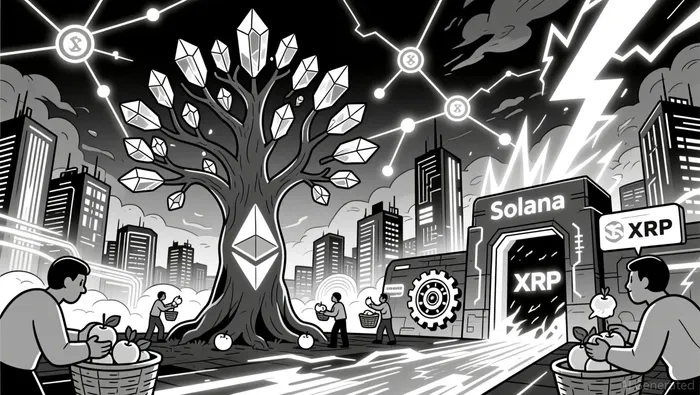
Strategic Implications: Rebalancing for a New Era
The 2025 inflow shift presents a compelling case for investors to rebalance their crypto portfolios. While Bitcoin remains a critical asset, its declining dominance and heightened volatility necessitate a more diversified approach. Ethereum's institutional-grade infrastructure and stablecoin dominance position it as a natural hedge against Bitcoin's cyclical swings. Meanwhile, high-growth altcoins like Solana and XRP offer exposure to innovation and scalability, albeit with higher risk.
Investors should prioritize assets that align with long-term utility and adoption. Ethereum's role in DeFi and cross-chain activity, coupled with Solana's focus on high-performance smart contracts, represents a structural shift toward application-layer value creation. For those seeking higher returns, XRP's regulatory progress and network efficiency provide a compelling case, though its volatility demands cautious allocation.
Conclusion: Embracing the New Crypto Paradigm
The 2025 crypto market has entered a new paradigm, where capital is increasingly flowing toward assets with tangible utility and institutional-grade infrastructure. Bitcoin's dominance, while still significant, is being challenged by Ethereum's ecosystem depth and the innovation of high-growth altcoins. For investors, this shift offers an opportunity to diversify risk, capitalize on emerging trends, and position portfolios for sustained growth in a maturing market.
As the year closes, one thing is clear: the future of crypto lies not in a single asset, but in a diversified portfolio that balances Bitcoin's store-of-value appeal with Ethereum's utility and altcoins' innovation.






Comentarios
Aún no hay comentarios