
The 2025 Clean Energy Boom: Why Now Is the Time to Invest in Renewable Infrastructure and Grid Modernization
The global energy transition has reached a pivotal inflection point in 2025, marked by a record-breaking $2.2 trillion in clean energy investment and an 11% surge in renewable capacity. These figures, underscored by technological innovation and shifting capital flows, signal an urgent opportunity for investors to strategically position themselves in the renewable infrastructure and grid modernization sectors. As the world accelerces its departure from fossil fuels, the convergence of policy, economics, and technological advancement is reshaping energy markets-and those who act now stand to reap outsized rewards.
A Record-Breaking $2.2 Trillion in Clean Energy Investment
According to the International Energy Agency, global clean energy investment in 2025 has surged to $2.2 trillion, outpacing fossil fuel spending by a staggering margin. This represents a 2% real increase in global energy investment compared to 2024, with total energy investment reaching $3.3 trillion. The $2.2 trillion figure encompasses a broad spectrum of technologies, including renewables, nuclear, grid infrastructure, storage, low-emissions fuels, and electrification. Solar energy alone accounts for $450 billion of this total, reflecting its dominance in the clean energy landscape.
This acceleration is driven by three key factors: technological maturity, cost reductions, and robust policy support from major economies such as China, the European Union, and the United States. For instance, the U.S. added 11.7 gigawatts (GW) of clean energy capacity in the third quarter of 2025, including a record 4.7 GW in battery storage. 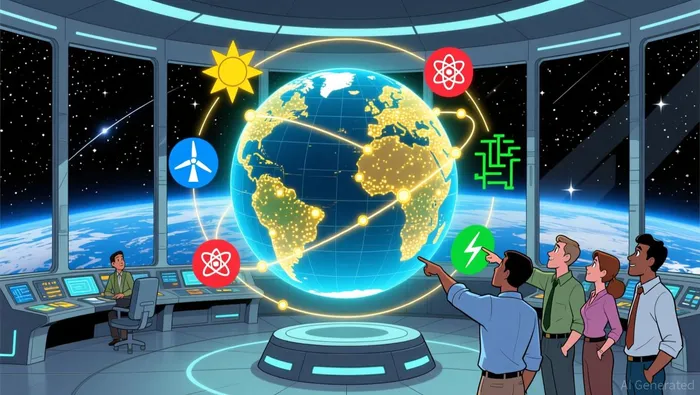 Such developments highlight the critical role of grid modernization in enabling the integration of intermittent renewable sources.
An 11% Surge in Global Renewable Capacity
The 2025 energy transition is also defined by a historic 11% increase in global renewable energy capacity, with 793 GW of new capacity added in the year. This growth, driven primarily by solar and wind (which accounted for 96.6% of net additions), underscores the world's shift toward decarbonization. China remains the largest contributor, leveraging its manufacturing scale and policy frameworks to dominate solar expansion.
This trajectory is critical for meeting global climate targets. While the current pace of growth is impressive, it still falls short of the tripling of renewable capacity required by 2030 to limit warming to 1.5°C. However, the momentum generated in 2025 suggests that the gap is narrowing-and investors who align with this trend are poised to benefit from long-term demand.
AI and Battery Innovation: The Twin Engines of Grid Resilience
The rapid advancement of artificial intelligence (AI) and battery technology is proving to be a game-changer for grid resilience and the energy transition. AI is optimizing energy systems by improving demand forecasting, grid management, and predictive maintenance. Meanwhile, battery prices have fallen by 8% in 2025, reaching record lows and making storage solutions more accessible for both electric vehicles and grid-scale applications.
These innovations are not just theoretical. In the U.S., battery storage additions hit a record 4.7 GW in Q3 2025, while global datacenter electricity use is projected to rise by 17% in 2026 due to AI expansion. Such pressures will necessitate further grid upgrades, creating a virtuous cycle of investment in infrastructure and technology.
The Capital Shift: Clean Energy Outperforms Fossil Fuels
The 2025 energy transition is also marked by a decisive shift in capital allocation. Clean energy investments now outpace fossil fuel spending by a ratio of 2:1, with $2.2 trillion directed toward renewables versus $1.1 trillion for oil, gas, and coal. This trend is driven by the cost-competitiveness of renewables: 91% of new renewable projects in 2024 were cheaper than any new fossil fuel alternatives. Solar photovoltaics (PV) were, on average, 41% cheaper than the lowest-cost fossil fuel alternatives, while onshore wind projects were 53% cheaper.
The financial markets are reflecting this reality. The electricity sector is projected to attract $1.5 trillion in investment in 2025, significantly outpacing the $1.1 trillion allocated to fossil fuels. Clean energy indices have also outperformed traditional sectors, with global renewable energy investment reaching $386 billion in the first half of 2025 alone. While regional challenges persist-such as a 36% decline in U.S. renewable investment in H1 2025 due to policy uncertainty, the global trajectory remains upward.
Strategic Positioning for the Future
For investors, the 2025 clean energy boom presents a clear imperative: act now to capitalize on the structural shift in energy markets. The convergence of record investment, technological innovation, and policy tailwinds creates a compelling case for strategic positioning in renewable infrastructure and grid modernization.
Key opportunities include:
- Solar and wind project development, particularly in emerging markets with high growth potential.
- Grid storage and smart grid technologies, which are essential for managing the intermittency of renewables.
- AI-driven energy management systems, which enhance efficiency and reduce operational costs.
- Battery manufacturing and recycling, as demand for storage solutions surges.
As the IEA notes, the energy transition is no longer a distant aspiration but an ongoing reality. For investors who recognize this shift, the next decade promises not only environmental impact but also substantial financial returns.







Comentarios
Aún no hay comentarios