
The 2025 Auto Recall Crisis: What It Means for EV and Traditional Automaker Stocks?
The 2025 auto recall crisis has exposed stark divergences between electric vehicle (EV) and traditional automakers, reshaping investor perceptions of reliability, innovation risks, and long-term value. As the industry grapples with the fallout, the crisis underscores a critical question: Can automakers balance technological ambition with safety and quality, or will the growing complexity of modern vehicles erode consumer trust and stock valuations?
Divergent Recall Patterns: EVs vs. Traditional Vehicles
The recall landscape in 2025 reveals a technological divide. For EVs, recalls were predominantly tied to battery systems, software malfunctions, and high-capacity lithium-ion components, with risks like thermal runaway and fires dominating concerns according to recent reports. TeslaTSLA--, for instance, addressed nearly 5.8 million vehicles through over-the-air (OTA) software updates, a hallmark of EVs' digital-first approach. Meanwhile, traditional automakers faced issues in braking systems, fuel delivery, and electronics, with Ford alone recalling over 5 million vehicles in Q3 2025 due to rearview camera failures, cracked fuel injectors, and display malfunctions.
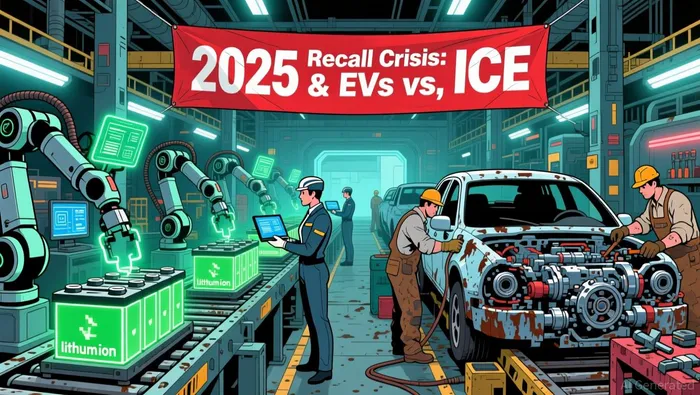 The repair dynamics further highlight this divergence. EVs, with their reliance on proprietary OEM parts, saw 85% of collision repairs depend on original equipment, compared to 62% for internal combustion engine (ICE) vehicles according to industry analysis. This not only inflates repair costs but also signals a systemic challenge: the limited availability of aftermarket solutions for EVs. Traditional automakers, by contrast, continue to leverage mature supply chains and modular designs, which may offer cost advantages in addressing recalls.
Stock Market Reactions and Investor Sentiment
The crisis has had uneven effects on stock performance. Ford, which incurred a $1.3 billion operating loss in its EV segment in Q2 2025 and projects a total EV loss exceeding $5 billion for the year, has seen its valuation pressured by recurring recalls and financial setbacks. Conversely, traditional automakers like General MotorsGM-- (GM) have shown resilience, with GM projected to lead 2025 new-vehicle sales and capture a 17.3% market share.
Investor sentiment for EVs has also cooled. EV retail sales in November 2025 dropped to 6% of total new vehicle sales, down from 12.9% in September, reflecting waning consumer confidence. The expiration of federal EV tax credits and rising concerns about range anxiety, charging infrastructure, and battery costs have further dampened enthusiasm according to research. In contrast, ICE vehicles are expected to reclaim 77.5% of November 2025 retail sales according to industry data, signaling a temporary retreat from EV adoption.
Long-Term Reliability Perceptions and Innovation Risks
The 2025 crisis has intensified scrutiny of long-term reliability. J.D. Power's 2025 U.S. Vehicle Dependability Study reported a 6% increase in problems per 100 vehicles (PP100) compared to 2024, with software-related defects-particularly in Android Auto and Apple CarPlay connectivity-emerging as a key concern. For EVs, the reliance on complex software systems amplifies the risk of systemic failures, as seen in Rivian's recall of 35,000 electric delivery vans due to seat belt pretensioner cable damage according to safety data.
Traditional automakers, while not immune to software challenges e.g., Chrysler's hybrid battery recall, face a different innovation risk: the struggle to integrate agile software development with legacy engineering practices. As one expert notes, "Silicon Valley isn't the future, Detroit isn't the past. They're both part of the winning strategy going forward" according to industry analysis. This cultural and technical divide could hinder traditional automakers' ability to compete in a software-defined era.
Strategies for Mitigating Risks and Sustaining Innovation
To navigate these challenges, automakers must adopt hybrid strategies. Predictive risk modeling and machine learning can help identify potential defects early, reducing recall costs and reputational damage according to industry experts. Cross-functional crisis teams-combining supply chain, engineering, and communications expertise-are also critical for rapid, transparent recall responses according to supply chain analysis.
For EVs, the industry must address technical debt from outdated code and fragmented development practices, which now consume over 20% of developmental budgets according to industry research. Meanwhile, traditional automakers must accelerate their software capabilities to avoid obsolescence. Blockchain-based product lifecycle management and partnerships with tech firms could enhance traceability and innovation agility according to supply chain experts.
Investment Implications
The 2025 recall crisis serves as a cautionary tale for investors. EV stocks, while still promising, face heightened risks from software complexity, battery safety, and consumer hesitancy. Traditional automakers, though benefiting from short-term demand for ICE vehicles, must prove their ability to adapt to software-driven innovation.
Investors should prioritize companies that demonstrate a balanced approach: those leveraging OTA updates and predictive analytics to enhance reliability while maintaining robust supply chains. For example, Tesla's OTA capabilities according to industry reports and GM's hybrid expansion according to market analysis highlight potential pathways for sustainable growth. Conversely, automakers with fragmented strategies-like Ford's struggling EV segment according to financial analysis-may face prolonged headwinds.
In the long term, the automotive sector's success will hinge on its ability to reconcile innovation with safety. As the industry transitions from mechanical to digital, the winners will be those who treat software not as an afterthought but as the foundation of a resilient, customer-centric ecosystem.







Comentarios
Aún no hay comentarios