
The 2025 Altcoin Surge: A Paradigm Shift in Digital Asset Allocations
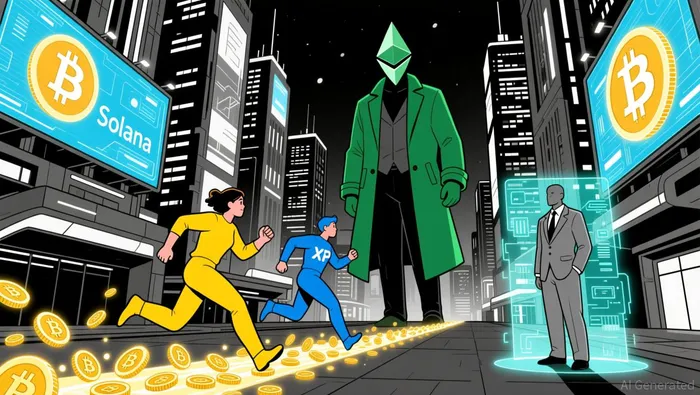
The year 2025 has cemented itself as a watershed moment in the evolution of digital asset allocations. For years, BitcoinBTC-- dominated institutional and retail portfolios as the de facto "digital gold." But 2025's explosive altcoin inflows-driven by EthereumETH--, SolanaSOL--, and XRP-signal a broader, more nuanced shift: digital assets are no longer a speculative niche but a foundational pillar of global finance. This transformation is not just about market share; it's about institutional validation, regulatory clarity, and the redefinition of what constitutes "safe" and "productive" capital.
Altcoin Inflows: Beyond Bitcoin's Shadow
Ethereum led the charge in 2025, attracting $12.7 billion in inflows-a 138% year-on-year surge. Solana's $3.6 billion influx (up 1000%) and XRP's 500% jump to $3.7 billion underscored a growing appetite for altcoins with real-world utility. These figures contrast sharply with Bitcoin's relative stagnation, which underperformed other crypto segments during Q3 2025. The data is clear: investors are no longer conflating "crypto" with Bitcoin alone. They're now evaluating the ecosystem's full spectrum, prioritizing innovation, scalability, and use cases over brand recognition.
This shift is underpinned by regulatory progress. The U.S. SEC's softened stance and the EU's MiCA framework have created a legal bedrock for altcoins to thrive. For the first time, institutions can allocate capital to Ethereum-based DeFi protocols or Solana-powered smart contracts without fear of regulatory ambiguity. As one industry analyst noted, "2025's altcoin dominance isn't a fad-it's a response to a maturing infrastructure that supports programmable finance and tokenized assets."
Institutional Adoption: From Skepticism to Strategic Allocation
Institutions are now treating digital assets as a parallel financial infrastructure, not a speculative add-on. By 2025, 35% of institutional portfolios allocated 1%-5% to digital assets, with hedge funds and private equity firms pushing allocations beyond 5%. This isn't just about Bitcoin ETFs which saw $21 billion in net inflows; it's about diversification across altcoins, stablecoins, and tokenized real-world assets.
Case studies highlight this trend. AAVEAAVE--, the DeFi lending protocol, now boasts a $24.4 billion total value locked (TVL) across 13 blockchains, with institutions leveraging its yield-generating capabilities. Similarly, Base-Coinbase's LayerLAYER-- 2 solution-captured 43.5% of the $11.36 billion TVL market, driven by its fiat bridge infrastructure and institutional-grade security. These platforms aren't just experiments; they're operational tools for managing liquidity.
Risk management has also evolved. Institutions now deploy advanced tools like Value-at-Risk (VaR) and correlation matrices to balance exposure. For example, Standard Chartered's partnership with FalconX and Citigroup's collaboration with CoinbaseCOIN-- reflect a strategic move to integrate crypto into traditional workflows. The message is clear: digital assets are no longer a side bet-they're a core component of institutional portfolios.
The Bigger Picture: A New Financial Paradigm
The 2025 altcoin surge isn't just about numbers; it's about redefining financial infrastructure. Tokenization is enabling institutions to tokenize real estate, art, and even sovereign debt, while stablecoins are streamlining global payments. Meanwhile, central banks and sovereign wealth funds are quietly exploring digital asset reserves signaling a potential shift in how nations manage liquidity.
Critics argue that altcoin volatility remains a risk, but 2025's data tells a different story. With Ethereum's inflows outpacing Bitcoin's and Solana's infrastructure gains attracting blue-chip investors, the market is voting for a multi-coin future. As one institutional investor put it, "The next decade won't be about picking the 'best' blockchain-it'll be about building ecosystems that work together."
Conclusion
2025's altcoin dominance is a harbinger of a new era. Regulatory clarity, institutional infrastructure, and technological innovation have converged to create a self-sustaining digital asset ecosystem. For investors, this means moving beyond Bitcoin-centric thinking and embracing a diversified, utility-driven approach. The paradigm shift is here-and it's being led by altcoins.





Comentarios
Aún no hay comentarios