
The 2025 Altcoin Rotation: Unlocking Value in Undervalued Layer-1 Blockchains Post-Cardano and TRON Slump
The 2025 crypto market has entered a new phase of altcoin rotation, driven by the maturation of blockchain infrastructure and the recalibration of investor sentiment post-Cardano and TRONTRX-- slumps. As the sector shifts from speculative hype to utility-driven adoption, layer-1 blockchains are emerging as critical infrastructure for decentralized finance (DeFi), tokenized assets, and cross-border payments. This analysis identifies undervalued layer-1 projects-XRP, SUISUI--, Apertum, BNBBNB--, CardanoADA--, and TRON-by dissecting on-chain metrics, adoption trends, and market sentiment to pinpoint strategic entry points and long-term upside.
The Post-Cardano/Tron Landscape: A New Era of Layer-1 Competition
Cardano and TRON, once dominant layer-1 contenders, have faced headwinds in 2025. Cardano, trading between $0.84 and $0.87, struggles to maintain support at $0.85 despite a $71 million scaling fund and inclusion in the Nasdaq Crypto Index, according to an Intellectia analysis. TRON, meanwhile, trades in a narrow range ($0.343–$0.351) but retains dominance in USDTUSDT-- transactions, processing 60% of the stablecoin's volume per the same analysis. These slumps have created a vacuum, allowing newer and more innovative layer-1s to gain traction.
XRP: Regulatory Clarity and Institutional Adoption
Ripple's XRPXRP-- has emerged as a post-SEC settlement success story. The $125 million settlement in August 2025 resolved regulatory uncertainty, enabling XRP to attract institutional investors and whale accumulation of over 50 million tokens, per the Intellectia analysis. On-chain metrics show XRP processing 70 million monthly transactions, with RLUSD-a Ripple-backed stablecoin-reaching $600 million in circulation per the same reporting. Despite a 2.23% 24-hour price increase to $2.29, XRP's fundamentals suggest a long-term bullish case: its role in cross-border payments and institutional ETF inflows ($2 billion in Q4 2025) position it as a foundational asset, according to XRP statistics.
SUI: Scalability and Developer-Centric Innovation
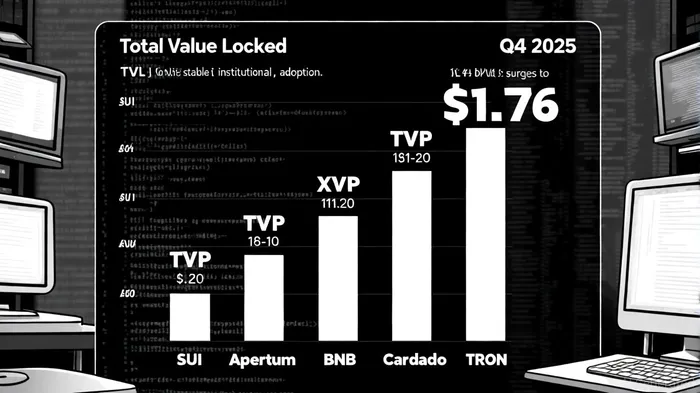
SUI, built on a Move-based object-centric model, has demonstrated exceptional scalability, processing 125,000 transactions per second, as highlighted in a BlockNews roundup. Its TVL surged to $1.76 billion in Q2 2025, driven by decentralized exchanges like Cetus ProtocolCETUS-- and Turbos Finance, according to Stakin on-chain data. However, SUI's price ($3.51) lags behind its fundamentals, creating a compelling risk-reward asymmetry. The network's 7.34 billion transactions in November 2024 and partnerships with Circle (USDC integration) underscore its potential to dominate consumer-facing dApps and Web3 gaming (Stakin on-chain data).
Apertum: Avalanche's Fastest-Growing Subnet
Launched in January 2025 as an EVM-compatible subnet on AvalancheAVAX--, Apertum has exploded in adoption. By Q3 2025, it processed 1.5 million transactions, with 50,000 active wallets and 530+ smart contracts deployed, according to a Blockonomi report. The $APTM token, which surged from $0.025 to $2.20 in April 2025, reflects strong retail and institutional demand. Apertum's DAO-driven model and focus on enterprise partnerships (e.g., liquidity solutions for tokenized assets) make it a high-conviction play for 2025's altcoin rotation (Blockonomi report).
BNB Chain: Resilience and Liquidity Expansion
BNB Chain's 7% daily price increase in Q4 2025 is supported by a 58% year-to-date surge in stablecoin supply, driven by B Strategy's $1 billion reserve plan, per the Intellectia analysis. The chain's DeFi TVL ($4.7 billion) and memecoinMEME-- activity (e.g., TRUMPTRUMP-- token) highlight its adaptability. BNB's institutional adoption, including its role in cross-chain bridges and enterprise solutions, ensures its relevance in the layer-1 war (BlockNews roundup).
Cardano and TRON: Rebuilding for the Long Game
Cardano's Plomin and Hydra upgrades have boosted throughput to 1,000 TPS, positioning it for AI-powered dApps and real-world asset tokenization, as discussed in the Intellectia analysis. Despite a $0.85 support level struggle, its inclusion in the Nasdaq Crypto Index and $71 million scaling fund signal institutional confidence. TRON, meanwhile, leverages its 60% USDT transaction dominance and Beacon Network compliance infrastructure to maintain relevance, with MetaMask integration unlocking access to 100 million users (Intellectia analysis).
Strategic Entry Points and Long-Term Projections
- XRP: Buy on dips near $2.00 support, with a target of $2.50 as institutional adoption accelerates (Intellectia analysis).
- SUI: Accumulate during volatility near $4.40 support, with a long-term target of $5.36 (its January 2025 ATH) (Stakin on-chain data).
- Apertum: Early-stage entry for $APTM, given its 31.3% circulating market cap growth and ecosystem expansion (Blockonomi report).
- BNB: Position for stablecoin-driven liquidity expansion and memecoin-driven TVL growth (BlockNews roundup).
- Cardano/TRON: Long-term holds for institutional upgrades and stablecoin dominance, respectively (Intellectia analysis).
Conclusion
The post-Cardano/Tron slump has created a fertile ground for undervalued layer-1 blockchains to thrive. XRP's regulatory clarity, SUI's scalability, Apertum's rapid adoption, and BNB's liquidity resilience form a diversified portfolio for investors seeking exposure to the next phase of crypto's evolution. As the sector matures, layer-1s with strong fundamentals and real-world utility will outperform, rewarding those who act decisively.





Comentarios
Aún no hay comentarios