
The $20 Billion Onchain Fee Shift: Crypto's Transition to Sustainable Financial Infrastructure
DeFi's Dominance in the Onchain Economy
DeFi protocols now account for 63% of onchain fees, outpacing even traditional financial systems in efficiency and user-driven monetization, according to a Yahoo Finance report. This growth is fueled by a 126% year-over-year increase in application usage, driven by plummeting transaction costs (down 90% from 2021 levels) and scalable infrastructure, as noted in a FinanceFeeds report. The result? A $20 billion economic engine where protocols generate revenue through actual utility-lending, trading, and staking-rather than speculative token issuance.
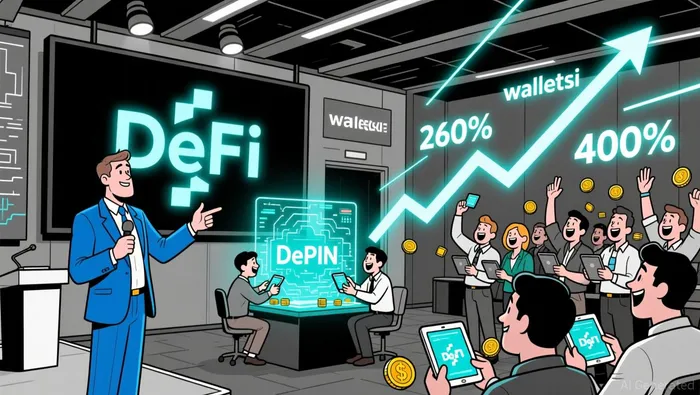
Emerging verticals like DePIN (Decentralized Physical Infrastructure Networks) and crypto wallets are amplifying this trend. Wallet revenue, for instance, has grown 260% year-over-year, while DePIN revenue surged 400%, reflecting a broader shift toward blockchain-powered real-world applications, as noted in the Yahoo Finance report.
Case Studies: Protocols Leading the Charge
Uniswap: Fee Switch and Token Burn Mechanisms
Uniswap's UNIfication proposal is a landmark in DeFi's evolution. By redirecting trading fees (0.05%–1%) to UNIUNI-- token holders and implementing a perpetual token burn, the protocol is aligning incentives with long-term value creation. As of late 2025, Uniswap v3 alone had accumulated $2.5 billion in cumulative fees, with proposed splits allocating 25–50% to burns, 30% to incentives, and the remainder to holders, according to a Coinotag analysis. This model, if executed, could boost UNI's market cap by 20–30%, according to the same analysis.
Aave: Buybacks and Institutional Integration
Aave's strategy combines deflationary tokenomics with institutional-grade infrastructure. A $50 million buyback program has repurchased 94 million AAVE tokens since May 2025, creating deflationary pressure, as noted in a Coinotag analysis. Meanwhile, Aave Labs' acquisition of Stable Finance aims to simplify onchain savings for retail users, expanding its consumer-facing footprint, as reported by CoinDesk. These moves signal a focus on balancing token economics with mainstream adoption.
Curve Finance: Precision in Fee Distribution
Curve Finance's fee model is a masterclass in efficiency. Trading fees and interest rate fees from crvUSD markets are aggregated, burned via CoWSwap's conditional orders, and distributed to veCRV holders, as described in the Curve documentation. This system, operational on EthereumETH-- and GnosisGNO-- Chain, ensures liquidity providers are rewarded while minimizing slippage-a critical edge in stablecoin trading.
Market Dynamics and Challenges
While the top 20 protocols capture 70% of onchain revenue, this concentration raises decentralization concerns, as noted in a 1kx report. However, the same report notes that new protocols can disrupt incumbents rapidly, thanks to blockchain's inherent agility. Regulatory clarity-such as the U.S. SEC's post-Gensler shift-has also reduced legal uncertainties, enabling protocols to focus on innovation, as noted in the Coinotag analysis.
Institutional interest is another tailwind. Platforms like CompoundCOMP-- are integrating with RoninRON-- (a gaming-focused chain) to tap into new liquidity pools. Meanwhile, Coinbase's USDCUSDC-- Bootstrap Fund indirectly benefits DeFi by expanding stablecoin usage.
The Road Ahead: From Speculation to Sustainability
The $20 billion onchain fee shift is more than a milestone-it's a validation of DeFi's potential to rival traditional finance. Protocols that prioritize usage-based revenue, transparent tokenomics, and institutional partnerships will dominate the next phase. However, investors must remain cautious: bearish market conditions could pressure tokens like Aave, which faces a potential 15% drop if seller dominance persists, as noted in the Coinotag analysis.
For now, the data is clear: crypto's financial infrastructure is no longer a speculative experiment. It's a $20 billion reality.





Comentarios
Aún no hay comentarios