
Is 20,000 XRP Enough for Long-Term Financial Freedom? A Realistic Crypto Investment Analysis
In the ever-evolving landscape of cryptocurrency, the question of whether a specific asset allocation can lead to long-term financial freedom is both tantalizing and complex. For investors holding 20,000 XRPXRP--, the token's current valuation, projected growth, and role in a diversified portfolio must be scrutinized through the lens of investment realism. This analysis examines whether 20,000 XRP-valued at approximately $37,200 as of December 29, 2025 according to Yahoo Finance-can realistically serve as a cornerstone for financial independence, while addressing the inherent risks and opportunities in the crypto space.
Current Valuation and Immediate Prospects
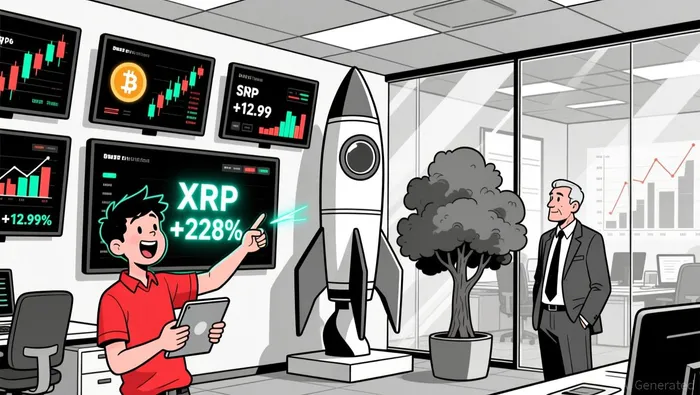
As of late December 2025, XRP traded within a narrow range of $1.84 to $1.91, with a closing price of $1.8477 as reported by YCharts. While this represents a modest valuation compared to historical peaks, it underscores the token's stability in a market often characterized by volatility. For context, a $1,000 investment in XRP over the past five years has yielded a 228% return, outperforming the S&P 500's 12.99% average annual return. However, such performance is not guaranteed, and the token's future hinges on macroeconomic conditions, regulatory clarity, and institutional adoption.
Long-Term Price Projections and Utility-Driven Growth
Analysts project XRP's price trajectory from 2025 to 2035 to range between $2.05 and $25, depending on adoption rates and technological advancements. Conservative estimates suggest a 2025 average price of $3.10 and a 2030 target of $5.00 according to financial projections, while bullish scenarios envision $12–$25 by 2030, driven by Ripple's partnerships and integration into CBDC systems as reported by Changelly. These projections are rooted in XRP's utility as a bridge asset for cross-border payments, a use case already adopted by major financial institutions via RippleNet as noted in financial reports.
However, the token's growth is not without challenges. Competition from stablecoins and SWIFT alternatives, coupled with regulatory uncertainties, could cap its potential. For instance, if adoption stagnates or newer technologies displace XRP's role in liquidity solutions, its long-term price trajectory may remain muted according to market analysis.
Diversification and Portfolio Allocation
A key tenet of investment realism is diversification. Institutional strategies in 2025 often allocate 60–70% of portfolios to core assets like BitcoinBTC-- and EthereumETH--, with 20–30% in high-growth altcoins such as XRP. For 20,000 XRP to contribute meaningfully to financial freedom, it must be part of a broader strategy that balances risk and reward.
Advanced tactics-such as dollar-cost averaging, dynamic rebalancing, and hedging with stablecoins-can mitigate volatility. For example, pairing XRP with USDC or USDT during bearish cycles can preserve capital while maintaining exposure to growth opportunities. Additionally, XRP futures and tokenized real-world assets (RWAs) offer tools to optimize capital efficiency and diversify return sources as recommended by portfolio experts.
Financial Freedom Thresholds and XRP's Role
The FIRE (Financial Independence, Retire Early) movement's 25x rule posits that a portfolio must equal 25 times annual expenses to sustain a 4% withdrawal rate adjusted for inflation as defined by Investopedia. For a $77,280 annual expense target, this requires $1.93 million in savings as calculated by financial experts. At current prices, 20,000 XRP contributes roughly 1.9% to this threshold. However, if XRP reaches $25 by 2030, its value would surge to $500,000, representing 26% of the required portfolio as projected by market analysts.
This scenario, while optimistic, hinges on XRP's ability to scale adoption and maintain its utility. A more conservative approach, such as the 33x rule (3% withdrawal rate), would require $2.58 million in savings as detailed in financial planning resources. Even in this case, XRP's projected growth could position it as a significant, though not sole, component of a diversified portfolio.
Risk Mitigation and Realistic Expectations
Investment realism demands acknowledging XRP's risks. Its volatility-evidenced by a 5.89% standard deviation in daily returns according to portfolio analysis-necessitates caution. Regulatory actions, macroeconomic shifts, and technological obsolescence could erode value. For instance, if XRP's price stagnates at $1.85, 20,000 XRP would remain a minor asset, insufficient to drive financial freedom without complementary investments.
Moreover, safe withdrawal rates for retirement portfolios in 2025 average 3.9%, with flexible strategies pushing this to 5.7%. While XRP's asymmetric upside could enhance portfolio resilience, its inclusion should not compromise liquidity or stability. A balanced approach-combining XRP with traditional assets and hedging instruments-is critical.
Conclusion: A Realistic Path Forward
Is 20,000 XRP enough for long-term financial freedom? The answer lies in context. At current valuations, it is a modest asset that requires strategic diversification and disciplined risk management. If XRP achieves its upper price projections, it could become a transformative component of a financial independence strategy. However, relying solely on its growth potential is unrealistic.
Investors must adopt a SMART framework-setting specific, measurable, and time-bound goals-while remaining adaptable to market dynamics as advised by financial experts. For 20,000 XRP to contribute meaningfully, it must be part of a diversified portfolio that balances high-growth crypto assets with stable, income-generating instruments. In the end, financial freedom in the crypto era demands not just optimism, but rigor, adaptability, and a clear-eyed assessment of both risks and rewards.






Comentarios
Aún no hay comentarios