
Can a $2,000 Stake in Ethereum Multiply to $10,000 by 2030? A Deep Dive into Ethereum's Future
As of July 7, 2025, EthereumETH-- (ETH) trades at $2,553, with a market cap exceeding $3 trillion. The question of whether a $2,000 investment could grow to $10,000 by 2030 hinges on Ethereum's ability to capitalize on technological upgrades, maintain market dominance, and navigate regulatory hurdles. Let's dissect the case for long-term growth—and the risks involved.
1. Ethereum's Technological Evolution: A Foundation for Scalability
Ethereum's journey from a proof-of-work (PoW) blockchain to a proof-of-stake (PoS) network via The Merge (2022) marked a pivotal shift. This transition reduced energy consumption by 99.95% and laid the groundwork for future upgrades.
Key Upgrades to Watch:
- The Surge (Layer-2 Rollups & Danksharding): By enabling 100,000+ transactions per second, Ethereum aims to rival competitors like SolanaSOL--. The Danksharding protocol, part of the Surge, reduces data storage costs, while zero-knowledge (ZK) rollups (e.g., zkSync) offload processing to cheaper, faster sidechains.
- The Verge (Statelessness & Verkle Trees): Replacing Merkle Trees with Verkle Trees could shrink node storage requirements by ~90%, making Ethereum more accessible.
- The Purge (EIP-4444): Nodes will discard historical data older than one year, reducing infrastructure costs and accelerating sync times.
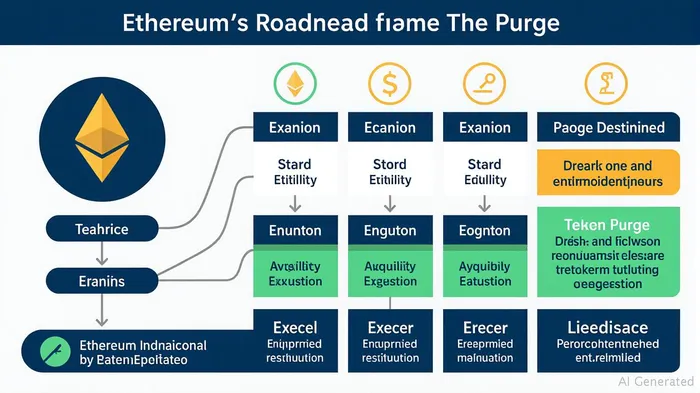
These upgrades address Ethereum's historical bottleneck—slow transaction speeds and high fees—and position it to support mass adoption.
2. Market Dominance: Ecosystem Strength vs. Rivals
Ethereum's ecosystem remains unparalleled. It hosts 50% of DeFi's total value locked (TVL), powers 80% of NFTs, and boasts partnerships with enterprises like MicrosoftMSFT-- and JPMorganJPM--. While competitors like Solana and CardanoADA-- offer faster speeds, Ethereum's network effects—a vast developer base, institutional trust, and cross-chain interoperability—are irreplaceable.
Competitor Comparison:
- Solana: Processes 50,000 TPS but faces network outages. Its DeFi TVL is a fraction of Ethereum's.
- Cardano: Focuses on sustainability and enterprise solutions but lags in ecosystem maturity.
- Polygon: A Layer-2 solution for Ethereum, not a direct competitor, but a complementary tool to reduce fees.
Ethereum's first-mover advantage in smart contracts and NFTs ensures it remains the backbone of decentralized finance.
3. Regulatory Developments: A Double-Edged Sword
The crypto regulatory landscape is evolving, with mixed implications for Ethereum:
- Positive Trends: The EU's MiCA framework (2023) grants legal clarity for staking and DeFi, while the U.S. SEC's incremental approvals (e.g., ETFs) signal mainstream acceptance.
- Risks: U.S. regulatory uncertainty, including potential crackdowns on unregistered tokens, could pressure prices.
Ethereum's shift to PoS has also improved its environmental profile, aligning with global ESG goals and reducing regulatory friction compared to energy-intensive blockchains like BitcoinBTC--.
4. Risks and Challenges
- Volatility: Crypto markets are prone to swings, as seen during the 2022 bear market when Ethereum fell from $4,800 to $1,050.
- Technical Hurdles: Upgrades like Danksharding (2024) must execute flawlessly to avoid delays.
- Competitor Innovation: Solana's PeerDAS and Cardano's Hydra could erode Ethereum's edge.
5. The Case for a $10,000 Return by 2030
To grow $2,000 to $10,000 by 2030, Ethereum's price would need to hit $33,000—a 12.9x increase over five years. While ambitious, this aligns with projections:
- Technical Upgrades: Scalability improvements could boost adoption, driving demand.
- Institutional Inflow: Ethereum's ETFs and staking platforms may attract pension funds and corporations.
- Bullish Projections: Analysts suggest Ethereum could reach $35,000 by 2030, fueled by enterprise use cases and regulatory clarity.
Required CAGR: A 37.9% annualized return from $2,553 to $33,000 is aggressive but plausible if Ethereum captures 50% of the $11.7B crypto market (per 2030 projections).
Investment Strategy: A Balanced Approach
- Dollar-Cost Average: Mitigate volatility by investing small amounts monthly.
- HODL for the Long Term: Ethereum's fundamentals justify a multi-year hold, especially if upgrades succeed.
- Monitor Regulatory Milestones: Track MiCA implementation and U.S. regulatory developments.
Conclusion: Ethereum's Future is Bright, but Not Risk-Free
A $2,000 stake turning into $10,000 by 2030 is far from guaranteed. However, Ethereum's technological roadmap, ecosystem dominance, and sustainability shifts make it a compelling long-term bet. Investors should weigh risks—technical execution, regulatory headwinds, and competition—but recognize that Ethereum's position as the DeFi and NFT leader could amplify returns if adoption accelerates.
For those with a high-risk tolerance and a 5+ year horizon, Ethereum is a strategic play for crypto exposure. Proceed with caution, but do not overlook its potential.






Comentarios
Aún no hay comentarios