
H-1B Visas and U.S. Tech Sector Productivity: A Strategic Investment Analysis
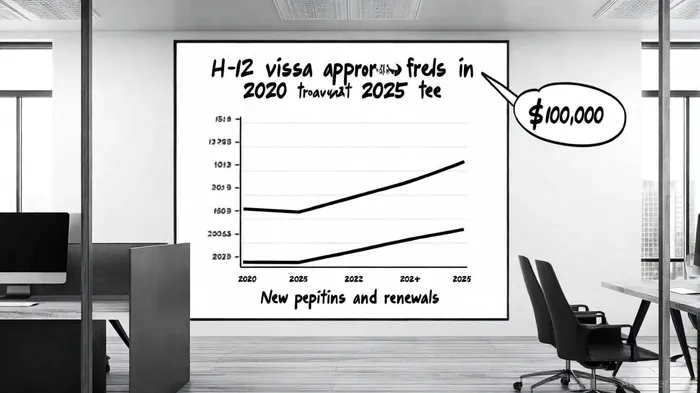
The U.S. tech sector's reliance on H-1B visa holders has become a cornerstone of its innovation-driven economy. In fiscal year 2024, nearly 400,000 H-1B applications were approved, with the majority representing renewals and extensions rather than new hires [1]. This trend underscores the program's role in maintaining workforce continuity, particularly for companies like AmazonAMZN--, MicrosoftMSFT--, and GoogleGOOGL--, which collectively sponsored over 21,000 beneficiaries in 2025 alone [2]. However, recent policy shifts, including a $100,000 annual fee for new petitions, are reshaping capital allocation strategies and long-term R&D investment decisions in the sector.
The Economic and Productive Impact of H-1B Visa Holders
H-1B visa holders contribute significantly to U.S. economic growth and productivity. According to a report by the U.S. Department of Labor, these workers fill critical roles in software development, AI, and cybersecurity, accounting for over 70% of H-1B approvals [3]. Their economic impact extends beyond wages: they generate over $85 billion annually in income taxes and inject tens of billions into local economies through consumer spending [4]. For every H-1B visa issued, studies suggest an average of 1.83 additional jobs are created for U.S. workers over seven years, highlighting a multiplier effect that bolsters domestic employment [4].
Moreover, H-1B visa holders drive innovation. Tech leaders like Sundar Pichai (Google) and Satya Nadella (Microsoft) began their careers under the program, and their contributions have spurred the creation of millions of jobs and billions in economic value [4]. Research indicates that firms with access to high-skill STEM workers are more likely to innovate and capture global market share, reinforcing the link between immigration and R&D competitiveness [5].
Policy Shifts and Their Impact on R&D Investment
The 2025 introduction of a $100,000 fee for new H-1B petitions has disrupted corporate R&D strategies. For large firms like Microsoft, which filed 5,189 petitions in 2025, this translates to an additional $415,120 in annual costs [6]. Smaller startups, however, face existential challenges: many lack the capital to absorb such fees, forcing them to prioritize visa renewals or pivot to automation and offshore operations [7]. This shift risks slowing innovation in emerging fields like AI and cybersecurity, where U.S. leadership is critical [6].
Data from the National Science Foundation reveals that nonmanufacturing industries, including IT, accounted for 70% of R&D growth between 2018 and 2022 [8]. Yet restrictive immigration policies threaten this momentum by limiting access to global talent. A study of multinational enterprises (MNEs) found that a threefold reduction in H-1B visas in 2004 led to a 4.7% increase in global dispersion of inventor networks and a 4.15% decline in patenting output [9]. These findings suggest that policy-driven talent shortages could erode the U.S.'s competitive edge in innovation.
Capital Reallocation and Global Talent Competition
The financial burden of the new H-1B fee is accelerating capital reallocation. Indian IT firms, which supply 75% of H-1B workers, are shifting operations to offshore hubs in India, Mexico, and the Philippines [10]. Meanwhile, European tech hubs like Amsterdam and Lisbon are capitalizing on U.S. uncertainty, offering lower corporate tax rates and streamlined immigration processes to attract talent and investment [10].
For U.S. firms, the cost of inaction is high. A 6.6% increase in labor investment efficiency has been observed for every 1% rise in H-1B approval chances, demonstrating the program's value in optimizing hiring for innovation-driven sectors [11]. Conversely, restrictive policies may push companies to redirect R&D budgets toward automation or offshore R&D centers, diminishing domestic returns on investment [12].
Strategic Implications for Investors
Investors must weigh these dynamics when evaluating tech sector opportunities. Firms with diversified talent strategies—such as leveraging cap-exempt visas or investing in domestic STEM education—may mitigate the risks of policy volatility. Conversely, startups reliant on H-1B talent could face funding challenges, particularly if venture capital shifts toward markets with more favorable immigration policies [10].
The Biden administration's recent efforts to streamline AI talent pathways, including updating the Schedule A list to include AI roles, offer a counterbalance to restrictive policies [13]. However, long-term stability will depend on resolving the tension between protecting domestic workers and preserving access to global talent.
Conclusion
The H-1B visa program remains a linchpin of U.S. tech sector productivity, but its future is increasingly contingent on policy decisions. While the program has historically fueled innovation and economic growth, recent restrictions risk stifling R&D investment and ceding global competitiveness. For investors, the key lies in identifying firms that can adapt to evolving immigration landscapes while maintaining their innovation pipelines. As the sector navigates these challenges, the interplay between immigration policy, capital allocation, and long-term growth will remain a critical focal point.





Comentarios
Aún no hay comentarios