
The '1011 Insider Whale' BTC Deposit and Its Implications for Institutional Adoption of Bitcoin
Whale Activity as a Dual-Edged Sword
The 1011 Insider Whale's actions exemplify how large on-chain movements can amplify short-term volatility. By depositing a test 0.01 BTC to Binance at 00:55 UTC and following it with a full 3,003 BTC deposit at 01:17 UTC, the whale signaled aggressive shorting intent, as reported by TheBlockBeats. This aligns with broader trends where institutional investors monitor whale wallets to anticipate liquidity shifts. However, as noted by on-chain analysts, not all whale activity equates to selling pressure. For instance, the 1011 Whale also expanded its EthereumETH-- long position to $132 million and added a BTC long position of 80 BTC, suggesting a diversified, leveraged strategy, per a CoinOTag report.
Institutional investors must distinguish between noise (e.g., short-term whale-driven volatility) and structural signals (e.g., sustained ETF inflows). A key insight from recent market dynamics is that whale movements often reflect tactical positioning rather than long-term conviction. For example, the 1011 Whale's $5.8 million floating profit on its BTC short position indicates a calculated bet on near-term price weakness, not a permanent exit from Bitcoin, according to a CoinOTag update.
Institutional Strategies: Balancing Whale Noise and Structural Demand
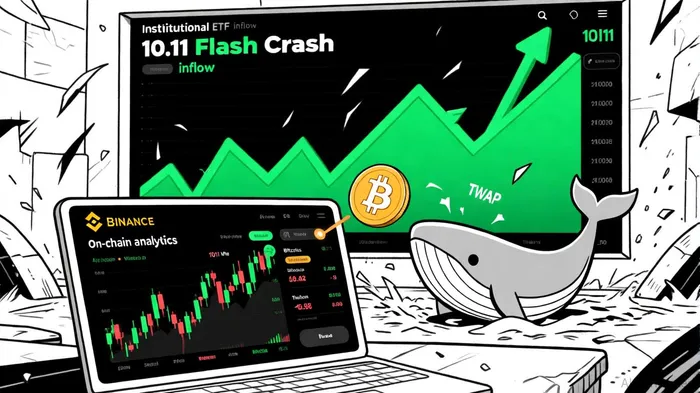
The surge in institutional Bitcoin adoption-exemplified by spot ETFs and corporate treasury allocations-has fundamentally altered market dynamics. In 2025, institutions acquired 944,330 BTC, surpassing miner production by over 7×, according to a Dzilla analysis. This structural demand acts as a counterweight to whale-driven volatility. For instance, during the 10.11 Flash Crash, institutional buyers absorbed much of the downward pressure, preventing a cascading sell-off, as observed in broader market commentary.
Historical precedents reinforce this trend. In October 2025, dormant whale wallets reactivated, causing temporary price swings, but institutional ETF inflows offset these pressures. This underscores a critical lesson for institutional investors: whale movements should be treated as tactical signals rather than existential threats. Tools like Whale Tracker and on-chain analytics platforms such as the CryptoChartIndex guide enable institutions to differentiate between benign reorganizations (e.g., moving BTC to cold storage) and genuine liquidity risks (e.g., large deposits to exchange wallets).
Strategic Entry Points: Leveraging Whale Behavior
For institutions seeking entry points, the 1011 Whale's actions offer a case study in timing. The whale's TWAP strategy-adding to its short position during a 32-minute window-created a temporary oversupply of BTC, driving prices below $109,000, a dislocation noted by TheBlockBeats. Institutional buyers who recognized this as a short-term dislocation, rather than a bearish trend, could have capitalized on discounted entry points.
Moreover, the whale's diversified portfolio-combining BTC shorts with ETH and BTC longs-suggests a hedged approach to macro uncertainty. Institutions adopting similar strategies might allocate capital to both short and long positions, using whale activity to identify imbalances. For example, the 1011 Whale's ETH long position, with $2.1 million in unrealized gains, was highlighted by CoinOTag and reflects confidence in Ethereum's resilience amid Bitcoin's volatility.
Conclusion: Whale Activity as a Signal, Not a Signal
The 1011 Insider Whale's October 11 deposit underscores the importance of contextual analysis in institutional investing. While whale movements can trigger short-term volatility, they rarely dictate long-term trends. Structural demand from ETFs, corporate treasuries, and institutional "permanent buyers" continues to anchor Bitcoin's value, as discussed in the Dzilla analysis. For investors, the key lies in using whale activity as a tactical signal while prioritizing structural metrics-such as ETF inflows and supply dynamics-to navigate the market's evolving landscape.






Comentarios
Aún no hay comentarios