
The 1000x Crypto Play: Why Infrastructure-Driven Projects Outperform Hype-Driven Tokens in 2025
The Infrastructure-Driven Edge: Long-Term Sustainability and Technical Adoption
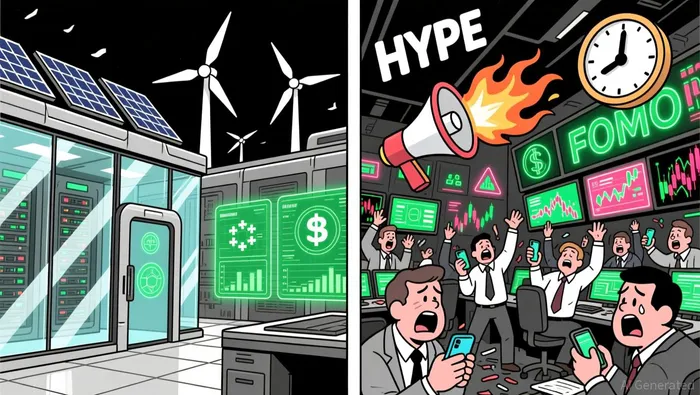
Infrastructure-driven projects are built to solve foundational problems in blockchain ecosystems. Take FY Energy, which launched its BTC Asset Management Plan in 2025. By integrating 100% renewable energy with blockchain analytics and institutional-grade security, FY Energy reduces carbon footprints while offering risk-adjusted investment strategies. This approach aligns with global ESG goals and attracts long-term capital from sustainability-focused investors.
In contrast, hype-driven tokens like PEPE (a memecoin) exemplify the risks of speculative mania. While one trader turned $2,000 into $43 million during PEPE's peak, the token's price plummeted by 74% within months, eroding most of its value. Such volatility underscores the fragility of hype-driven models, which lack technical depth or real-world utility.
Financial Performance: Institutional Adoption and Funding Trends
Infrastructure-driven projects have consistently outperformed hype-driven tokens in attracting institutional capital. Across Protocol, an EthereumETH-- crosschain interoperability platform, raised $41 million in 2025, backed by Paradigm and Coinbase Ventures. Its "intents" architecture addresses critical scalability issues, making it a cornerstone for layer-2 adoption. Similarly, Level USD, a DeFi-yielding stablecoin, grew from $2.6 million in funding to a $116 million market cap, driven by its integration with protocols like PendlePENDLE--.
Hype-driven tokens, however, struggle to retain institutional interest. A 2025 report by LKI Consulting found that 90% of high-valuation token launches saw price declines within four weeks, with 75% losing over 60% of their value. This volatility stems from poor tokenomics, lack of liquidity, and no tangible use cases.
Governance and Risk Management: The Infrastructure Advantage
Infrastructure-driven projects also excel in governance frameworks. The whitepaper Decentralized Project Delivery on the Crypto Commons highlights how 22 blockchain governance mechanisms prioritize community-driven decision-making and transparency. Projects like Chronicle, an Ethereum Oracle provider, leverage decentralized governance to tokenize real-world assets (RWAs), attracting institutional clients seeking secure, auditable infrastructure.
Hype-driven tokens, by contrast, often suffer from centralized control and poor governance. The collapse of QuadrigaCX and SushiSwapSUSHI-- in earlier years demonstrated how centralized leadership can lead to fraud or mismanagement. In 2025, institutional investors increasingly favor projects with transparent, decentralized governance models.
Real-World Utility and ESG Integration
The most promising infrastructure-driven projects are those that bridge blockchain with real-world applications. FY Energy's renewable-powered asset management plan, for instance, combines green energy with BitcoinBTC-- custody, appealing to both ESG-focused investors and institutional clients. Similarly, Validation Cloud uses AI-driven blockchain infrastructure to optimize staking and node APIs, addressing scalability challenges for major chains like HederaHBAR-- and Polygon.
Hype-driven tokens, meanwhile, often lack such integration. A 2025 study found that 53% of tokens launched since 2021 had "died," losing all utility and community engagement. These projects fail to adapt to evolving market demands or regulatory scrutiny.
Conclusion: The Path to 1000x Returns
The next 1000x crypto opportunity will likely emerge from infrastructure-driven projects that:
1. Solve real-world problems (e.g., crosschain interoperability, RWA tokenization).
2. Attract institutional capital through robust governance and technical innovation.
3. Align with ESG trends and regulatory frameworks.
While hype-driven tokens may offer short-term gains, their volatility and lack of sustainability make them poor long-term bets. For investors, the key is to identify projects like FY Energy, Across ProtocolACX--, or Level USD-those building the rails of the next crypto cycle.







Comentarios
Aún no hay comentarios