
The $1 Price Race: Mutuum Finance's Utility vs Dogecoin's Meme Momentum
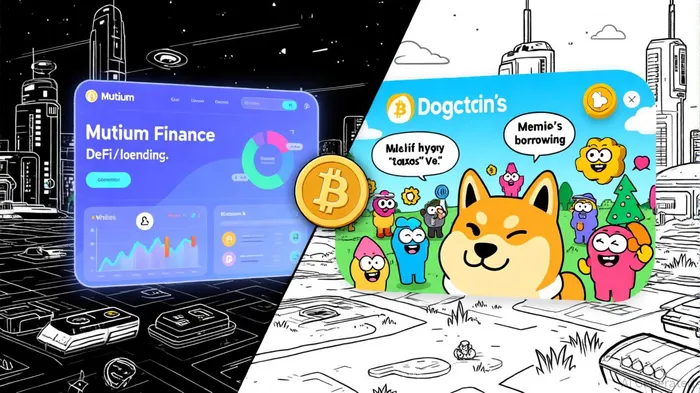
The race to reach a $1 price point has become a defining narrative in the cryptocurrency market, with projects leveraging either utility-driven innovation or meme-driven hype to capture investor attention. Two prominent contenders in this race—Mutuum Finance (MUTM) and DogecoinDOGE-- (DOGE)—represent divergent strategies. While Mutuum Finance emphasizes decentralized finance (DeFi) infrastructure and institutional-grade security, Dogecoin thrives on viral social media trends and macroeconomic speculation. This analysis examines their contrasting approaches, evaluates their growth trajectories, and assesses which model offers a more sustainable path to $1.
Mutuum Finance: Utility-Driven DeFi Innovation
Mutuum Finance (MUTM) positions itself as a utility-first project, offering decentralized lending and borrowing services through a dual-market model: Peer-to-Contract (P2C) and Peer-to-Peer (P2P). By enabling users to interact directly with liquidity pools or negotiate loans for assets like Dogecoin and PepePEPE--, Mutuum Finance bridges the gap between traditional finance and DeFi[1]. A key differentiator is its buy-and-distribute mechanism, where a portion of platform fees is used to repurchase MUTM tokens and redistribute them to stakers, reducing circulating supply and fostering demand[3].
The project's presale has raised over $16 million with more than 16,450 investors enrolled, with tokens priced at $0.035 in Phase 6[1]. Analysts project 30x returns as MUTM transitions to exchange listings, supported by a $50,000 bug bounty program and a CertiK audit[1]. Technological innovations, including a dynamic liquidity-balanced interest rate model and Chainlink oracles for asset pricing, further enhance its appeal to institutional investors[3].
Mutuum Finance's roadmap includes expanding to multiple blockchain networks and forming partnerships with traditional financial institutions, signaling a strategic shift toward mainstream adoption[1]. These developments underscore its focus on security, scalability, and long-term utility, positioning MUTM as a potential alternative to memeMEME-- coins like Shiba InuSHIB-- (SHIB) and Pepe (PEPE), which lack tangible financial tools[2].
Dogecoin: Meme-Driven Volatility and Institutional Hype
Dogecoin's price surged to $0.28 in late September 2025, driven by a combination of meme culture, celebrity endorsements, and institutional interest[2]. The upcoming launch of a U.S. Dogecoin ETF and the accumulation of 2 billion DOGEDOGE-- tokens by institutional buyers in August 2025 have amplified speculation about its potential to break $0.50[2]. Social media platforms like Twitter and Reddit remain pivotal, with viral campaigns and Elon Musk's tweets historically influencing price movements[1].
However, Dogecoin's value proposition remains largely symbolic. Unlike utility-driven tokens, DOGE lacks a hard supply cap and offers no inherent financial tools beyond its role as a speculative asset[2]. Analysts caution that its reliance on macroeconomic factors—such as Federal Reserve rate cuts—and short-term hype makes it vulnerable to volatility[2]. While DOGE's cultural significance and ETF-driven institutional adoption could propel it toward $1, its long-term sustainability remains questionable compared to projects with robust DeFi ecosystems[1].
Comparative Analysis: Sustainability and Long-Term Viability
The contrast between MUTM and DOGE highlights a broader debate in the crypto space: utility versus hype. Mutuum Finance's institutional-grade security, decentralized financial tools, and structured tokenomics create a foundation for sustained growth, even in bear markets[3]. Its buy-and-distribute model and CertiK audit address common DeFi pain points, such as security risks and token inflation, while its dual-market lending system caters to both retail and institutional users[1].
Dogecoin, by contrast, thrives on network effects and cultural relevance. Its recent price surge reflects a bullish altcoin season and macroeconomic tailwinds, but its lack of utility and infinite supply cap pose challenges for reaching $1[2]. As noted in a recent analysis, meme coins like PEPE and SHIBSHIB-- face insurmountable hurdles in achieving $1 due to their token supply structures and limited use cases[2].
Conclusion: The $1 Price Race—Which Model Wins?
While both Mutuum Finance and Dogecoin have captured investor interest in the $1 race, their underlying strategies diverge significantly. Mutuum Finance's utility-driven approach, bolstered by DeFi innovation and institutional partnerships, offers a more sustainable path to long-term value creation. Dogecoin's meme-driven momentum, though powerful in the short term, remains subject to market volatility and cultural shifts.
For investors, the choice between MUTM and DOGE hinges on risk tolerance and investment horizon. Those seeking tangible financial tools and institutional-grade security may favor Mutuum Finance, while traders capitalizing on social media trends and ETF-driven speculation might lean toward Dogecoin. As the crypto market evolves, the project that balances innovation with adoption will likely emerge as the true winner.






Comentarios
Aún no hay comentarios