
The $1.1B Bitcoin Short Squeeze: A Case Study in Predictive Trading and Tariff-Driven Volatility
The $1.1B BitcoinBTC-- Short Squeeze: A Case Study in Predictive Trading and Tariff-Driven Volatility
In the high-stakes arena of cryptocurrency trading, predictive analysis has become a critical tool for navigating macroeconomic and geopolitical risks. The summer of 2025 provided a vivid case study in this dynamic, as a $1.1 billion Bitcoin short position-established ahead of U.S. tariff announcements-collided with a surge in institutional demand and bullish macroeconomic sentiment. This event, which triggered the largest short-side wipeout of the year, underscores the interplay between strategic positioning, market timing, and exogenous shocks like trade policy shifts.
The Setup: Short Position Timing and Market Conditions
By late June 2025, Bitcoin had been trading in a consolidation phase around $81,000–$83,000, a range that attracted aggressive short sellers. The $1.1B short position, concentrated on platforms like Bybit and HTX, was established amid bearish sentiment fueled by ongoing U.S.-China trade tensions and the Trump administration's proposed tariffs, according to a Cointelegraph timeline. Analysts at the time speculated that Bitcoin could dip to $76,000–$78,000 by summer, per a CCN analysis.
However, this bearish outlook overlooked two critical factors: the rapid inflow of capital into U.S. spot Bitcoin ETFs and the Trump administration's simultaneous efforts to build a Strategic Bitcoin Reserve, as outlined in a White House fact sheet. These developments, coupled with a broader risk-on market environment, created a fragile equilibrium. Short sellers, confident in their thesis, overextended their positions, setting the stage for a dramatic reversal.
The Catalyst: July 11, 2025 – A $118K Surge and $1.1B Liquidation
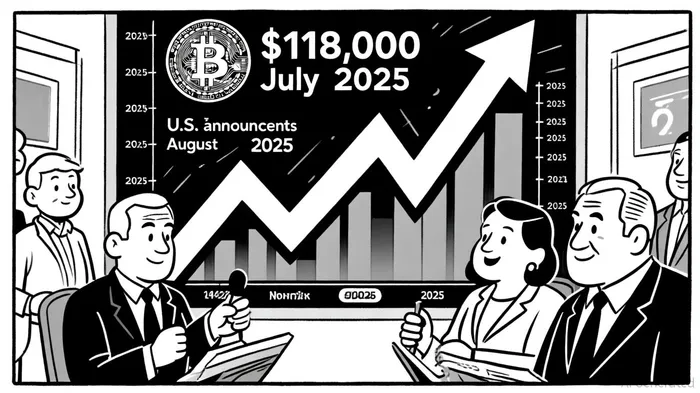
On July 11, 2025, Bitcoin broke through its previous all-time high of $109,000, surging to $118,000 in a matter of hours, according to a CoinDesk report. This move triggered a cascading liquidation of short positions, with over $1.01 billion in losses concentrated on exchanges like Bybit (93% short liquidations) and HTX (largest single liquidation: $88.5M), as noted in a BTCC post. The short squeeze was exacerbated by reduced exchange reserves and institutional buying, which amplified upward momentum, per a 10x Research analysis.
Notably, this price surge occurred before the administration's major tariff announcements, including the 100% tariff on Chinese imports (effective November 1, 2025), according to a Coinpedia report. The timing suggests that the short position was not directly tied to tariff policy but rather to broader macroeconomic optimism-such as dovish Federal Reserve signals and a rebound in global equities, as shown in a C.H. Robinson timeline. This highlights a key challenge in predictive trading: distinguishing between correlated and causative factors.
Tariff Announcements: A Post-Squeeze Wild Card
While the short liquidation event in July was driven by bullish fundamentals, the subsequent tariff announcements in August and November 2025 reintroduced volatility. For instance, the August 11, 2025, extension of the tariff pause on China provided temporary relief, but the November 1, 2025, 100% tariff on Chinese imports sent Bitcoin plummeting below $110,000, triggering $19B in liquidations, according to an IncoDocs timeline. This duality-bullish short-term momentum vs. long-term tariff uncertainty-demonstrates the need for adaptive risk management in crypto trading.
Lessons for Predictive Trading
- Macro Signals Over Micro Events: The July 2025 surge was driven by institutional inflows and global risk appetite, not immediate tariff decisions. Traders must prioritize macroeconomic indicators (e.g., Fed policy, ETF flows) over short-term geopolitical noise.
- Leverage On-Chain Data: The easing of selling pressure (as seen in the P/L ratio) before the July surge signaled short-term exhaustion, a key on-chain indicator for contrarian trades, as argued in a Forbes column.
- Scenario Planning for Tariff Shocks: While the $1.1B short was liquidated before major tariffs, subsequent announcements in late 2025 caused sharp corrections. Position sizing and stop-loss strategies must account for both near-term and tail-risk events.
Conclusion: Navigating the New Normal
The $1.1B Bitcoin short squeeze of July 2025 serves as a cautionary tale and a playbook for predictive trading. It illustrates how leveraged positions can be undone by rapid shifts in sentiment and macroeconomic fundamentals, even in the absence of immediate policy triggers. For investors, the takeaway is clear: in an era of heightened geopolitical volatility and institutional adoption, predictive trading requires a synthesis of on-chain analytics, macroeconomic foresight, and geopolitical agility.
As the Trump administration's tariff policies continue to evolve, the crypto market's resilience-and its susceptibility to short-term shocks-will remain a defining feature of 2025's investment landscape.






Comentarios
Aún no hay comentarios