
Catch pre-market movers with AI signals.
MS Research: Flexible Power as the Next Wave of Growth
AI data centers are doubling power demand, but the real challenge has shifted from “how much power” to “how flexible.” Morgan Stanley identifies Flexible Power as the Next Wave of Growth in AI. Discover why these 3 stocks may benefit.
Key Takeaways:
- AI inference workloads are inflecting, making power more volatile and shifting focus from pure capacity build-out to flexibility.-
- ESS is the most efficient way to meet this demand — absorbing shocks, fast-response, peak-shaving, and deferring costly infrastructure.
- Compelling LCOE versus gas peakers, plus infrastructure deferral value, strengthen the economic case.
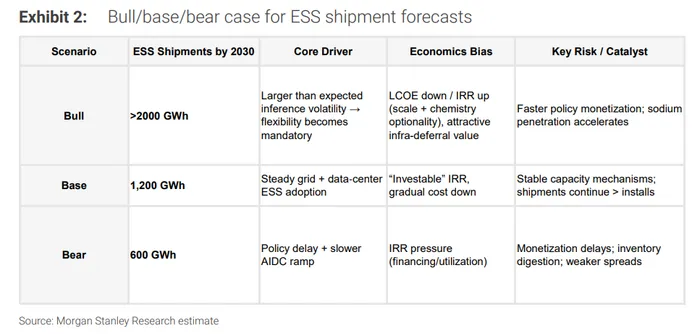
- Global ESS annual incremental deployment from data centers is forecast at ~321 GWh by 2030 (bull case ~590 GWh), roughly matching today’s entire utility-scale ESS market and implying a 30% CAGR.
Morgan Stanley’s report reframes the $1.5 trillion “Power for AI” theme. The rapid inflection in AI inference workloads now structurally alters electricity demand. Inference is continuous, user-facing, latency-sensitive, and highly volatile — producing spikier, less predictable load profiles than training. This shifts the binding constraint from “how much power can we generate?” to “how flexibly and reliably can we deliver it in real time?”
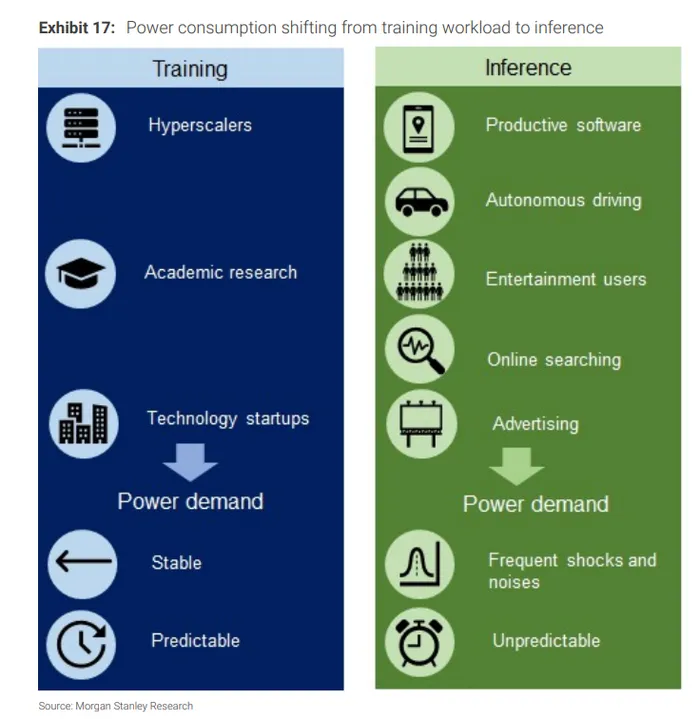
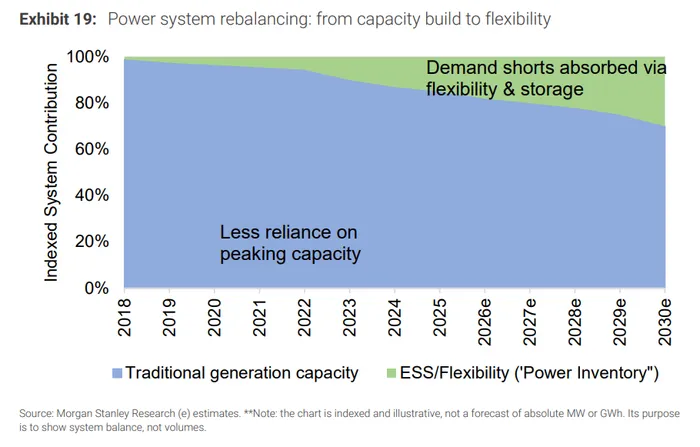
Energy storage systems (ESS) emerge as the logical and economically superior next leg. ESS functions as “electricity inventory,” absorbing shocks, performing peak-shaving, providing millisecond response times, and enabling infrastructure deferral. The report argues that ESS is no longer an adjunct but a system-level necessity as AI data centers are projected to double power demand within five years.
Key Drivers and Structural Changes
Inference Inflection Is Challenging Power System Flexibility Training workloads are episodic and schedulable. Inference runs continuously and close to end users (search, enterprise software, autonomous driving, real-time decision engines), creating persistent, latency-sensitive, and highly volatile load profiles.
This drives sharp intra-second and intra-hour power swings that traditional grids and thermal generation were not designed to absorb.
Capacity Constraints Today
Global power demand is projected to rise at a 3.8% CAGR from 2025–2030, with data-center demand growing at 21% CAGR. The US faces particularly acute risks due to the concentration of AI data centers and grid interconnection bottlenecks. Morgan Stanley’s Global Tech and Utilities team estimates a potential net power shortfall of 9–18 GW in the US for 2025–2028 even after exhausting available grid access and “time-to-power” solutions.
Why ESS Is Becoming Critical
ESS acts as “inventory for electricity,” smoothing volatility without requiring overbuilding of generation or transmission. It is modular, rapidly deployable, location-agnostic, and can serve multiple roles (arbitrage, reserves, reliability). As inference scales, flexibility moves from “nice-to-have” to system-level necessity.
Economics and Cost Advantages Beyond LCOE
ESS has already reached cost parity with gas peakers in multiple regions. Sodium-ion batteries, now scaling toward mass production, are expected to reduce LCOE by an additional 25–30%, improving safety and cold-weather performance.
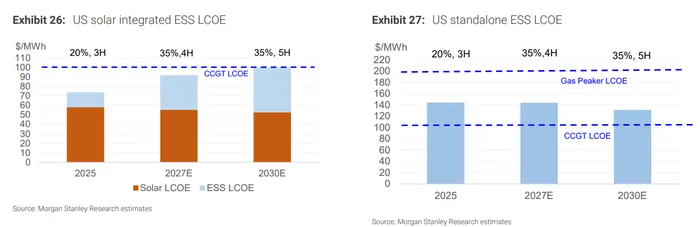
Beyond LCOE, ESS delivers significant infrastructure deferral value: by shaving peaks, it can defer or downsize costly, irreversible investments in generation, transmission, and distribution (estimated ~10% system-level capex reduction when factoring in interest, inflation, and time value of money).
Market Size and Forecasts
Global ESS annual incremental deployment from data centers: ~321 GWh by 2030 (US 169 GWh, China 85 GWh, Rest of World 68 GWh).
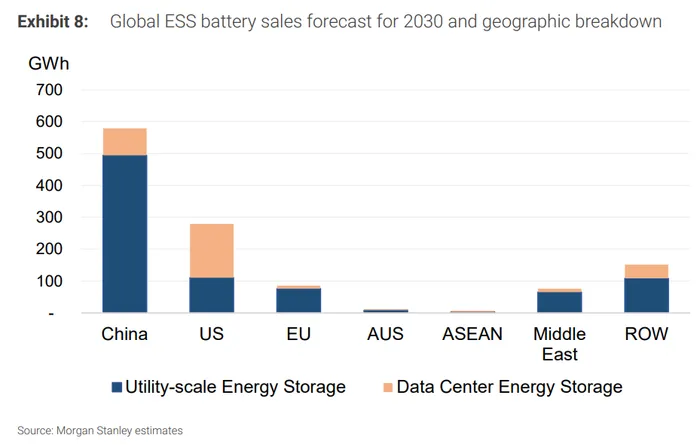
Combined with utility-scale growth (22% CAGR), the overall ESS market enters a structural multi-year upcycle.
Bull case (faster inference volatility and policy support): more than 2000 GWh by 2030.
US-Listed High-Conviction Beneficiaries
Tesla (TSLA) , Equal-weight, price target US$415
Vertically integrated ESS system provider via Megapack. Benefits from rapid deployment capability, full-system economics, and time-to-power urgency in AI infrastructure. Strong positioning in both data-center and grid-scale storage.
Ford(F), Equal-weight, price target US$14
Ford is entering the ESS market as part of its broader strategic reset, targeting battery energy storage demand from data centers and grid infrastructure.
Fluence Energy (FLNC)
Pure-play ESS system integrator and software platform (hardware-agnostic). Monetizes adoption through turnkey deployment, digital optimization, and long-term services — perfectly aligned with data centers’ need for reliability, flexibility, and fast response.
Risk Factors
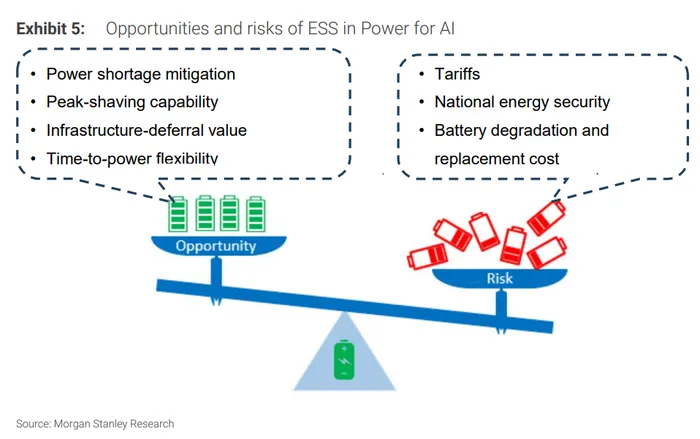
Policy/monetization delays, slower AI data-center ramp, inventory digestion, weaker price spreads, execution risk in sodium-ion scale-up, and potential tariff or national-security restrictions on battery supply chains.
However, the structural shift toward inference volatility makes ESS a necessity rather than discretionary.

Independent investment research powered by a team of market strategists with 20+ years of Wall Street and global macro experience. We uncover high-conviction opportunities across equities, metals, and options through disciplined, data-driven analysis.
Unlock Market-Moving Insights.
Subscribe to PRO Articles.
Already have an account? Sign in






