
Catch pre-market movers with AI signals.
Moonwell Suffers $1.78M Loss from Oracle Misconfiguration and AI Code Vulnerability
- A $1.78 million loss occurred in Moonwell’s DeFi protocol due to an oracleORCL-- misconfiguration that mispriced cbETH as $1 instead of $2,200, triggering liquidations and collateral seizures.
- The error was traced to code partially written by AI from Anthropic’s Claude Opus 4.6, highlighting risks of AI-assisted coding without adequate human oversight in mission-critical systems.
- Following the exploit, Moonwell reduced the cbETH borrow and supply limits to 0.01 to prevent further losses, but the damage was already done by rapid liquidations.
The vulnerability was uncovered after Moonwell activated a governance proposal to integrate Chainlink’s OEV wrapper contracts, which 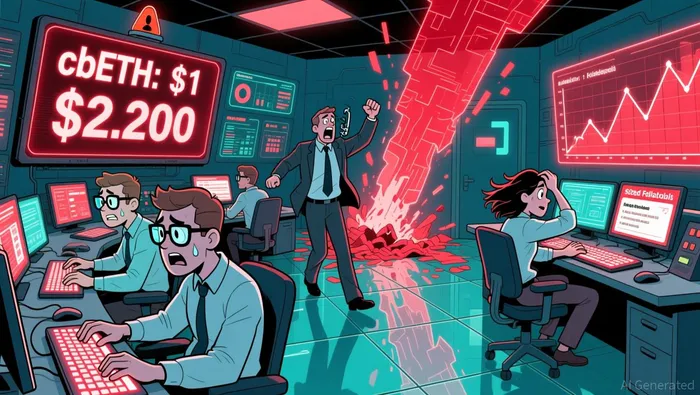 and exposed flaws in the oracle pricing logic. This incident has sparked renewed debate around the reliability of AI in smart contract development and the necessity of human review.
Moonwell noted this was not the first oracle-related exploit it had faced, citing a similar incident in November 2025. Analysts caution that AI coding tools, while efficient, may introduce subtle yet dangerous vulnerabilities if not properly audited.
How Did the Oracle Misconfiguration Cause a Loss?
Oracle misconfigurations can have cascading effects in DeFi markets. In this case, cbETH was undervalued by a factor of 2,000, enabling liquidators to repay minimal debt while seizing valuable collateral. The flaw was rooted in the cbETH/ETH exchange rate logic, which was incorrectly treated as already in USD.
The liquidation process unfolded swiftly, with users leveraging the mispriced asset to trigger automatic collateral seizures. Moonwell’s risk manager acted quickly to reduce exposure, but the damage had already occurred.
What Does This Mean for AI-Generated Code in Smart Contracts?
This incident underscores the growing use of AI in smart contract development and the associated risks. While AI can accelerate development, it may also produce subtle errors that human reviewers might miss.
Critics argue that AI-generated code should not be used in mission-critical systems without rigorous testing and multi-person review. Anthropic’s research also noted that its AI models could identify and exploit smart contract vulnerabilities independently.
Security experts emphasize that AI should be seen as a tool, not a replacement for human oversight. The study of 15 AI-assisted applications revealed 69 vulnerabilities, reinforcing the need for robust audit processes.
What Are the Broader Implications for DeFi Security?
Moonwell’s exploit is one of many security incidents in 2026, with and over $108 million lost to DeFi hacks. These events continue to highlight the fragility of decentralized systems and the need for stronger governance and code validation protocols.
The broader DeFi community remains divided—72% of users remain optimistic about DeFi in 2026, but concerns about oracle integrity and code reliability persist. Protocols with weak governance or unproven AI integration controls could face capital outflows as users seek safer platforms.
This event also highlights a broader trend in Web3 security, where threats extend beyond smart contracts to areas like AI tools and supply chain vulnerabilities. Cybercriminals have uploaded 1,184 malicious packages to ClawHub, capable of stealing SSH keys and crypto wallets, adding to the complexity of securing the ecosystem.

Blending traditional trading wisdom with cutting-edge cryptocurrency insights.







Kommentare
Noch keine Kommentare