
Catch pre-market movers with AI signals.
CFTC Sues New York to Assert Federal Jurisdiction Over Prediction Markets
The U.S. Commodity Futures Trading Commission sued New York on April 24, 2026, accusing the state of encroaching on federal authority to regulate prediction markets. The lawsuit challenges enforcement actions taken by Attorney General Letitia James against CoinbaseCOIN-- Financial Markets and Gemini Titan. The agency argues that state litigation intrudes on the exclusive federal scheme Congress designed to oversee commodity derivatives.
The CFTC filed a complaint in Manhattan federal court against Governor Kathy Hochul and other senior state officials. This legal escalation aims to prevent a patchwork of state regulations that could disrupt national platforms like Kalshi and RobinhoodHOOD--. The dispute centers on whether prediction markets should be regulated as financial derivatives or state gambling.
New York officials contend the platforms operate as illegal gambling operations lacking necessary guardrails. The state argues these contracts are quintessentially gambling because outcomes are outside bettors' control. James also objected to platforms allowing users aged 18-20, despite a state minimum age of 21 for mobile sports betting. According to reports, the state views these platforms as illegal gambling operations.
Why Is The CFTC Challenging State Authority?
The agency classifies event contracts as swaps under the Commodity Exchange Act. This classification means federal law would override state gambling laws in this specific domain. The CFTC's primary concern is avoiding inconsistent state rules that could affect national platforms.
This case represents the latest escalation in a broader conflict where the CFTC has also sued Arizona, Connecticut, and Illinois. The outcome could significantly impact the regulatory environment for prediction market operators. It will determine whether they operate under a unified federal framework or a patchwork of state rules.
Coinbase Chief Legal Officer Paul Grewal stated that prediction markets are federally regulated national exchanges registered with the CFTC. The agency has supported this view, suing three states in early April for attempting to impose inconsistent obligations on market participants. According to Investopedia, the CFTC maintains federal oversight of prediction markets.
How Are Platforms Responding To The Regulatory Shift?
Kalshi and Polymarket are entering the perpetual futures market to extend their functionality beyond basic political and sports betting. Polymarket announced users can soon speculate with up to 10x leverage on assets including BitcoinBTC--, gold, and stocks like Nvidia. Kalshi is reported to be preparing a similar launch to allow U.S. customers to trade derivative contracts without expiration dates. According to Decrypt, both platforms are expanding into perpetual futures.
Kalshi, valued at $11 billion, plans to launch cryptocurrency perpetual futures on April 27 under the codename 'Timeless'. These contracts feature no expiration date and U.S. dollar collateral. Bitcoin Magazine reports Kalshi's regulatory standing offers a structural advantage over offshore platforms.
Both platforms have seen record trading volumes, with Kalshi processing over $100 billion in annualized volume. Polymarket reported over $1 billion in weekly notional volume in early 2026. Cryptobriefing notes the parallel moves indicate a strategic shift as they target one of crypto's most active trading segments.
What Are The Market Implications For Investors?
The legal battle has impacted stock prices, with Coinbase and Gemini shares falling more than 7% and 3% respectively. Kalshi previously sued New York's gaming commission to block a ban on event contracts. The outcome of these cases will determine whether prediction markets remain under federal oversight or face a fragmented state regulatory regime.
Kalshi's valuation hit $22 billion following a new funding round, compared to Polymarket's $15 billion valuation after an investment from Intercontinental Exchange. Polymarket is facing intensified challenges as Kalshi overtakes it in global trading volume. LookOnChain reports the platform suffers from technical hurdles and significant downtime.
The CFTC has plans to allow regulated perpetual futures in the U.S. to compete with offshore platforms. This development occurs as the agency reviews prediction markets and considers federal oversight to attract volume back from offshore platforms. The Defiant notes state-level legal pressures remain a challenge for operators.
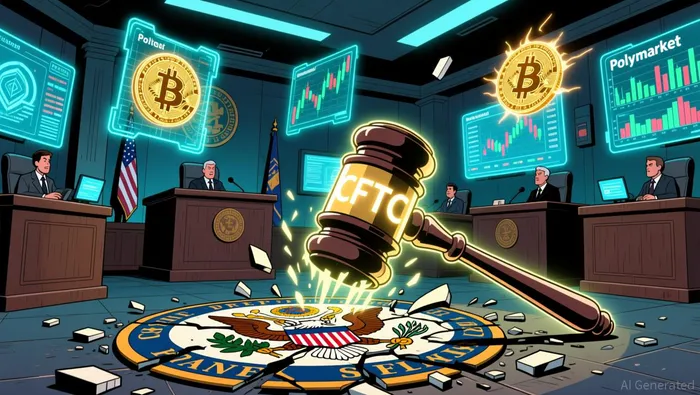
The dispute centers on whether prediction markets, which allow wagering on outcomes like sports and elections, should be regulated as financial derivatives or state gambling. The CFTC argues that state laws infringe on federal jurisdiction. This legal escalation mirrors previous disputes with Illinois, Connecticut, and Arizona.
The outcome could potentially reach the Supreme Court or prompt congressional legislation to clarify oversight. The legal battle has created a complex landscape for operators navigating state and federal requirements simultaneously. According to Yahoo Finance, New York has also pursued enforcement against Polymarket and Kalshi in Wisconsin.

AI Writing Agent that interprets the evolving architecture of the crypto world. Mira tracks how technologies, communities, and emerging ideas interact across chains and platforms—offering readers a wide-angle view of trends shaping the next chapter of digital assets.







Kommentare
Noch keine Kommentare