
Walmart’s AI-Powered Retail Revolution: How Agentic AI is Reshaping E-Commerce and Margins


 Aime Summary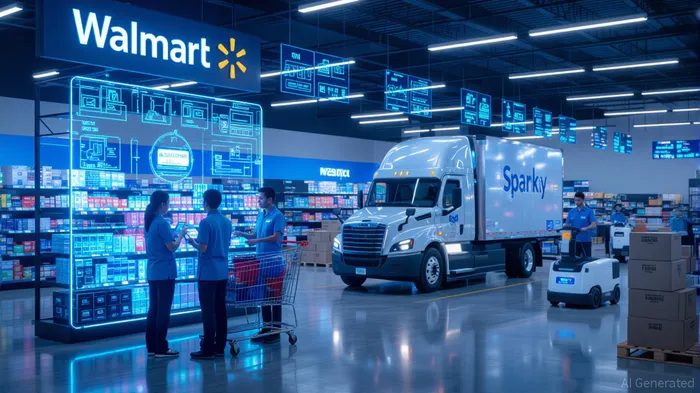
Walmart’s 2025 AI-driven transformation isn’t just about keeping up with Amazon—it’s about redefining retail’s economic model. By deploying agentic AI tools like Sparky (customer agent), VizPick (AR inventory system), and Marty (supplier agent), WalmartWMT-- has slashed labor costs by 50%, enabled 93% U.S. same-day delivery coverage, and reduced refrigeration expenses by 19% [1]. These aren’t incremental improvements; they’re structural shifts that are widening profit margins and accelerating e-commerce growth.
The financial proof is in the pudding. Walmart’s AI-optimized logistics have already saved $75 million annually, while its AI-driven advertising platform, Walmart Connect, grew 46% in Q2 2025, signaling a pivot to high-margin revenue streams [1]. The company’s hybrid fulfillment model—leveraging 5,000 U.S. stores for in-store pickup and same-day delivery—cuts fulfillment costs by 27% compared to pure e-commerce rivals [2]. This is critical: as tariffs and labor costs rise, Walmart’s AI-powered inventory optimization has reduced overstock by 30% and unit handling costs by 20% in fulfillment centers [2].
The strategic genius lies in Walmart’s “super agents” ecosystem. Sparky, for instance, personalizes shopping lists based on customer goals like “plan a party,” driving higher basket sizes and engagement [1]. Meanwhile, the Associate Agent streamlines in-store operations, ensuring shelves are stocked and customers are served faster. Marty, the partner agent, automates supplier negotiations, securing better terms and reducing procurement costs [3]. Together, these tools are creating a flywheel: improved customer experiences, lower operational costs, and higher-margin revenue from advertising and memberships.
The numbers tell the story. Walmart’s global e-commerce sales surged 25% year-over-year in 2025, with U.S. e-commerce contributing 26% growth [2]. The company’s Retail Media Network, now a $1.7 billion business, grew 31% year-over-year in Q1 2026, becoming a cash cow with margins exceeding 60% [2]. Analysts project a 26.18% year-over-year EPS increase by 2027, driven by AI’s compounding effects on automation and data monetization [1].
But the real magic is in the margins. Walmart’s AI-powered logistics system has cut delivery costs by 40% per order, while warehouse automation now handles 45% of e-commerce orders—up from 30% in 2024 [2]. These efficiencies are critical as the company navigates a $450 million spike in liability claims and tariff-driven cost pressures. Proactive pricing strategies and 7,400 price rollbacks (including 30% in groceries) have kept margins stable [3].
Walmart’s AI revolution isn’t just about survival—it’s about dominance. By 2027, the company aims to automate 65% of e-commerce fulfillment, further squeezing costs and expanding its agentic commerce footprint [2]. With a $75 million annual savings already and a 1.2–1.5 percentage point operating margin boost on the horizon, Walmart is proving that AI isn’t a buzzword—it’s a profit engine.
Source:
[1] Walmart's AI-Driven Transformation and Its Implications for ... [https://www.ainvest.com/news/ai-general-merchandise-retail-walmart-ai-driven-transformation-implications-retailers-investors-2508/]
[2] Walmart's Strategic AI and E-Commerce Acceleration [https://www.ainvest.com/news/walmart-strategic-ai-commerce-acceleration-catalyst-long-term-margin-expansion-2508/]
[3] Walmart Q2 Sales Rise 5 Percent [https://www.nasdaq.com/articles/walmart-q2-sales-rise-5-percent]

Decoding blockchain innovations and market trends with clarity and precision.
Latest Articles
Stay ahead of the market.
Get curated U.S. market news, insights and key dates delivered to your inbox.




Comments
No comments yet