
Solana vs. Remittix: Why PayFi's 60x Altcoin Could Outperform the Institutional Play in 2025


 Aime Summary
In the evolving landscape of blockchain-based finance, two narratives dominate: speculative Layer-1 (L1) momentum and utility-driven value creation. SolanaSOL-- (SOL), the high-speed L1 blockchain, has captured institutional attention with its 1 million TPS capacity and partnerships with major financial players. However, structural bottlenecks—regulatory uncertainty, scalability issues, and integration complexity—threaten its long-term viability. Meanwhile, Remittix (RTX), a PayFi (Payments + DeFi) project targeting the $19 trillion global remittance market, is building a deflationary, real-world utility-driven model that could outperform Solana's speculative narrative in 2025.
Solana's Institutional Momentum: A Double-Edged Sword
Solana's institutional adoption in 2025 has been nothing short of explosive. With staking platforms like Chorus One and custodians like Fidelity investing billions in SOL, the network has become a cornerstone of institutional-grade blockchain infrastructure. However, this rapid growth has exposed critical vulnerabilities:
- Regulatory Uncertainty: While Solana's spot ETF approval in October 2025 could unlock billions in inflows, the U.S. SEC's ambiguous stance on crypto assets creates a high-risk environment. Institutions are hesitant to overcommit until regulatory clarity is achieved.
- Scalability Bottlenecks: During peak usage, Solana's network has experienced congestion, disrupting real-time transaction execution—a critical flaw for institutional operations requiring 100% reliability.
- Integration Complexity: Transitioning legacy systems to Solana's infrastructure demands significant technical overhauls, deterring slower-moving institutions.
- Liquidity Volatility: SOL's price swings, such as the 7.68% 24-hour surge in July 2025, highlight the risks of overleveraging in a speculative asset.
These challenges underscore a key limitation of L1 blockchains: they prioritize technical performance over real-world adoption. Solana's institutional narrative, while compelling, remains vulnerable to systemic risks that could stall its growth.
Remittix's Utility-Driven Flywheel: A PayFi Revolution
Remittix (RTX) is redefining cross-border payments by combining Ethereum's security, Solana's speed, and deflationary tokenomics to create a hybrid infrastructure. Its Q3 2025 roadmap—centered on a beta wallet launch and CEX expansion—positions it as a high-conviction altcoin with asymmetric upside.
Real-World Adoption in Action
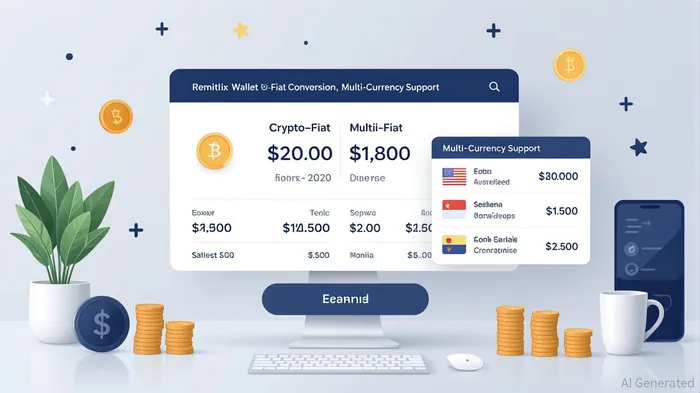
RTX's core utility lies in its crypto-to-fiat wallet, which will support 40+ cryptocurrencies and 30+ fiat currencies, enabling real-time FX conversions and sub-1-second transactions at 0.1% fees. By July 2025, the platform had already processed 400,000 cross-border transactions, serving 1.2 million active users—a testament to its scalability and demand.
Deflationary Tokenomics: Scarcity Meets Utility
RTX's token model burns 50% of transaction fees, reducing supply and aligning token value with network usage. With 621 million tokens sold in a $21.5 million presale at $0.0987, the project has unlocked a BitMart listing, enhancing liquidity and visibility. Analysts project a post-launch price range of $0.30–$0.50, implying a 60x–100x return for early investors.
Strategic Execution: Q3 2025 as a Pivotal Inflection Point
The beta wallet launch in Q3 2025 will enable 50 early testers to experience RTX's core features, including staking, multi-currency settlements, and integrated FX conversion. Simultaneously, the project is preparing for a second CEX listing, contingent on surpassing $22 million in presale funds. These milestones are not just technical achievements—they are catalysts for mass adoption and institutional validation.
Why RTXRTX-- Outpaces Solana in 2025
While Solana's institutional narrative hinges on speculative momentum, RTX's value proposition is rooted in real-world utility and deflationary scarcity. Here's how they stack up:
| Metric | Solana (SOL) | Remittix (RTX) |
|---|---|---|
| Primary Use Case | High-speed L1 infrastructure | Cross-border remittance platform |
| Tokenomics | Inflationary (2% annual supply increase) | Deflationary (50% fee burn) |
| Institutional Risks | Regulatory ambiguity, scalability issues | CertiK audit, KYC-compliant infrastructure |
| Growth Drivers | ETF speculation, staking demand | Real-world adoption, fee burn, CEX listings |
RTX's focus on underbanked markets—where traditional remittance fees are 5–10%—creates a flywheel effect: lower fees drive adoption, which drives token demand. Solana, by contrast, lacks a comparable real-world use case and remains exposed to speculative volatility.
Investment Timing: The Q3 2025 Window
For investors, the Q3 2025 window is critical. RTX's presale is currently priced at $0.0987, with a 40% token bonus expiring upon crossing $20 million. Early buyers benefit from referral incentives and beta wallet access, creating a first-mover advantage. Meanwhile, Solana's price action remains tied to regulatory outcomes and macroeconomic trends, making it a higher-risk bet.
Conclusion: Utility Over Speculation
In 2025, the crypto market is shifting from speculative L1 narratives to utility-driven projects that solve real-world problems. Solana's institutional adoption is impressive, but its structural bottlenecks and speculative nature make it a riskier long-term play. Remittix, with its deflationary model, real-world adoption, and Q3 2025 execution roadmap, offers a compelling alternative. For investors seeking asymmetric upside in a maturing market, RTX's 60x–100x potential is hard to ignore.
Investment Advice: Allocate a portion of your altcoin portfolio to RTX ahead of its Q3 2025 wallet launch and CEX expansion. Monitor Solana's regulatory developments but prioritize projects with tangible utility and deflationary mechanics. The future of PayFi belongs to platforms that bridge DeFi and traditional finance—Remittix is leading the charge.

Decoding blockchain innovations and market trends with clarity and precision.
Latest Articles
Stay ahead of the market.
Get curated U.S. market news, insights and key dates delivered to your inbox.


AInvest
PRO
AInvest
PRO



Comments
No comments yet