
Solana’s Market Stabilization and Accumulation Potential: A Strategic Entry Point for Investors


 Aime Summary
Solana (SOL) has entered a critical juncture in its price trajectory, marked by a 14% weekly decline but accompanied by robust on-chain signals of stabilization and accumulation. As of August 2025, the cryptocurrency is trading at $160.55, with key support levels at $158.80 and resistance at $176.33. While the short-term volatility is evident, the interplay of technical indicators, institutional adoption, and on-chain behavior suggests a compelling case for a strategic entry point.
On-Chain Metrics Signal Accumulation Amid Volatility
Despite the recent price weakness, Solana’s on-chain data reveals a shift in sentiment among long-term holders. The Liveliness metric, which measures token movement, has dropped to 0.76, the lowest in months, indicating reduced selling pressure and growing confidence in holding SOL [4]. Simultaneously, the Hodler Net Position Change surged by 102% since July 30, confirming that large investors are locking tokens into long-term storage [5]. This accumulation is further reinforced by the Realized Profit/Loss Ratio, which hit a 30-day low of 0.15, suggesting most sellers are exiting at a loss—a classic precursor to market bottoms [4].
Technical Analysis: A Bearish Pattern with Bullish Undercurrents
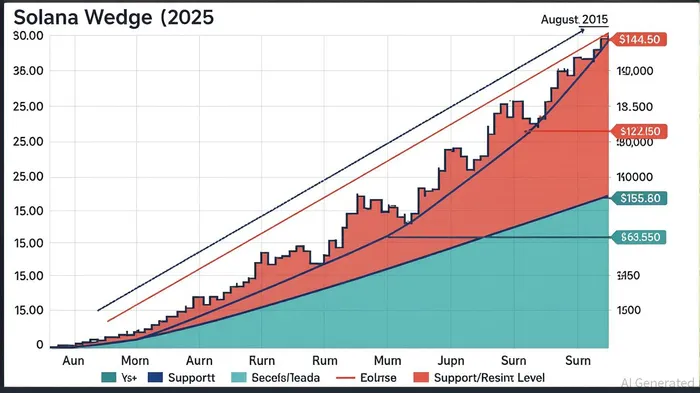
Solana’s price action has formed an ascending wedge on the weekly chart, a pattern historically associated with bearish continuation. However, bulls retain control as long as the $175 support level holds [2]. Historical backtesting of Solana’s price near support levels from 2022 to 2025 shows that a buy-and-hold strategy has yielded positive returns with manageable drawdowns over 30-day periods [1]. Specifically, backtests reveal 66 instances where SOL tested its 20-day support level, with an average 10-day return of approximately +1.4% and a win rate of 52%. While short-term reactions were mixed—showing near-zero returns in the first week—positive drift emerged after ~10 trading days, with mean 30-day excess returns of +3% compared to a benchmark of -2%. However, these results lack strong statistical significance, indicating that simply buying every support test has not delivered a robust edge in SOL over the past three years [1]. Whale activity also supports this narrative: $23 million in SOL has been withdrawn from exchanges like Binance and Kraken, with 60% staked, reducing short-term supply pressure and signaling long-term commitment [1].
Institutional Adoption: A Catalyst for Long-Term Value
Institutional adoption has emerged as a cornerstone of Solana’s 2025 growth. Over $1.72 billion in institutional capital has flowed into SolanaSOL-- treasuries, with 13 public companies collectively holding 1.44% of the total supply [1]. These entities, including UpexiUPXI--, Inc. and DeFi DevelopmentDFDV-- Corp., are leveraging Solana’s 7–8% staking yields to generate returns while building long-term positions [3]. The network’s Alpenglow consensus upgrade has further solidified its appeal, boosting throughput to 65,000 TPS and sub-150ms finality, making it a preferred infrastructure for DeFi and institutional-grade applications [3].
The potential approval of a U.S. spot Solana ETF by October 2025 could unlock an additional $3–6 billion in institutional capital, mirroring the inflows seen with BitcoinBTC-- and EthereumETH-- ETFs [4]. This regulatory development, combined with partnerships with Stripe, SpaceX, and BlackRockBLK--, has positioned Solana as a scalable, high-yield blockchain for institutional players [1].
Ecosystem Growth and Capital Inflows
Solana’s ecosystem has also seen explosive growth, with 7,600 new developers joining in 2025 and 2,100 active dApps driving a $13 billion TVL in DeFi [5]. The launch of the REX-Osprey Solana + Staking ETF (SSK) attracted $1.2 billion in net inflows in 30 days, outpacing Ethereum and Arbitrum combined [1]. Institutional partnerships with Franklin Templeton and Société Générale have further tokenized assets on the Solana network, while 5.9 million SOL held in corporate treasuries (1% of the circulating supply) underscores the shift from passive to productive assets [5].
Strategic Implications for Investors
The convergence of on-chain accumulation, technical support, and institutional adoption creates a high-probability setup for a potential breakout. If Solana holds its $158.80 support level, a rally toward $176.33—and beyond to $270–$330—becomes increasingly likely [2]. Risks remain, including regulatory delays or whale selling, but the current alignment of indicators suggests a bullish outcome. For investors, this represents a strategic entry point to capitalize on Solana’s long-term value proposition.
Source:
[1] Institutional Solana Adoption: A New Era of Corporate-Driven Demand, Price Resilience
[2] Solana's Technical Setup and On-Chain Fundamentals
[3] Solana Institutional Strategy: How $1.25 Billion Initiatives Are Reshaping the Blockchain Ecosystem
[4] Solana's $250M USDCUSDC-- Minting and Institutional Adoption
[5] Solana's $250M USDC Minting and Institutional Adoption

Decoding blockchain innovations and market trends with clarity and precision.
Latest Articles
Stay ahead of the market.
Get curated U.S. market news, insights and key dates delivered to your inbox.


AInvest
PRO
AInvest
PRO



Comments
No comments yet