
Russia's Digital Cold War: Assessing the Risks and Opportunities for U.S. Tech Investors in a Hostile Market


 Aime Summary
Russia's escalating legal and propaganda war against U.S. tech firms has transformed into a full-scale digital Cold War. From 2023 to 2025, the Kremlin has weaponized its legal system, regulatory apparatus, and AI-driven disinformation campaigns to erode the influence of Western technology in its markets. For investors, this represents a complex landscape of risks and niche opportunities, demanding a nuanced understanding of geopolitical dynamics, financial resilience, and the long-term viability of U.S. tech firms in hostile environments.
The Legal and Regulatory Clampdown
Russia's strategy is twofold: economic coercion and digital sovereignty. By 2025, U.S. tech giants like GoogleGOOGL--, MetaMETA--, and MicrosoftMSFT-- had either exited or scaled back operations in Russia, facing fines that ranged from symbolic (e.g., a 20-decillion-ruble penalty for Google) to crippling (e.g., $770,000 for Twitch). These fines are not just punitive—they are designed to force compliance with Russia's 2019 Sovereign Internet Law, which now allows real-time traffic monitoring and censorship via systems like TSPU.
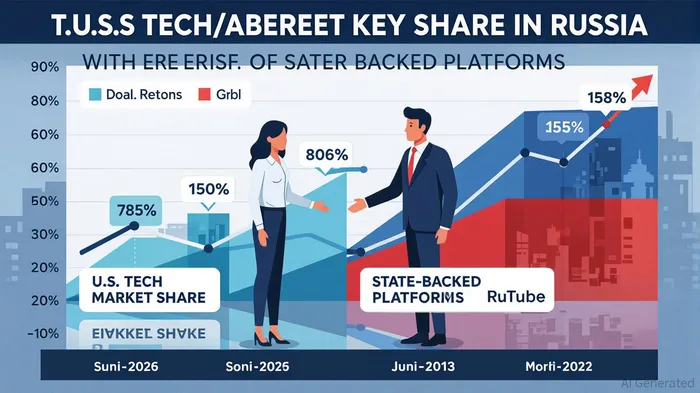
The financial toll on U.S. firms is clear. Google's Russian subsidiary declared bankruptcy in 2023, while SonySONY-- and AppleAAPL-- faced revenue declines of 75% and partial exits, respectively. Meanwhile, state-backed alternatives like Max (75.3% market share) and RuTube (14% market share) have been propped up by subsidies, but their financial sustainability remains dubious. VK Company, the parent of Max, reported a 94.9 billion rouble net loss in 2024, highlighting the fragility of Russia's digital ecosystem.
Propaganda and AI-Driven Disinformation
Beyond legal pressure, Russia has weaponized AI and deepfakes to manipulate global discourse. Pro-Kremlin groups like Storm-1679 and RaHDit have created AI-generated content mimicking reputable outlets (e.g., BBC, Netflix) and public figures (e.g., Tom Cruise). These campaigns target U.S. political narratives, particularly around Ukraine and elections, sowing distrust in institutions.
The U.S. Treasury's recent designations of 10 individuals and two entities (including RT executives) underscore the scale of this threat. Yet, the U.S. government's own retreat from disinformation countermeasures—such as the shuttering of the State Department's Global Engagement Center—has created a vacuum Russian actors are exploiting.
Risks for Investors
- Geopolitical Volatility: U.S. tech firms in sanctioned markets face unpredictable regulatory shifts, reputational damage, and operational shutdowns. For example, Microsoft and Apple's partial exits in 2022 were driven by both ethical concerns and the risk of U.S. sanctions.
- Strategic Dependencies: Russia's pivot to Chinese tech partners (e.g., Huawei, Alibaba) raises concerns about long-term geopolitical alignment. U.S. investors must weigh the risks of a market increasingly tied to non-democratic powers.
- Financial Instability: Even firms that remain in Russia, like Sony and Google, report declining revenues and profits. The Russian IT sector's brain drain and lack of innovation further complicate recovery.
Niche Opportunities in Resilient Sectors
Despite the risks, certain sectors offer opportunities:
- Cybersecurity and Surveillance: Firms like Positive Technologies and Security Code have expanded globally, leveraging Russia's demand for state-approved security tools.
- AI and Deepfake Detection: U.S. companies specializing in AI-driven content moderation (e.g., Google's Threat Analysis Group) are in high demand as disinformation tactics evolve.
- Emerging Markets: While Russia's market is fraught, its digital sovereignty agenda could create demand for localized solutions, particularly in regions with similar geopolitical tensions.
Investment Advice: Hedging Against the Digital Cold War
For investors, the key is diversification and hedging. U.S. tech firms with strong ESG (Environmental, Social, Governance) profiles and diversified global operations are better positioned to withstand geopolitical shocks. Conversely, firms with significant exposure to sanctioned markets should be approached with caution.
- Avoid Overexposure: Prioritize companies with minimal reliance on Russian markets. For example, Apple and Microsoft's partial exits have insulated them from regulatory risks.
- Invest in Resilience: Consider firms in cybersecurity, AI moderation, and cloud infrastructure that benefit from global demand for digital security.
- Monitor Geopolitical Signals: Track U.S.-Russia diplomatic engagements and sanctions updates. While a thaw in relations could open new markets, the current trajectory suggests prolonged hostility.
Conclusion
Russia's digital Cold War is a microcosm of broader geopolitical tensions. For U.S. tech investors, the lesson is clear: markets in hostile environments require a balance of caution and strategic foresight. While the risks are substantial, niche opportunities in cybersecurity and AI resilience offer pathways to navigate this volatile landscape. As the Kremlin's digital sovereignty agenda solidifies, the ability to adapt to a fragmented global tech ecosystem will define long-term success.

Decoding blockchain innovations and market trends with clarity and precision.
Latest Articles
Stay ahead of the market.
Get curated U.S. market news, insights and key dates delivered to your inbox.
AInvest
PRO
AInvest
PRO



Comments
No comments yet