
U.S. Q2 GDP Revisions and the Impact on Rate Cut Expectations


 Aime Summary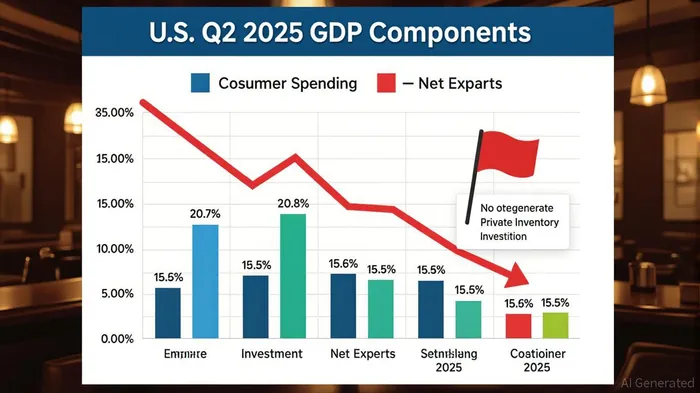
The U.S. economy’s Q2 2025 GDP growth was revised upward to 3.3% annualized, masking a fragile undercurrent of transitory factors and softening demand. While the headline figure reflects a rebound from Q1’s 0.5% contraction, the revision hinges on a 30.3% plunge in imports—a temporary distortion caused by businesses front-loading purchases in Q1 to avoid anticipated tariffs [1]. This “mirage-like” growth [4] raises critical questions for investors: Is the Federal Reserve’s next move a rate cut, or will it delay action to stabilize inflation?
The Illusion of Strength: A Breakdown of Q2’s Components
The 3.3% growth rate was driven by three key factors:
1. Consumer Spending (1.6% annualized): A broad-based increase in services (health care, food services) and goods (motor vehicles, pharmaceuticals) masked a slowdown in core demand. Final sales to private domestic purchasers—a better gauge of underlying strength—rose only 1.9% [4].
2. Business Investment (5.7% annualized): A surge in AI-related software and transportation equipment investment offset a 15.6% decline in private inventory investment, particularly in nondurable goods manufacturing [2].
3. Net Exports (+4.9% contribution): A 30.3% drop in imports—largely in medicinal and pharmaceutical goods—boosted GDP by nearly 5 percentage points, despite a 2.1% decline in exports [3].
These dynamics highlight a paradox: While business investment in AI and automation suggests long-term resilience, the GDP revision is inflated by a one-time import collapse. As economist Michelle Bowman has warned, such distortions risk misleading policymakers [4].
The Fed’s Dilemma: Transitory Growth vs. Persistent Inflation
The Federal Reserve faces a classic policy conundrum. On one hand, the 3.3% GDP figure could justify rate cuts, especially with AI-driven productivity gains and a 2.5% annualized rise in the PCE price index (excluding food and energy) [3]. On the other, the labor market’s weakness—just 35,000 average monthly job gains over three months [4]—and the transitory nature of Q2’s growth argue for caution.
Internal divisions are already evident. Officials like Christopher Waller advocate cuts to support a “soft landing,” while others, including Bowman, insist on waiting for clearer inflation stabilization [4]. This uncertainty has created a “Goldilocks scenario” for markets: Equities in AI and consumer discretionary sectors have rallied on growth optimism, while bond yields have risen on inflation concerns [5].
Investment Implications: Sectoral Strategies for a Fragile Recovery
For investors, the key is hedging against both outcomes:
- Equities: Overweight sectors benefiting from AI-driven productivity (e.g., software, semiconductors) and underweight consumer discretionary stocks, which may face headwinds if the import-driven GDP boost fades [2].
- Fixed Income: A delayed rate cut could push yields higher, favoring short-duration bonds. However, if the Fed acts aggressively, long-term Treasuries may outperform [5].
- Commodities: A weaker labor market and potential rate cuts could pressure industrial metals, but energy prices may stabilize if inflation remains sticky [3].
The final Q2 GDP estimate, due September 25, will be pivotal. If the 3.3% figure holds, markets may price in a 75-basis-point rate cut by year-end. But if the BEA confirms that growth was largely import-driven, the Fed’s hand will be forced—and investors will need to recalibrate.
**Source:[1] U.S. GDP Growth Revised to 3.3% in Q2, Withstanding ... [https://www.investopedia.com/second-quarter-gdp-revision-11799388][2] Gross Domestic Product, 2nd Quarter 2025 (Advance ... [https://www.bea.gov/news/2025/gross-domestic-product-2nd-quarter-2025-advance-estimate][3] US GDP: Economy Expands at Revised 3.3% Rate as ... [https://www.bloomberg.com/news/articles/2025-08-28/us-economy-expands-at-revised-3-3-rate-as-investment-improved][4] The Fed's Dilemma: Will 3.3% Q2 GDP Growth Cement ... [https://www.ainvest.com/news/fed-dilemma-3-3-q2-gdp-growth-cement-rate-cuts-delay-2508/][5] United States GDP Growth Rate [https://tradingeconomics.com/united-states/gdp-growth]

Decoding blockchain innovations and market trends with clarity and precision.
Latest Articles
Stay ahead of the market.
Get curated U.S. market news, insights and key dates delivered to your inbox.






Comments
No comments yet