
Navigating 'Red September' in Crypto: Strategic Opportunities Amid Volatility


 Aime Summary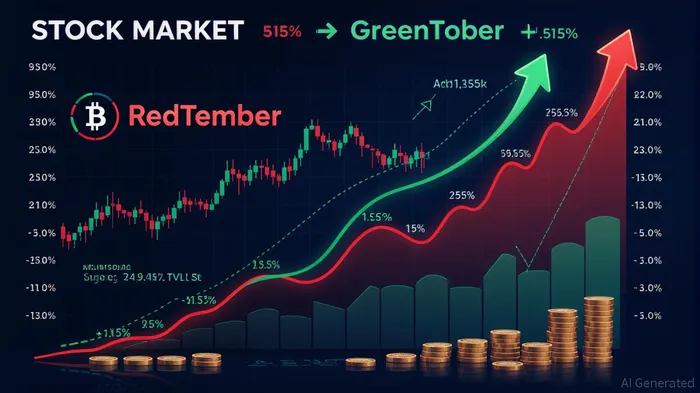
The crypto market’s September volatility, often dubbed “Redtember,” has long been a test of investor discipline. Historical data reveals a consistent pattern: BitcoinBTC-- typically declines by an average of -7.5% in September, with 8 out of the last 10 years showing losses [1]. This seasonal weakness, driven by profit-taking, reduced liquidity, and macroeconomic uncertainty, is often followed by a “Greentober” rebound, where October averages returns of +18.5% [2]. In 2025, however, the playbook is evolving. Macroeconomic tailwinds, regulatory clarity, and institutional-grade strategies are reshaping the landscape, offering opportunities for those who understand how to position for rebounds and selectively allocate to altcoins.
The Macroeconomic Catalysts Behind the Rebound
The Federal Reserve’s dovish pivot in 2025 has been a game-changer. Rate cuts have reduced the opportunity cost of holding cryptocurrencies, while a weaker U.S. dollar has bolstered Bitcoin’s appeal as a hedge against fiat devaluation [3]. Expansionary fiscal and monetary policies, as Fidelity’s Jurrien Timmer notes, are creating a fertile environment for digital assets, particularly if liquidity remains accommodative [2]. Conversely, high inflation and geopolitical risks—such as Trump-era tariffs—have amplified Bitcoin’s role as a decentralized store of value [4].
For investors, the key lies in timing. On-chain metrics suggest Bitcoin’s declining dominance (now at 59%) and high leveraged positions signal a potential 20–30% correction in September [1]. Yet this volatility is not a death knell. It is a setup for a strategic entry point, especially for those who can balance risk with macroeconomic signals.
Selective Altcoin Exposure: Beyond Bitcoin
While Bitcoin remains the market’s bellwether, the altcoin sector is showing early signs of a cyclical shift. EthereumETH--, for instance, has attracted over $3 billion in U.S. spot ETF inflows, driven by its dominance in decentralized finance (DeFi) and tokenized real-world assets (RWAs) [1]. The ETH/BTC ratio—a proxy for altcoin strength—has surged, indicating capital rotation into mid- and large-cap altcoins [4].
A core-satellite investment strategy—allocating 60–80% to Bitcoin and Ethereum and 20–30% to high-beta altcoins—offers a balanced approach [1]. SolanaSOL-- (SOL), XRPXRP--, and LitecoinLTC-- (LTC) are among the tokens showing strong technical setups, with Solana’s 500,000 TPS throughput and cross-chain integrations positioning it as a scalability leader [2]. Meanwhile, on-chain data like the OTHERS/ETH ratio (a measure of smaller altcoin performance relative to Ethereum) is at extreme oversold levels, historically a precursor to large altcoin surges [3].
Institutional adoption is another critical factor. The approval of 92 altcoin ETFs in 2025 has streamlined access for institutional capital, with projected inflows of $5–8 billion by year-end [2]. Projects with verifiable adoption metrics—such as tokenized real estate or staking products—are attracting attention, while whale activity (e.g., ADAADA-- accumulation and ETH reallocation to institutional wallets) underscores growing confidence [4].
Navigating the Risks
Despite these opportunities, the altcoin market remains fragmented. Many tokens are still below 10% of their all-time highs, and liquidity constraints persist due to the sheer number of tokens [3]. Investors must prioritize fundamentals: real-world utility, scalability, and regulatory alignment. For example, Ethereum’s independence from Bitcoin’s price action—driven by its role as both a technology platform and a financial asset—highlights the importance of ecosystem-specific analysis [5].
Whale behavior also provides insights. A surge in ADA accumulation by large wallets and Ethereum’s strategic reallocation to institutional holdings suggest a shift toward long-term, strategic positioning [4]. These trends indicate that altcoin momentum is no longer driven by retail speculation but by institutional-grade strategies.
Conclusion: A Barbell Strategy for 2025
The 2025 crypto cycle demands a barbell approach: hold a core position in Bitcoin as a macro hedge while selectively allocating to altcoins with strong fundamentals and institutional backing. September’s volatility, though daunting, is a feature, not a bug. It creates asymmetric opportunities for disciplined investors who can navigate the seasonal “Redtember” dip and position for a “Greentober” rebound.
As the market evolves, the winners will be those who combine macroeconomic foresight with granular on-chain analysis—and who recognize that altcoin season is no longer a gamble, but a calculated bet.
**Source:[1] Navigating September's Crypto Volatility: Strategic Entry Points [https://www.bitgetapp.com/news/detail/12560604940716][2] 2025 crypto market outlook [https://www.fidelity.com/learning-center/trading-investing/crypto-outlook-2025][3] Altcoin Market at Critical Cycle Bottom: Strategic Entry ... [https://www.ainvest.com/news/altcoin-market-critical-cycle-bottom-strategic-entry-points-oversold-assets-2025-2508/][4] Bitcoin's September Dilemma: Seasonal Volatility and the Macroeconomic Forces Shaping Investor Strategy [https://www.ainvest.com/news/bitcoin-september-dilemma-seasonal-volatility-macroeconomic-forces-shaping-investor-strategy-2508/][5] How Bitcoin Market Trends Affect Major Cryptocurrencies [https://www.sciencedirect.com/science/article/abs/pii/S0378437125002390]

Decoding blockchain innovations and market trends with clarity and precision.
Latest Articles
Stay ahead of the market.
Get curated U.S. market news, insights and key dates delivered to your inbox.






Comments
No comments yet