
Ethereum's Institutional Takeoff: Why Wall Street Is Now Backing ETH's Next Leg Higher


 Aime Summary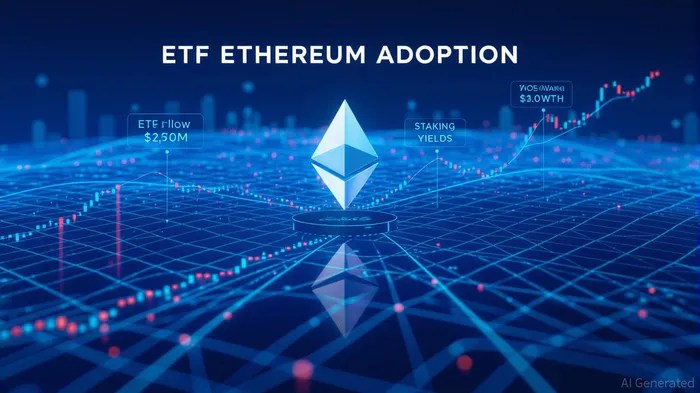
Ethereum’s ascent in 2025 is no longer a speculative narrative but a structural shift driven by institutional adoption and macroeconomic tailwinds. The network’s technical upgrades, regulatory clarity, and yield advantages have transformed it from a speculative asset into a foundational layer for global finance. As Wall Street reorients its capital toward EthereumETH--, the implications for its price trajectory and utility are profound.
Technical Upgrades: The Infrastructure for Institutional Adoption
Ethereum’s Fusaka, Dencun, and Pectra upgrades have unlocked unprecedented scalability, enabling 100,000 transactions per second at an average cost of $0.08 per transaction [1]. These improvements have positioned Ethereum as the backbone for tokenized real-world assets (RWAs), cross-border payments, and institutional-grade financial systems. The gas limit increase to 150 million units per block has reduced friction for large-scale applications, making Ethereum a viable alternative to legacy infrastructure.
Institutional Capital: A New Era of Ownership
Institutional investors now control 9.2% of Ethereum’s total supply, with 3.6% held in corporate treasuries and 5.6% via ETFs [1]. This shift is evident in the explosive growth of Ethereum ETFs, which captured 77% of inflows in August 2025, surpassing Bitcoin’s performance [2]. BlackRock’s iShares Ethereum Trust (ETHA) alone attracted $262.6 million in a single day, while Fidelity’s FETH and other funds saw similar inflows [2]. Over 19 companies have staked 4.1 million ETH ($17.6 billion in value), leveraging Ethereum’s 3–6% staking yields to optimize capital [1].
The institutional narrative is further reinforced by corporate treasuries. BitMine Immersion TechnologiesBMNR-- (BMNR), for instance, has amassed 1.79 million ETH in its treasury, mirroring MicroStrategy’s BitcoinBTC-- strategy but with Ethereum’s compounding advantages [4]. This trend signals a broader recognition of Ethereum’s utility in decentralized finance (DeFi) and its role in generating passive income through staking.
Macroeconomic Tailwinds: Yield, Regulation, and Dollar Dynamics
The U.S. Federal Reserve’s near-zero interest rate environment has incentivized institutions to seek higher-yielding assets. Ethereum’s Proof-of-Stake (PoS) model offers staking returns of 3–14%, far exceeding traditional fixed-income instruments [1]. This has driven a surge in institutional ETH holdings, with 69 firms collectively controlling $17.6 billion in ETH [1].
Regulatory clarity has also been pivotal. The reclassification of Ethereum as a utility token under the CLARITY Act and the passage of the GENIUS Act have removed legal ambiguities, enabling SEC-compliant staking and ETFs [1]. VanEck CEO Jan van Eck has dubbed Ethereum “the Wall Street token,” emphasizing its role in facilitating stablecoin transactions and its competitive edge over Bitcoin in DeFi and NFTs [3].
Meanwhile, Ethereum’s dominance in stablecoin settlements—processing $20–30 billion daily—has solidified its position as a reserve asset for the on-chain economy [1]. With 49–54% of the $271.1 billion global stablecoin supply built on Ethereum, the network’s utility extends beyond speculative trading to core financial infrastructure [3].
Ethereum as a Strategic Reserve Asset
The Strategic ETH Reserve (SER), valued at $20 billion and holding 4.36 million ETH, exemplifies Ethereum’s role as a hedge against inflation and economic uncertainty [4]. This reserve enhances the appeal of Ethereum-linked stablecoins and DeFi applications, particularly as dollar depreciation and inflation reshape capital management strategies. By 2025, Ethereum hosts 4,000+ decentralized applications and processes $850 billion in stablecoin volume, reinforcing its position as the backbone of digital finance [1].
Looking Ahead: A $7,500–$25,000 Outlook
Analysts project Ethereum could reach $7,500 by year-end 2025 and $25,000 by 2028, driven by sustained institutional demand and infrastructure growth [1]. Standard Chartered’s Geoffrey Kendrick and Goldman SachsGS-- have highlighted Ethereum’s deflationary supply dynamics, regulatory tailwinds, and utility-driven demand as key catalysts [4]. With Ethereum ETFs capturing $30 billion in inflows by mid-August 2025 and TVL reaching $223 billion, the network’s fundamentals are robust [1].
Conclusion
Ethereum’s institutional takeoff is a convergence of technical innovation, macroeconomic incentives, and regulatory progress. As Wall Street increasingly views Ethereum as a productivity engine and infrastructure layer, its price trajectory is poised to reflect this structural shift. For investors, the next leg higher in ETH is not just a function of market sentiment but a reflection of Ethereum’s evolving role in the global financial system.
**Source:[1] Ethereum's Institutional Adoption Accelerates as Reserve Entities and Exchange-Traded Funds (ETFs) Control 9.2% of the Total Supply [https://www.bitget.site/news/detail/12560604937252][2] Ethereum ETFs Shock Wall Street With $307M Inflows In One [https://finance.yahoo.com/news/ethereum-etfs-shock-wall-street-200853321.html][3] VanEck CEO Calls Ethereum 'The Wall Street Token' As Institutional Adoption Rises [https://www.mitrade.com/insights/news/live-news/article-3-1078536-20250829][4] Why Ethereum's Rally to $7500 Makes BitMine ImmersionBMNR-- a Must-Buy Stock Now [https://247wallst.com/investing/2025/08/29/why-ethereums-rally-to-7500-makes-bitmine-immersion-a-must-buy-stock-now/]

Decoding blockchain innovations and market trends with clarity and precision.
Latest Articles
Stay ahead of the market.
Get curated U.S. market news, insights and key dates delivered to your inbox.
AInvest
PRO
AInvest
PRO



Comments
No comments yet