
Ethereum's 30-40% Correction: Navigating the Bear Phase with Technical Precision and Risk Mitigation Strategies


 Aime Summary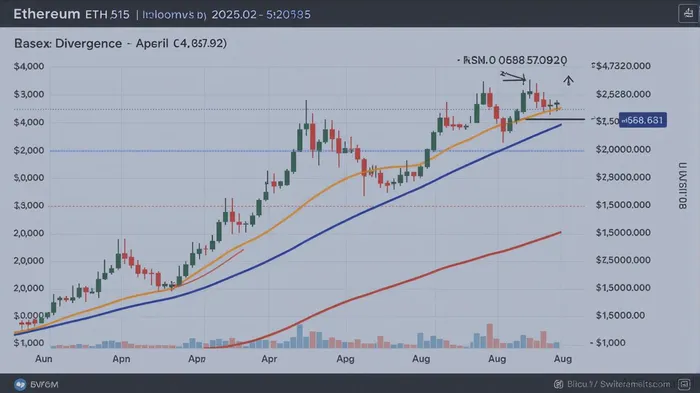
Ethereum’s price action in 2025 has painted a complex picture of bullish potential and looming bearish risks. While the network’s dominance and institutional adoption have driven it to record highs, technical indicators and historical patterns suggest a 30-40% correction could materialize. For investors, understanding these dynamics is critical to identifying strategic entry points while mitigating downside risks.
Technical Indicators Signal a Potential Correction
Ethereum’s recent price behavior reveals conflicting signals. On the weekly chart, ETH validated a bullish breakout from the $1,300–$1,400 zone in May 2025 but has since tested the $4,600 area with bearish momentum [4]. The Relative Strength Index (RSI) currently sits at 56.2, indicating neutral conditions, while the MACD line remains below the signal line, signaling weakening bullish momentum [2]. More concerning is the ascending wedge pattern in Ethereum’s dominance (ETH/BTC ratio), which often precedes a topping reversal [3].
Historical corrections provide further context. In early 2025, EthereumETH-- fell from a peak of $4,791 to an intraday low of $4,064, testing critical support at $4,200 [1]. If history repeats, the $3,500–$3,600 range could act as a key accumulation zone, with rebounds potentially targeting $4,500–$4,875 [3]. However, a breakdown below $4,320 could trigger a deeper decline toward $4,000, especially if macroeconomic conditions deteriorate [1].
Strategic Entry Points Amid Institutional Accumulation
Despite the bearish risks, Ethereum’s corrections have historically created high-probability entry points. During the August 2025 dip, over $6 billion in staking inflows and $13 billion in ETF accumulation signaled strong institutional confidence [3]. The $4,400–$4,500 range, supported by prior accumulation and Pectra upgrades (EIP-7251/6110), is a prime target for long-term investors [5].
Technical analysis reinforces this view. Ethereum remains above its 20-day ($4,545), 50-day, and 200-day moving averages, confirming a bullish trend [5]. However, investors should remain cautious: a close below the 50-day MA could invalidate this trend and accelerate the correction [2].
Risk Mitigation: Lessons from Past Corrections
To navigate a potential 30-40% correction, investors must adopt disciplined risk management strategies. Historical case studies highlight three key approaches:
Position Sizing and Diversification: Limiting Ethereum exposure to 15–25% of a portfolio and hedging with other layer-1 blockchains and stablecoins reduces volatility risks [1]. For example, during the March 2024 correction, traders like Alex Chen limited ETH positions to 5% of their portfolios, scaling into dips while adjusting for volatility [1].
Trailing Stops and Dollar-Cost Averaging (DCA): Trailing stops prevent premature exits during short-term volatility, while DCA smooths out price fluctuations. Investor Maria Kovacs used DCA to recover 115% of her losses after the September 2023 crash, outperforming the broader market’s 70% rebound [1].
Security and Recovery Planning: Cold storage via hardware wallets and post-incident security audits are essential for large ETH holdings. After the July 2023 phishing incident, users who revoked unnecessary DeFi permissions and diversified storage methods minimized losses [1].
Conclusion: Balancing Opportunity and Caution
Ethereum’s potential 30-40% correction presents both risks and opportunities. While technical indicators and historical patterns suggest a bearish phase, strategic entry points and robust risk mitigation strategies can position investors to capitalize on long-term growth. As Tom Lee of Fundstrat notes, Ethereum’s institutional adoption and network upgrades could drive it toward $5,500 in the near term and $12,000 by year-end [5]. However, success hinges on disciplined execution, macroeconomic awareness, and a commitment to risk management.
Source:
[1] Ethereum Risk Management: Real Trading Lessons [https://www.mexc.com/crypto-pulse/article/ethereum-risk-management-198]
[2] Ethereum (ETH) Technical Analysis Statistics 2025 [https://altindex.com/ticker/eth/technical-analysis]
[3] Ethereum's August 2025 Correction: A Calculated Entry Point [https://www.ainvest.com/news/ethereum-august-2025-correction-calculated-entry-point-macroeconomic-tailwinds-network-evolution-2508/]
[4] Ethereum's Technical Analysis + Macro [https://www.moomoo.com/community/feed/ethereum-s-technical-analysis-macro-115107212755349]
[5] Ethereum to $12000 by year-end? Tom Lee's bold crypto forecast [https://m.economictimes.com/news/international/us/ethereum-to-12000-by-year-end-tom-lees-bold-crypto-forecast-sparks-investor-frenzy/articleshow/123586609.cms]

Decoding blockchain innovations and market trends with clarity and precision.
Latest Articles
Stay ahead of the market.
Get curated U.S. market news, insights and key dates delivered to your inbox.






Comments
No comments yet