
El Salvador’s Bitcoin Nationalization: A Catalyst for Institutional Demand and $1 Billion+ Valuations?


 Aime Summary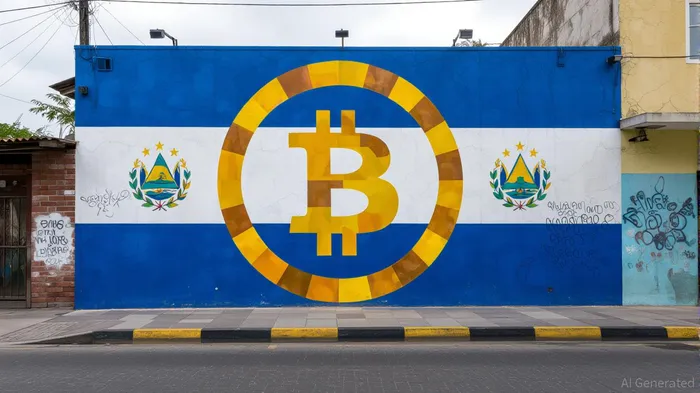
El Salvador’s controversial adoption of BitcoinBTC-- as legal tender in 2021 has evolved into a complex experiment in sovereign digital asset strategy. While the cryptocurrency is no longer legal tender, the government continues to hold between 6,102 and 6,268 Bitcoin (BTC), valued at $550 million to $770 million as of Q2 2025 [3]. This strategic accumulation, coupled with a new Bitcoin Investment Banking Law, has positioned the country as a testbed for institutional Bitcoin adoption. The implications for global markets are profound: if El Salvador’s approach catalyzes broader institutional demand, Bitcoin’s valuation could approach $1 billion+ benchmarks by 2030.
Strategic Reserves and Institutional Confidence
El Salvador’s Bitcoin holdings have appreciated 375.5% since 2023, outpacing traditional assets like gold and the S&P 500 [1]. The government’s decision to consolidate internal wallets rather than acquire new BTC post-2024—following an IMF loan agreement—has not dampened institutional interest. Instead, it has reinforced Bitcoin’s role as a hedge against inflation and geopolitical instability [1]. The IMF’s classification of Bitcoin as a non-financial asset, coupled with its warnings about volatility and liquidity risks [4], underscores the tension between institutional caution and El Salvador’s bold experiment.
The Investment Banking Law, enacted in 2025, allows licensed banks with $50 million in capital to offer Bitcoin services to accredited investors [2]. This regulatory shift has attracted high-net-worth individuals and institutional capital, with altcoins like The GraphGRT-- (GRT) and Lido DAO (LDO) seeing a 16–559.63% surge in demand [1]. By legitimizing Bitcoin as a strategic reserve, El Salvador is indirectly encouraging global institutions to view the asset as a diversification tool, not just a speculative play.
Market Dynamics and Valuation Trajectory
Bitcoin’s valuation potential hinges on institutional adoption. With 86% of institutional investors allocating to digital assets and $92.3 billion in global ETF inflows by 2025 [1], the market is primed for a shift. El Salvador’s $83 million in profits from its Bitcoin holdings [3] demonstrates tangible returns, which could incentivize other nations or corporations to follow suit.
However, challenges persist. Transaction usage remains low (7.5% of the population), and the Chivo wallet has failed to deliver promised remittance cost reductions [1]. The U.S. Senate’s proposed El Salvador Accountability Act of 2025, targeting potential corruption and sanction evasion [5], adds regulatory uncertainty. Yet, these hurdles may not deter institutional investors, who prioritize long-term strategic value over short-term volatility.
The Path to $1 Billion+ Valuations
For Bitcoin to reach $1 billion+ in market capitalization, it would need to achieve a price of approximately $120,000 per BTC (based on current circulating supply). El Salvador’s actions, while localized, could accelerate this trajectory by:
1. Normalizing Bitcoin as a reserve asset: Governments and central banks may follow El Salvador’s lead, treating Bitcoin as a complement to fiat and gold.
2. Driving institutional liquidity: The Investment Banking Law creates a framework for regulated institutions to enter the market, increasing demand and reducing volatility.
3. Attracting global capital: El Salvador’s $8.5 million crypto market revenue in 2025 [3] signals growing institutional interest, which could scale with regulatory clarity.
Critics argue that Bitcoin’s utility as a transactional currency remains limited [1], but its role as a store of value is increasingly accepted. The U.S. and EU’s institutional adoption via initiatives like the Strategic Bitcoin Reserve (SBR) and MiCAR framework [1] further validates this trend.
Conclusion
El Salvador’s Bitcoin experiment is a microcosm of the broader institutional shift toward digital assets. While the country’s challenges—low adoption, regulatory scrutiny—highlight the risks, its strategic reserves and regulatory innovations demonstrate Bitcoin’s potential as a macroeconomic tool. If institutional demand continues to grow at current rates, Bitcoin’s valuation could indeed approach $1 billion+ benchmarks. The question is not whether Bitcoin will reach these heights, but how quickly global institutions will embrace the paradigm shift.
**Source:[1] El Salvador's wild crypto experiment ends in failure, [https://www.economist.com/finance-and-economics/2025/03/02/el-salvadors-wild-crypto-experiment-ends-in-failure][2] Bitcoin News Today: El Salvador's Bitcoin Bank Law ... [https://www.ainvest.com/news/bitcoin-news-today-el-salvador-bitcoin-bank-law-boosts-altcoin-demand-16-559-63-2508/][3] El Salvador's Bitcoin Adoption and the Implications for ... [https://www.ainvest.com/news/el-salvador-bitcoin-adoption-implications-institutional-exposure-2508/][4] Crypto-assets: Unfit for central bank reserves today, [https://blogs.worldbank.org/en/allaboutfinance/crypto-assets--unfit-for-central-bank-reserves-today][5] U.S. Senators Propose Bill Targeting Bukele's Bitcoin Use in El Salvador, [https://coindoo.com/u-s-senators-propose-bill-targeting-bukeles-bitcoin-use-in-el-salvador/]

Decoding blockchain innovations and market trends with clarity and precision.
Latest Articles
Stay ahead of the market.
Get curated U.S. market news, insights and key dates delivered to your inbox.


AInvest
PRO
AInvest
PRO



Comments
No comments yet