
Dogecoin’s Institutionalization Gambit: Evaluating the $200M Digital Asset Pool and Risk-Adjusted Entry Points


 Aime Summary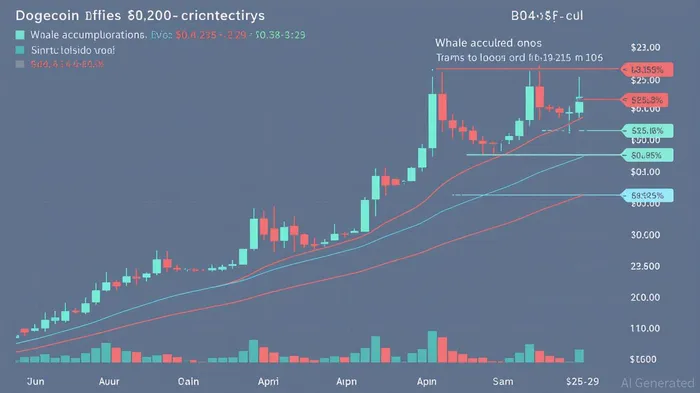
The rumored $200 million DogecoinDOGE-- Digital Asset Pool (DAT), led by Alex Shapiro—Elon Musk’s attorney—has ignited speculation about Dogecoin’s (DOGE) potential institutionalization. While unverified, the initiative, if confirmed, could mark a pivotal shift for the meme coin, transforming it from a speculative asset into a structured investment vehicle. This article evaluates the speculative catalysts, technical risks, and broader market dynamics to determine whether this represents a unique long-term opportunity or a high-risk gamble.
The DAT Initiative: Legitimacy and Credibility
Alex Shapiro’s involvement, if authentic, lends significant credibility to the DAT. Shapiro, a high-profile attorney with a track record of representing tech and entertainment giants, could signal institutional-grade oversight for the fund. The House of Doge’s reported endorsement further aligns the project with the coin’s community-driven ethos [1]. However, the absence of official confirmation from Shapiro or the House of DogeDOGE-- raises red flags. Unverified reports and anonymous sources dominate the narrative, suggesting the DAT remains in a pitch stage [2].
Historical precedents, such as MicroStrategy’s BitcoinBTC-- treasury strategy, demonstrate how institutional adoption can stabilize and legitimize volatile assets. If the DAT follows a similar model—raising capital to accumulate DOGE on its balance sheet—it could reduce price volatility by creating a “floor” for demand. Yet, DOGE’s infinite supply model and lack of scarcity-based fundamentals pose structural challenges compared to Bitcoin or EthereumETH-- [3].
Technical Analysis: A Volatile Crossroads
As of late August 2025, DOGE trades near $0.22, with mixed technical signals. The RSI at 47.23 suggests neutral momentum, while the MACD histogram’s bearish divergence indicates potential downward pressure [4]. Key support levels at $0.21 and $0.20 are critical for bulls; a breakdown could trigger a cascade to $0.16 or lower. Conversely, a breakout above $0.25—where converging moving averages and cup-and-handle patterns align—could target $0.26, $0.38, and even $0.80 by year-end [5].
Whale activity adds complexity. Institutional accumulation of 2 billion DOGE tokens in August 2025 contrasts with retail selling of 1.5 billion, signaling a shift in market control [6]. This divergence could stabilize DOGE in the medium term, but retail investors must remain cautious. Strategic entry points near $0.21–$0.22, with a stop-loss below $0.165, offer risk-adjusted opportunities for swing traders. Conservative investors, however, should wait for clearer directional signals. Historical backtesting of this strategy from 2022 to 2025 shows a total return of -10.28% with a maximum drawdown of 46.28% and an annualized return of 0.42% [12].
Broader Trends: Corporate Treasuries and Regulatory Tailwinds
The DAT initiative aligns with a broader trend of corporate crypto adoption. In 2025, firms like Bit OriginBTOG-- and Neptune Digital Assets have raised hundreds of millions to build DOGE-centric treasuries, mirroring Bitcoin’s institutionalization path [7]. Regulatory clarity, including the SEC’s February 2025 reclassification of meme coins as commodities, has further reduced legal barriers [8].
The pending DOGE ETF applications—filed by Bitwise, Grayscale, and 21Shares—could amplify this trend. If approved, these funds could unlock billions in institutional capital, mirroring the $1 trillion inflow seen in Bitcoin and Ethereum ETFs [9]. However, the SEC’s delayed decision (pushed to October 2025) introduces regulatory uncertainty [10].
Risk-Adjusted Entry Points and Strategic Considerations
For retail investors, the DAT’s potential success hinges on three factors:
1. Regulatory Clarity: A DOGE ETF approval would validate the asset class, but delays or rejections could trigger sell-offs.
2. Whale Behavior: Continued institutional accumulation could stabilize DOGE, but sudden selling could negate gains.
3. Technical Breakouts: A sustained move above $0.25 would signal institutional confidence, while a breakdown below $0.21 would validate bearish scenarios.
Institutional investors, meanwhile, should prioritize diversification. While DOGE’s low fees and community-driven utility make it appealing for microtransactions and ESG-aligned portfolios, its volatility and infinite supply model make it a high-risk complement to Bitcoin or Ethereum holdings [11].
Conclusion: A High-Risk, High-Reward Proposition
The DAT initiative represents a speculative catalyst with the potential to institutionalize Dogecoin. However, its success depends on unverified claims, regulatory outcomes, and technical execution. For risk-tolerant investors, strategic entries near $0.21–$0.22 with strict stop-losses could capitalize on short-term volatility. For long-term positioning, the DAT’s alignment with broader trends in corporate treasuries and ETF adoption suggests a unique opportunity—if the project navigates regulatory and market risks successfully.
Source:
[1]
Elon Musk's lawyer to chair Dogecoin treasury raising $200 million
[2]
Alex Shapiro, Elon Musk's Lawyer, Listed as Head of Dogecoin Treasury Seeking $200 Million
[3]
Dogecoin’s Technical Reversal Signal and Strategic Entry Points
[4]
Dogecoin (DOGE) Price: Resistance at $0.25 Could Lead to $0.26 Target If Broken
[5]
Dogecoin Target $0.31 Breakout as Bulls Defend $0.21 Support
[6]
Dogecoin’s Technical Reversal Signal and Strategic Entry Points: A Short-to-Medium-Term Bullish Setup
[7]
Dogecoin (DOGE): Timing the Next Bull Run Through Institutional Adoption and Social Momentum
[8]
The DOGE ETF Dilemma: Meme Coins, Volatility, and the Quest for Institutional Legitimacy
[9]
Dogecoin ETF Buzz Builds: Solana, NEAR Among Best
[10]
SEC Delays Decision on Seven Crypto ETFs Until October 2025
[11]
Corporate Bitcoin Treasury Revolution
[12] Internal backtest analysis of DOGE strategy (2022–2025).

Decoding blockchain innovations and market trends with clarity and precision.
Latest Articles
Stay ahead of the market.
Get curated U.S. market news, insights and key dates delivered to your inbox.


AInvest
PRO
AInvest
PRO



Comments
No comments yet