
The Deep Blue Opportunity: How Underwater Defense Startups Are Drowning Out Legacy Giants


 Aime Summary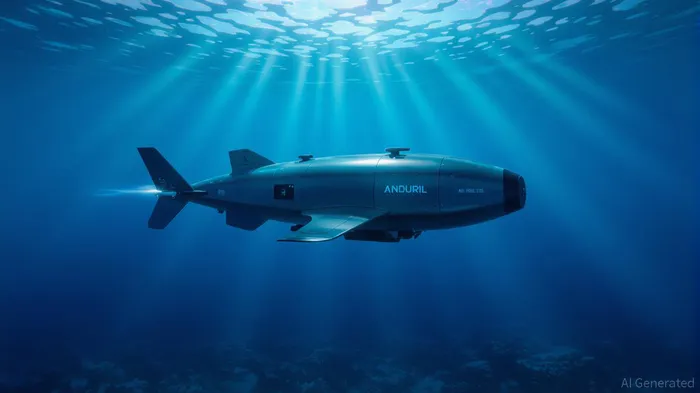
The global underwater defense technology market is surging toward $25.63 billion by 2032, growing at a blistering 7.3% CAGR. This isn't just a niche corner of the defense sector—it's a high-margin, high-stakes battlefield where startups are rewriting the rules. Legacy contractors like BoeingBA-- and Lockheed MartinLMT--, long dominant in undersea warfare, are now being outpaced by agile innovators like Anduril Industries, which is leveraging AI, autonomy, and software-first strategies to redefine maritime security. For investors, this is a no-brainer: the future of underwater defense is being built by disruptors, not dinosaurs.
The AI-Driven Tidal Shift
The heart of this revolution lies in artificial intelligence. Traditional undersea systems—think sonar arrays and manned submarines—rely on human operators for decision-making, a bottleneck in an era where speed and real-time adaptability are paramount. Enter Anduril's Copperhead UUVs, which integrate edge-based AI to autonomously detect threats, adapt to dynamic environments, and relay data to command centers in real time. These systems aren't just tools; they're intelligent nodes in a networked battlespace, capable of persistent surveillance and rapid response.
Legacy contractors, meanwhile, are still playing catch-up. While Boeing's Echo Voyager and Lockheed Martin's Orca AUVs boast impressive endurance, they lack the AI-native architecture that allows startups to iterate rapidly. Anduril's open-architecture design, for instance, enables rapid payload swaps and software updates, turning a $500 million platform into a $500 million ecosystem. This is the difference between a static asset and a scalable, evolving solution.
Ghost Shark and the Ghost of Legacy Contracts
Anduril's Ghost Shark program with Australia's Royal Navy is a masterclass in strategic disruption. This large-displacement AUV, designed for stealthy Indo-Pacific operations, is already in production, with satellite lines delivering units to Australia by mid-2025. Unlike legacy contractors, which often take years to move from prototype to deployment, Anduril's venture-backed speed and modular approach let it scale quickly.
The Ghost Shark isn't just a military asset—it's a geopolitical lever. By partnering with allies like Australia, Anduril is positioning itself as a key player in the Indo-Pacific's security architecture, a region where U.S. influence is increasingly contested. For investors, this means exposure to both defense and diplomatic tailwinds.
Why Startups Are Winning the Deep
The funding landscape tells a clear story: defense startups are outpacing legacy primes in innovation and agility. In 2025 alone, companies like Blue Water Autonomy (focused on autonomous surface and subsurface vessels) and Scout AI (developing universal AI platforms for robotics) have raised tens of millions in venture capital. These firms are building dual-use technologies that serve both military and commercial markets, creating a flywheel effect where commercial revenue funds defense R&D.
Take Mach Industries, which raised $185 million to scale low-cost cruise missiles. While not underwater-focused, its approach—rapid, scalable production of AI-integrated systems—mirrors the strategies of underwater disruptors. The lesson? Investors should prioritize startups that combine venture-speed iteration with government-grade security.
The Data-Driven Case for Investors
The numbers don't lie. The underwater defense market is expected to nearly double in seven years, driven by AI, autonomy, and geopolitical urgency. Startups are capturing this growth by solving problems legacy contractors can't:
- Speed: Anduril's Arsenal-1 facility in Ohio can produce autonomous systems in weeks, not years.
- Cost: Modular designs and software-driven updates reduce lifecycle costs.
- Scalability: Open architectures allow rapid integration with existing military networks.
For investors, the key is to identify early-stage players with strong government partnerships and AI-native platforms. Look for companies with contracts from the Defense Innovation Unit (DIU) or the Replicator initiative, which prioritize autonomous systems.
Risks and the Road Ahead
No investment is without risk. The underwater defense sector is capital-intensive, and not all startups will survive the transition from prototype to production. However, the sector's high barriers to entry (e.g., specialized R&D, government certifications) mean that successful players will dominate for years.
Legacy contractors aren't going away—they'll adapt, as Boeing and Lockheed Martin are already doing. But the startups that combine AI, autonomy, and software-first thinking will capture the lion's share of the $50B+ market.
Final Call: Dive In Before the Tide Turns
The underwater defense boom is here, and it's being driven by innovators who think in code, not contracts. For investors, the playbook is simple: back the disruptors, not the dinosaurs. Companies like Anduril, Blue WaterBLUW-- Autonomy, and Scout AI are building the future of maritime security—one autonomous vehicle, one AI model, one ghostly AUV at a time.
Don't wait for the next earnings report to realize the potential. The deep blue opportunity is already rising—and it's time to get in before the waves wash away the old guard.

Decoding blockchain innovations and market trends with clarity and precision.
Latest Articles
Stay ahead of the market.
Get curated U.S. market news, insights and key dates delivered to your inbox.
AInvest
PRO
AInvest
PRO



Comments
No comments yet