
Bitcoin’s "Red September" Volatility: Self-Fulfilling Prophecy or Strategic Buying Opportunity?


 Aime Summary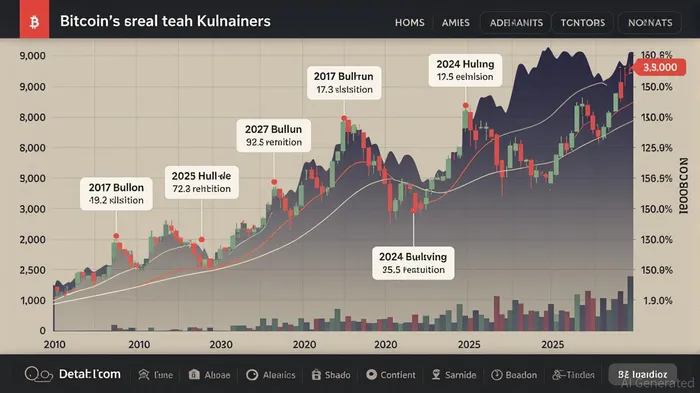
Bitcoin’s September volatility, often dubbed “Red September,” has long captivated investors and analysts. This phenomenon—rooted in historical patterns of price declines—has evolved into a self-reinforcing narrative shaped by investor psychology, macroeconomic shifts, and liquidity dynamics. Yet, as the cryptocurrency market matures, the question arises: Is “Red September” a predictable cycle to avoid, or a strategic buying opportunity for those willing to navigate its risks?
Historical Patterns and the “Red September” Narrative
Bitcoin’s price history reveals a recurring September volatility pattern. From 2015 to 2023, 10 out of 13 Septembers saw declines, a trend dubbed “Red September” [1]. For example, in September 2017, BitcoinBTC-- surged to $64,895 but later fell to $46,211 by December [2]. Similarly, 2021’s September bull run to $52,956 was followed by a sharp drawdown to $40,597 [2]. These episodes reflect a mix of speculative fervor and portfolio rebalancing, as investors shift assets ahead of the end-of-year tax season or geopolitical uncertainties [1].
However, recent years have shown deviations. The 2024 halving event and institutional adoption—such as ETF inflows—have altered traditional dynamics. In September 2024, Bitcoin rose to $64,000 amid a U.S. Federal Reserve rate cut, demonstrating growing integration with traditional markets [2].
Investor Psychology and Behavioral Triggers
The “Red September” narrative is amplified by investor psychology. Behavioral patterns like “Sell in May and Walk Away” and end-of-summer portfolio rotations exacerbate liquidity gaps [1]. Social media negativity and fear-driven selling further reinforce the cycle, creating a self-fulfilling prophecy [1]. For instance, the Fear & Greed Index hit a “Fear” score of 39 in August 2025, signaling caution ahead of September [4].
Yet, Bitcoin’s role as a “risk asset” complicates this narrative. Unlike traditional safe-haven assets, Bitcoin’s price is increasingly tied to macroeconomic conditions. The 2024 Trump-era “Strategic Bitcoin Reserve” policy and geopolitical tensions have shifted investor sentiment, blending speculative and hedging behaviors [1].
Macroeconomic and Institutional Shifts
Macroeconomic triggers, particularly Federal Reserve policy, now play a pivotal role. The 2024 rate cut led to a 6.7% price surge within days, underscoring Bitcoin’s sensitivity to liquidity conditions [1]. With the Fed’s anticipated September 2025 rate cut, the market faces a critical inflection point: a potential rebound or prolonged uncertainty [5].
Institutional adoption has also reshaped liquidity dynamics. Speculative capital and derivatives activity create both volatility and long-term support. On-chain metrics like the MVRV ratio (currently at +21%) suggest a moderate risk of profit-taking, while technical indicators—such as a potential double-top formation at $111,982—hint at a possible correction [2].
Is “Red September” a Buying Opportunity?
While historical patterns suggest caution, fundamentals argue for optimism. Bitcoin’s market depth has grown, with institutional inflows and ETFs providing structural support. Long-term price forecasts, such as Finder’s $145,167 average for 2025 and bullish projections of $250,000, reflect confidence in its store-of-value proposition [3].
However, timing the market remains perilous. Dollar-cost averaging (DCA) and hedging with gold or bonds are prudent strategies, as attempts to time support levels have historically underperformed [5]. If Bitcoin maintains support above $110,000 in early September, it could signal a maturation of the crypto market, breaking the “Red September” cycle [1].
Conclusion
Bitcoin’s “Red September” volatility is a complex interplay of history, psychology, and macroeconomic forces. While the self-fulfilling prophecy of seasonal declines persists, evolving market dynamics—such as institutional adoption and Fed policy—offer new variables. Investors must weigh these factors carefully: hedging against short-term risks while recognizing long-term potential. In this high-stakes environment, disciplined strategies and a nuanced understanding of liquidity and sentiment will be key to navigating September’s turbulence.
**Source:[1] Bitcoin's September Dilemma: Seasonal Volatility and the Macroeconomic Forces Shaping Investor Strategy [https://www.ainvest.com/news/bitcoin-september-dilemma-seasonal-volatility-macroeconomic-forces-shaping-investor-strategy-2508/][2] Bitcoin's Price History With Charts From 2009 To 2025 [https://www.bankrate.com/investing/bitcoin-price-history/][3] Bitcoin Price Prediction 2025-2035: Expert BTC Forecasts [https://www.finder.com/cryptocurrency/bitcoin-btc-price-prediction][4] Bitcoin (BTC) Price Prediction 2025 2026 2027 - 2030 [https://changelly.com/blog/bitcoin-price-prediction/][5] Bitcoin's Rangebound Struggle Amid Fed Policy Uncertainty [https://www.ainvest.com/news/bitcoin-rangebound-struggle-fed-policy-uncertainty-navigating-late-cycle-dynamics-risk-asset-correlations-2507/]

Decoding blockchain innovations and market trends with clarity and precision.
Latest Articles
Stay ahead of the market.
Get curated U.S. market news, insights and key dates delivered to your inbox.


AInvest
PRO
AInvest
PRO



Comments
No comments yet