
Bitcoin Price Analysis: Key Support and Resistance Levels to Watch for Strategic Entry and Exit Points


 Aime Summary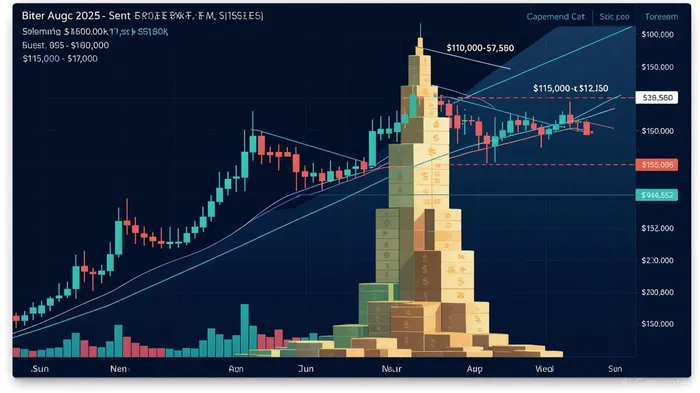
Bitcoin's price trajectory in late August 2025 has become a focal point for investors navigating a volatile market. After reaching an all-time high of $124,200 on August 14, the cryptocurrency has since retreated to test critical support levels near $111,464. This correction phase, while unsettling for short-term traders, presents a unique opportunity for long-term investors to assess strategic entry and exit points based on technical structure and macroeconomic catalysts.
Key Support and Resistance Levels: A Technical Roadmap
Bitcoin's current price action is defined by a tug-of-war between bearish and bullish forces. On the support side, the $110,000–$112,000 range represents a pivotal psychological and technical zone. This area has historically acted as a retest of Bitcoin's all-time high, and a sustained break below $110,000 could signal a deeper correction. Further down, $106,000 and $100,000 serve as secondary and tertiary support levels, respectively. The $100,000 mark, in particular, is a critical psychological threshold; a breach here could trigger broader market panic.
On the resistance side, the immediate pivot zone lies between $115,000 and $117,000. A breakout above this range could reignite bullish momentum, with the $122,000–$124,500 zone—encompassing the all-time high of $124,596—acting as the ultimate test of institutional conviction. A sustained close above $124,500 would not only validate a bullish continuation but also cement Bitcoin's role as a mainstream asset class.
Technical indicators add nuance to this analysis. The RSI on the 4-hour chart shows a bullish divergence, suggesting a potential short-term rebound. However, the 50-day moving average crossing below the 200-day MA (a bearish “death cross”) creates conflicting signals. Meanwhile, a descending wedge pattern on the 4-hour timeframe hints at a possible bullish breakout, though its effectiveness will depend on macroeconomic sentiment, particularly the outcome of Federal Reserve Chair Jerome Powell's speech at the Jackson Hole Symposium.
Macroeconomic Catalysts: The Powell Factor and ETF Inflows
Bitcoin's price action is inextricably linked to broader macroeconomic trends. The Nasdaq is currently in a correction phase, and cryptocurrencies have mirrored this decline, albeit with greater volatility. Investors are closely watching Federal Reserve policy, with Powell's Jackson Hole speech expected to influence risk-on/risk-off behavior across asset classes. A dovish stance—hinting at rate cuts—could catalyze a short-term rally in BitcoinBTC--, while hawkish signals may prolong the bearish consolidation.
Institutional adoption remains a structural tailwind. U.S. Bitcoin ETFs have absorbed $219 million in weekly inflows in August, with MicroStrategy's $71 billion accumulation reinforcing the $100,000–$107,000 support zone. Public BTC treasuries now hold 951,000 BTC, and mining infrastructure has expanded, with U.S. miners commanding 31.5% of global hashrate. These developments underscore Bitcoin's growing role as a hedge against monetary inflation and a store of value.
Strategic Entry and Exit Points: A Data-Driven Approach
For investors, the current market structure offers clear entry and exit opportunities:
- Entry Points:
- Dollar-Cost Averaging (DCA) into the $111,900–$113,800 range is advisable, as on-chain data indicates strong institutional buying here.
- A high-conviction entry at the $100,000–$105,000 floor aligns with historical support levels and offers a margin of safety.
Options-based hedging is attractive given low volatility (~32%), with out-of-the-money calls costing ~6% of spot value.
Exit Strategies:
- A rebound above $113,500 validates a bullish flag pattern, while a close above $112,000 could trigger a retest of $124,500.
- Trailing stop-loss orders and Fibonacci retracement levels (particularly the 61.8% level) provide dynamic profit-taking targets.
- A breakdown below $106,000 would signal increased bearish sentiment, warranting a reassessment of risk exposure.
The Long-Term Outlook: Structural Strength Amid Short-Term Volatility
While Bitcoin's short-term volatility is driven by leveraged positions and macroeconomic uncertainty, its long-term fundamentals remain robust. On-chain metrics show 92% of Bitcoin held in profit by long-term holders, reducing the likelihood of deeper corrections. The 200-day EMA at $110,798 and Fibonacci retracement levels further reinforce the market's resilience.
Investors who recognize these signals and act with discipline are well-positioned to capitalize on Bitcoin's next phase. The key is to balance technical precision with macroeconomic awareness, using strategic entry points to accumulate at attractive valuations and exit strategies to lock in gains during favorable conditions.
In conclusion, Bitcoin's current price action reflects a maturing bull cycle, supported by institutional adoption, regulatory clarity, and on-chain strength. By focusing on key support/resistance levels and aligning strategies with macroeconomic catalysts, investors can navigate the volatility with confidence and position themselves for long-term success.

Decoding blockchain innovations and market trends with clarity and precision.
Latest Articles
Stay ahead of the market.
Get curated U.S. market news, insights and key dates delivered to your inbox.


AInvest
PRO
AInvest
PRO



Comments
No comments yet