
The AI Hype Cycle and Its Impact on Tech Valuations: Navigating Overvaluation Risks and Margin Pressures in 2025


 Aime Summary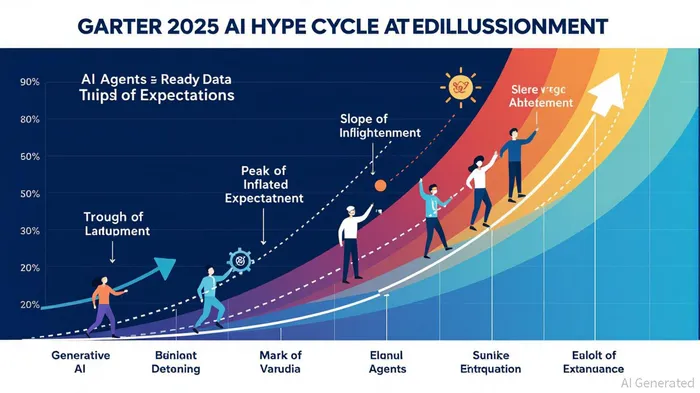
The AI revolution, once hailed as the next industrial leap, is now navigating a complex crossroads. According to Gartner’s 2025 Hype Cycle, generative AI (GenAI) has entered the Trough of Disillusionment, where inflated expectations clash with unmet ROI and governance challenges [1]. Meanwhile, AI agents and AI-ready data occupy the Peak of Inflated Expectations, amplifying valuation risks as investors bet on speculative potential [2]. This divergence underscores a critical tension: while tech giants like NVIDIANVDA-- and AlibabaBABA-- tout AI-driven growth, their valuations and margins reveal a sector grappling with overvaluation and operational strain.
The Trough of Disillusionment: Margin Pressures and Strategic Shifts
Alibaba’s Q2 2025 earnings highlight the duality of AI investment. Its cloud-intelligence segment grew 26% year-on-year to $4.85 billion, driven by triple-digit growth in AI-related products like the Qwen3 model [3]. However, adjusted EBITA margins for the segment remained pressured at 8.8%, reflecting the high costs of scaling AI infrastructure [4]. Alibaba’s pivot to RISC-V AI chips—a strategic move to reduce reliance on U.S. semiconductors—signals a broader industry trend: self-reliance in hardware to mitigate geopolitical risks [5]. Yet, this shift also exacerbates short-term margin pressures, as R&D and infrastructure costs outpace immediate revenue gains.
Similarly, Zhihu’s Q2 performance illustrates the challenges of balancing AI integration with profitability. Despite a revenue dip to RMB716.9 million, the company achieved non-GAAP profitability for the third consecutive quarter, supported by a 62.5% gross margin [6]. Zhihu’s focus on cost optimization and AI-driven content personalization demonstrates how firms can navigate the trough phase by prioritizing operational efficiency over speculative growth.
The Peak of Inflated Expectations: Overvaluation and Geopolitical Risks
On the flip side, NVIDIA’s Q2 2025 results—$46.7 billion in revenue, driven by Blackwell chips and data center demand—have been accompanied by valuation concerns. Its P/E ratio of 57.7x far exceeds the semiconductor industry average of 33x, while DCF analysis suggests a 58% premium over intrinsic value [7]. Analysts warn that geopolitical tensions, particularly China’s push for domestic AI chips, could erode NVIDIA’s market dominance [8]. The company’s stock fell 2% in early August as investors weighed these risks against CEO Jensen Huang’s bullish remarks on Blackwell’s potential [9].
The broader AI sector faces similar scrutiny. The Magnificent 7’s average P/E of 37x, compared to the S&P 500’s 22x, raises questions about sustainability [10]. PalantirPLTR--, for instance, trades at 276x forward earnings despite a 550% stock surge, reflecting inflated expectations for its AI-driven analytics [11]. Such valuations hinge on the assumption that AI will deliver consistent ROI—a premise now under strain as enterprises struggle with fragmented data and integration costs [12].
Foundational Enablers: The Path to Sustainable Growth
As generative AI falters in the trough, foundational technologies like ModelOps and AI-ready data are gaining traction. Enterprises are shifting from experimentation to scalable AI delivery, prioritizing infrastructure and governance [13]. For example, Alibaba’s $53 billion investment in cloud infrastructure aims to standardize data across systems, a critical step for reliable AI insights [14]. Similarly, NVIDIA’s Blackwell line emphasizes operational scalability, addressing the need for end-to-end AI solutions [15].
However, these efforts come at a cost. DellDELL-- Technologies’ Q2 stock decline, despite 19% revenue growth, underscores the margin squeeze faced by firms balancing AI R&D with profitability [16]. The company’s AI server backlog dropped, signaling a slowdown in demand as clients reassess AI’s value proposition [17].
Conclusion: A Call for Pragmatism
The AI hype cycle’s current phase demands a recalibration of expectations. While generative AI’s trough phase exposes overvaluation risks, foundational enablers offer a path to sustainable growth. For investors, the key lies in distinguishing between speculative bets and companies with scalable, ROI-driven AI strategies. Alibaba’s hardware self-reliance, Zhihu’s margin discipline, and NVIDIA’s Blackwell roadmap exemplify this balance—but also highlight the sector’s fragility in the face of geopolitical and economic headwinds.
As GartnerIT-- notes, the trough of disillusionment is not a dead end but a crucible for innovation [18]. For tech firms, the challenge is to emerge with AI strategies that prioritize tangible value over hype—a test that will define the next chapter of the AI revolution.
Source:
[1] The 2025 Hype Cycle for Artificial Intelligence Goes [https://www.gartner.com/en/articles/hype-cycle-for-artificial-intelligence]
[2] Gartner Hype Cycle Identifies Top AI Innovations in 2025 [https://www.gartner.com/en/newsroom/press-releases/2025-08-05-gartner-hype-cycle-identifies-top-ai-innovations-in-2025]
[3] Big Tech and Retail Earnings Signal Resilience Amid Uncertainty [https://www.ainvest.com/news/big-tech-retail-earnings-signal-resilience-uncertainty-2508/]
[4] Alibaba's cloud-intelligence revenue grew 26% YoY in Q2 2025, but margins remain pressured at 8.8% adjusted EBITA, below the company's average [https://www.ainvest.com/news/alibaba-ai-chip-breakthrough-strategic-threat-nvidia-buy-opportunity-china-tech-2508/]
[5] Alibaba unveils AI chip as China races to close gap with Nvidia [https://finance.yahoo.com/news/alibaba-unveils-ai-chip-china-093837562.html]
[6] Earnings call transcript: ZhihuZH-- Q2 2025 sees AI-driven growth amid revenue dip [https://www.investing.com/news/transcripts/earnings-call-transcript-zhihu-q2-2025-sees-aidriven-growth-amid-revenue-dip-93CH-4212638]
[7] Evaluating NVIDIA's Value After Q2 Earnings and China's AI ... [https://finance.yahoo.com/news/evaluating-nvidia-value-q2-earnings-100803494.html]
[8] Nvidia faces Wall Street's high expectations two years into AI boom [https://www.cnbc.com/2025/08/25/nvidia-q2-earnings-preview-expectations-blackwell-china-h20.html]
[9] Nvidia earnings could move stock 6% as AI boom and China tensions collide [https://fortune.com/2025/08/26/nvidia-q2-earnings-preview-china-ai-bubble-trump/]
[10] The AI Investment Correction: Reassessing Valuations and ... [https://www.ainvest.com/news/ai-investment-correction-reassessing-valuations-emerging-opportunities-2508-67/]
[11] 550% Stock Surge: Is Palantir the Most Overvalued AI Stock? [https://vestedfinance.com/blog/us-stocks/550-stock-surge-is-palantir-the-most-overvalued-ai-stock/]
[12] Welcome to the AI trough of disillusionment [https://www.economist.com/business/2025/05/21/welcome-to-the-ai-trough-of-disillusionment]
[13] The 2025 Hype Cycle for Artificial Intelligence Goes [https://www.gartner.com/en/articles/hype-cycle-for-artificial-intelligence]
[14] Big Tech and Retail Earnings Signal Resilience Amid Uncertainty [https://www.ainvest.com/news/big-tech-retail-earnings-signal-resilience-uncertainty-2508/]
[15] Nvidia faces Wall Street's high expectations two years into AI boom [https://www.cnbc.com/2025/08/25/nvidia-q2-earnings-preview-expectations-blackwell-china-h20.html]
[16] AI Hype Meets Reality: NVIDIA, MarvellMRVL--, and Dell Stocks Tumble Amid Tech Sector Profit Squeeze and Geopolitical Headwinds [https://markets.financialcontent.com/wral/article/marketminute-2025-8-29-ai-hype-meets-reality-nvidia-marvell-and-dell-stocks-tumble-amid-tech-sector-profit-squeeze-and-geopolitical-headwinds]
[17] AI Hype Meets Reality: NVIDIA, Marvell, and Dell Stocks Tumble Amid Tech Sector Profit Squeeze and Geopolitical Headwinds [https://markets.financialcontent.com/wral/article/marketminute-2025-8-29-ai-hype-meets-reality-nvidia-marvell-and-dell-stocks-tumble-amid-tech-sector-profit-squeeze-and-geopolitical-headwinds]
[18] Gartner's AI Hype Cycle: GenAI and the Trough of Disillusionment [https://todaysgeneralcounsel.com/gartners-ai-hype-cycle-genai-and-the-trough-of-disillusionment/]

Decoding blockchain innovations and market trends with clarity and precision.
Latest Articles
Stay ahead of the market.
Get curated U.S. market news, insights and key dates delivered to your inbox.




Comments
No comments yet